

Reports
Reports
The global welding products market size was valued at USD 23.5 Billion in 2025 and is projected to reach USD 40.7 Billion by 2036, expanding at a CAGR of 5.1% from 2026 to 2036. The market is expected to be driven by rising infrastructure and industrial construction investments accelerating welding demand.
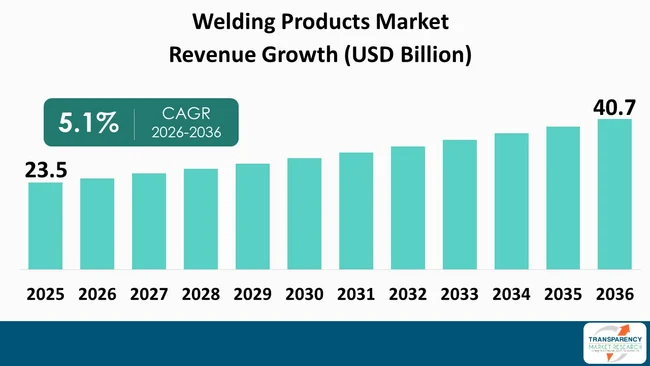
The welding products market has been growing steadily owing to an increase in construction operations, industrial manufacturing, automotive manufacturing, and investments in infrastructure and energy projects. Welding products include equipment and consumables, which are vital in joining metal parts within several industries including heavy machinery, transportation, shipbuilding, oil & gas industry, and power generation. The process usually requires the use of heat and pressure, and even both, to join metals. Some of the welding technologies used in this process include arc welding, resistance welding, laser welding, and gas welding. Some of the consumables used in the welding process include electrodes, filler metals, and fluxes.
Market growth has also been facilitated by the increased use of automation and precision manufacturing processes. Firms have been focusing on advanced welding technologies, including robotic welding machines, among others. Efficiency and environmental friendliness are some of the other features that are also offered by the manufacturers to meet the demand for sustainability within the welding products industry. With the help of efficient business collaborations, regional expansion, and research and development efforts, the manufacturers have managed to offer improved products and services to their industrial clients, allowing them to grow in the future.
| Attribute | Detail |
|---|---|
| Welding Products Market Drivers |
|
The welding products market includes equipment, consumables, and accessories that facilitate joining of metals or thermoplastics for manufacturing, construction, maintenance, and repair purposes. The list of welding products includes welding machines, torches, robotic welding systems, electrodes, filler materials, wires, fluxes, and shielding gases that assist in making a secure joint between two materials. The process of welding includes application of heat and pressure or both to make a joint between two metal surfaces. Some common types of welding include arc welding, resistance welding, laser welding, and gas welding. Welding products have found many applications in various industries like automobile, aerospace, ship building, oil and gas, power generation, and infrastructural construction. The requirement of automation and high-quality fabrications in industries has resulted in higher demands for welding products.
Infrastructure and industrial construction works are growing very quickly, and they have become one of the most significant driving forces behind the growth of the welding products market across the globe. The governments and the private sectors of developed as well as developing countries have been making extensive investments in the development of infrastructure, including transport infrastructure, commercial buildings, smart cities, industrial complexes, rail networks, ports, and energy infrastructure. The utilization of welding products is important for such ventures since they are widely employed in the construction of structural steel constructions, pipelines, bridges, heavy machinery, and metal structures. Due to urbanization and industrialization, there has been an increasing demand for durable welded structures.
Besides, the increasing investments in residential and non-residential construction works have been driving the demand for welding products which are able to deliver accurate results along with high speed. Infrastructure and industrial construction works may need advanced welding systems to maintain the integrity of the structures built. In recent times, increasing demand has been witnessed for portable and automated welding machines at construction sites due to their efficiency and capability to complete projects faster.
The major players in the market are also increasing their presence regionally and building up their supply chain network in order to meet the rising demands for infrastructure. Energy-saving welding equipment, intelligent monitoring equipment, and high-quality consumable products have been introduced by companies in order to increase productivity while minimizing downtime. With industrial construction witnessing expansion all over the world, welding products will continue to be in demand.
The rise in usage of industrial automation and robotic welding systems is playing an important role in the growth of the market. Manufacturers are increasingly looking towards automated welding products in order to increase productivity, minimize operational mistakes, and overcome shortage of labor. Some benefits associated with the use of robotic welding systems include consistency in weld quality, high level of accuracy, minimal material waste, and increased safety of workers. Robotic welding systems are very popular among those industries that require large scale production, such as the automobile industry, aerospace industry, ship building industry, and manufacturing of heavy equipment.
Manufacturers are constantly trying to increase their operational efficiencies and as a result, the demand for smart welding equipment that combines modern technology such as sensors, artificial intelligence, and real-time monitoring system is rapidly increasing.
The leading producers of welding products have been reacting to this by increasing their investments in research and development, forming alliances with automation companies, and developing new products. Welding robots, Internet of Things-based welding machines, and digitally enabled equipment are some of the initiatives that are being introduced to enhance production capacity. The shift to Industry 4.0 and smart manufacturing environments is bound to generate many growth opportunities for welding product suppliers in the future.
| Attribute | Detail |
|---|---|
| Opportunity |
|
The fast growth of the number of renewable energy projects offers tremendous opportunities for the Welding Products market. More investments into the construction of wind power stations, solar energy systems, hydropower plants, and production of green hydrogen require more and more welding products due to the need for durable connections. Welding technology is vital when building wind turbine towers, solar systems support, pipelines, and energy storage units which require strong and durable joints. There is an increasing trend among manufacturers to create special welding consumables and automated welding systems for renewable energy purposes.
| Attribute | Detail |
|---|---|
| Leading Product Type Segment |
|
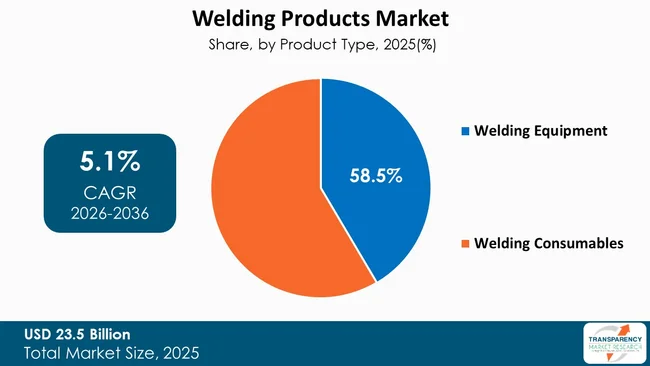
Welding consumables dominates welding products Market, holding almost 58.5% market share due to constant and continuous use in welding processes in industries like construction, automotive, ship building, oil and gas, and heavy fabrication industries. Products such as electrodes, filler metals, fluxes, and welding wires need replacement often, leading to high demand. The growth in industrial fabrication processes, infrastructure developments, and adoption of automation systems in welding processes have led to increased consumption, thereby resulting in welding consumables being a key market segment in comparison to welding equipment.
Welding consumables include materials that are consumed in the welding process to create strong and durable metallic joints. Such materials include electrodes, filler metals, welding wires, fluxes, shielding gases, and rods for arc stabilization and protection of molten metal from any contamination. In the welding products industry, such consumables play a key role in the efficiency, precision, and quality of welding processes in various industries like construction, automotive, ship building, energy, and heavy fabrication industries.
| Attribute | Detail |
|---|---|
| Leading Region |
|
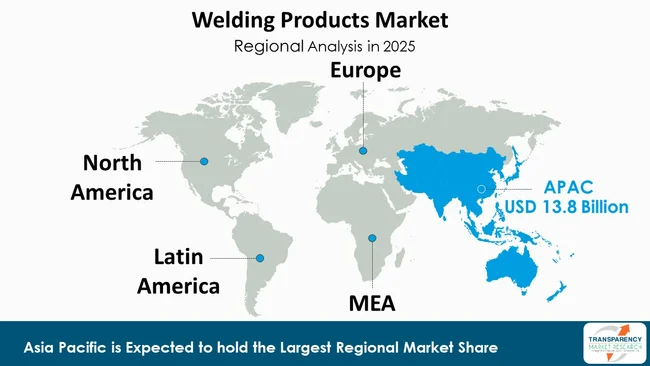
Regional dynamics play a huge role in influencing the global welding products market as the Asia Pacific accounts approximately 41.0% of the global market due to rapid industrialization, large-scale infrastructure development, and expanding manufacturing sectors in countries such as China, India, Japan, and South Korea. Strong growth in automotive, shipbuilding, construction, and heavy engineering industries significantly increases demand for welding equipment and consumables. Lower manufacturing costs, rising investments in industrial automation, and government-backed infrastructure initiatives continue to strengthen regional market expansion.
Nippon Steel Welding & Engineering Co Ltd, Lincoln Electric, ESAB, Illinois Tool Works Inc., Miller Electric Mfg. LLC, Fronius International, Panasonic Welding Systems, Air Liquide Welding, Kemppi, and Kobe Steel Ltd produce a wide range of welding products including welding machine, robot, electrode, welding wire, filler metal, shielding gas, plasma cutter, and automation for use in construction, automobile manufacturing, shipbuilding, power plant, and other industrial uses.
The prominent players in the welding products industry are Voestalpine Böhler Welding, Daihen Corporation, Hyundai Welding Co Ltd, Kiswel Ltd., Taiyo Nippon Sanso Corporation, Hobart Welding Products, Everlast Power Products Inc., Denyo Co Ltd, and Ador Welding Ltd. The Welding Products industry is very competitive and marked by innovation that seeks to increase productivity.
Each of these players has been profiled in the welding products market research report based on parameters such as company overview, financial overview, business strategies, Product Type portfolio, business segments, and recent developments
| Attribute | Detail |
|---|---|
| Market Size Value in 2025 | USD 23.5 Billion |
| Market Forecast Value in 2036 | USD 40.7 Billion |
| Growth Rate (CAGR) | 5.1% |
| Forecast Period | 2026-2036 |
| Historical Data Available for | 2021-2025 |
| Quantitative Units | USD Billion for Value |
| Market Analysis | It includes cross-segment analysis at the global as well as regional level. The qualitative analysis includes drivers, restraints, Welding Products market opportunities, key trends, Porter’s Five Forces analysis, value chain analysis, and key trend analysis. |
| Competition Landscape |
|
| Format | Electronic (PDF) + Excel |
| Market Segmentation | Product Type
|
| Regions Covered |
|
| Countries Covered |
|
| Companies Profiled |
|
| Customization Scope | Available upon request |
| Pricing | Available upon request |
The welding products market was valued at USD 23.5 Billion in 2025.
The welding products industry is expected to grow at a CAGR of 5.1% from 2026 to 2036
Rising infrastructure and industrial construction investments accelerating welding demand and growing industrial automation and robotic welding adoption enhancing production efficiency.
Welding consumables was the largest product type segment and its value is anticipated to grow at a CAGR of 5.8% during the forecast period
Asia Pacific was the most lucrative region in 2025
Nippon Steel Welding & Engineering Co Ltd, Lincoln Electric, ESAB, Illinois Tool Works Inc., Miller Electric Mfg. LLC, Fronius International, Panasonic Welding Systems, Air Liquide Welding, Kemppi, Kobe Steel Ltd, Voestalpine Böhler Welding, Daihen Corporation, Hyundai Welding Co Ltd, Kiswel Ltd., Taiyo Nippon Sanso Corporation, Hobart Welding Products, Everlast Power Products Inc., Denyo Co Ltd, Ador Welding Ltd are the major players in the welding products market
Table 1: Global Welding Products Market Value (USD Billion) Forecast, by Product Type, 2026 to 2036
Table 2: Global Welding Products Market Value (USD Billion) Forecast, by Application, 2026 to 2036
Table 3: Global Welding Products Market Value (USD Billion) Forecast, by End-use Industry, 2026 to 2036
Table 4: Global Welding Products Market Value (USD Billion) Forecast, by Region, 2026 to 2036
Table 5: North America Welding Products Market Value (USD Billion) Forecast, by Product Type, 2026 to 2036
Table 6: North America Welding Products Market Value (USD Billion) Forecast, by Application, 2026 to 2036
Table 7: North America Welding Products Market Value (USD Billion) Forecast, by End-use Industry, 2026 to 2036
Table 8: North America Welding Products Market Value (USD Billion) Forecast, by Country, 2026 to 2036
Table 9: U.S. Welding Products Market Value (USD Billion) Forecast, by Product Type, 2026 to 2036
Table 10: U.S. Welding Products Market Value (USD Billion) Forecast, by Application, 2026 to 2036
Table 11: U.S. Welding Products Market Value (USD Billion) Forecast, by End-use Industry, 2026 to 2036
Table 12: Canada Welding Products Market Value (USD Billion) Forecast, by Product Type, 2026 to 2036
Table 13: Canada Welding Products Market Value (USD Billion) Forecast, by Application, 2026 to 2036
Table 14: Canada Welding Products Market Value (USD Billion) Forecast, by End-use Industry, 2026 to 2036
Table 15: Europe Welding Products Market Value (USD Billion) Forecast, by Product Type, 2026 to 2036
Table 16: Europe Welding Products Market Value (USD Billion) Forecast, by Application, 2026 to 2036
Table 17: Europe Welding Products Market Value (USD Billion) Forecast, by End-use Industry, 2026 to 2036
Table 18: Europe Welding Products Market Value (USD Billion) Forecast, by Country and Sub-region, 2026 to 2036
Table 19: Germany Welding Products Market Value (USD Billion) Forecast, by Product Type, 2026 to 2036
Table 20: Germany Welding Products Market Value (USD Billion) Forecast, by Application, 2026 to 2036
Table 21: Germany Welding Products Market Value (USD Billion) Forecast, by End-use Industry, 2026 to 2036
Table 22: France Welding Products Market Value (USD Billion) Forecast, by Product Type, 2026 to 2036
Table 23: France Welding Products Market Value (USD Billion) Forecast, by Application, 2026 to 2036
Table 24: France Welding Products Market Value (USD Billion) Forecast, by End-use Industry, 2026 to 2036
Table 25: U.K. Welding Products Market Value (USD Billion) Forecast, by Product Type, 2026 to 2036
Table 26: U.K. Welding Products Market Value (USD Billion) Forecast, by Application, 2026 to 2036
Table 27: U.K. Welding Products Market Value (USD Billion) Forecast, by End-use Industry, 2026 to 2036
Table 28: Italy Welding Products Market Value (USD Billion) Forecast, by Product Type, 2026 to 2036
Table 29: Italy Welding Products Market Value (USD Billion) Forecast, by Application, 2026 to 2036
Table 30: Italy Welding Products Market Value (USD Billion) Forecast, by End-use Industry, 2026 to 2036
Table 31: Spain Welding Products Market Value (USD Billion) Forecast, by Product Type, 2026 to 2036
Table 32: Spain Welding Products Market Value (USD Billion) Forecast, by Application, 2026 to 2036
Table 33: Spain Welding Products Market Value (USD Billion) Forecast, by End-use Industry, 2026 to 2036
Table 34: Russia & CIS Welding Products Market Value (USD Billion) Forecast, by Product Type, 2026 to 2036
Table 35: Russia & CIS Welding Products Market Value (USD Billion) Forecast, by Application, 2026 to 2036
Table 36: Russia & CIS Welding Products Market Value (USD Billion) Forecast, by End-use Industry, 2026 to 2036
Table 37: Rest of Europe Welding Products Market Value (USD Billion) Forecast, by Product Type, 2026 to 2036
Table 38: Rest of Europe Welding Products Market Value (USD Billion) Forecast, by Application, 2026 to 2036
Table 39: Rest of Europe Welding Products Market Value (USD Billion) Forecast, by End-use Industry, 2026 to 2036
Table 40: Asia Pacific Welding Products Market Value (USD Billion) Forecast, by Product Type, 2026 to 2036
Table 41: Asia Pacific Welding Products Market Value (USD Billion) Forecast, by Application, 2026 to 2036
Table 42: Asia Pacific Welding Products Market Value (USD Billion) Forecast, by End-use Industry, 2026 to 2036
Table 43: Asia Pacific Welding Products Market Value (USD Billion) Forecast, by Country and Sub-region, 2026 to 2036
Table 44: China Welding Products Market Value (USD Billion) Forecast, by Product Type 2026 to 2036
Table 45: China Welding Products Market Value (USD Billion) Forecast, by Application, 2026 to 2036
Table 46: China Welding Products Market Value (USD Billion) Forecast, by End-use Industry, 2026 to 2036
Table 47: Japan Welding Products Market Value (USD Billion) Forecast, by Product Type, 2026 to 2036
Table 48: Japan Welding Products Market Value (USD Billion) Forecast, by Application, 2026 to 2036
Table 49: Japan Welding Products Market Value (USD Billion) Forecast, by End-use Industry, 2026 to 2036
Table 50: India Welding Products Market Value (USD Billion) Forecast, by Product Type, 2026 to 2036
Table 51: India Welding Products Market Value (USD Billion) Forecast, by Application, 2026 to 2036
Table 52: India Welding Products Market Value (USD Billion) Forecast, by End-use Industry, 2026 to 2036
Table 53: India Welding Products Market Value (USD Billion) Forecast, by End-use Industry 2026 to 2036
Table 54: ASEAN Welding Products Market Value (USD Billion) Forecast, by Product Type, 2026 to 2036
Table 55: ASEAN Welding Products Market Value (USD Billion) Forecast, by Application, 2026 to 2036
Table 56: ASEAN Welding Products Market Value (USD Billion) Forecast, by End-use Industry, 2026 to 2036
Table 57: Rest of Asia Pacific Welding Products Market Value (USD Billion) Forecast, by Product Type, 2026 to 2036
Table 58: Rest of Asia Pacific Welding Products Market Value (USD Billion) Forecast, by Application, 2026 to 2036
Table 59: Rest of Asia Pacific Welding Products Market Value (USD Billion) Forecast, by End-use Industry, 2026 to 2036
Table 60: Latin America Welding Products Market Value (USD Billion) Forecast, by Product Type, 2026 to 2036
Table 61: Latin America Welding Products Market Value (USD Billion) Forecast, by Application, 2026 to 2036
Table 62: Latin America Welding Products Market Value (USD Billion) Forecast, by End-use Industry, 2026 to 2036
Table 63: Latin America Welding Products Market Value (USD Billion) Forecast, by Country and Sub-region, 2026 to 2036
Table 64: Brazil Welding Products Market Value (USD Billion) Forecast, by Product Type, 2026 to 2036
Table 65: Brazil Welding Products Market Value (USD Billion) Forecast, by Application, 2026 to 2036
Table 66: Brazil Welding Products Market Value (USD Billion) Forecast, by End-use Industry, 2026 to 2036
Table 67: Mexico Welding Products Market Value (USD Billion) Forecast, by Product Type, 2026 to 2036
Table 68: Mexico Welding Products Market Value (USD Billion) Forecast, by Application, 2026 to 2036
Table 69: Mexico Welding Products Market Value (USD Billion) Forecast, by End-use Industry, 2026 to 2036
Table 70: Rest of Latin America Welding Products Market Value (USD Billion) Forecast, by Product Type, 2026 to 2036
Table 71: Rest of Latin America Welding Products Market Value (USD Billion) Forecast, by Application, 2026 to 2036
Table 72: Rest of Latin America Welding Products Market Value (USD Billion) Forecast, by End-use Industry, 2026 to 2036
Table 73: Middle East & Africa Welding Products Market Value (USD Billion) Forecast, by Product Type, 2026 to 2036
Table 74: Middle East & Africa Welding Products Market Value (USD Billion) Forecast, by Application, 2026 to 2036
Table 75: Middle East & Africa Welding Products Market Value (USD Billion) Forecast, by End-use Industry, 2026 to 2036
Table 76: Middle East & Africa Welding Products Market Value (USD Billion) Forecast, by Country and Sub-region, 2026 to 2036
Table 77: GCC Welding Products Market Value (USD Billion) Forecast, by Product Type, 2026 to 2036
Table 78: GCC Welding Products Market Value (USD Billion) Forecast, by Application, 2026 to 2036
Table 79: GCC Welding Products Market Value (USD Billion) Forecast, by End-use Industry, 2026 to 2036
Table 80: South Africa Welding Products Market Value (USD Billion) Forecast, by Product Type, 2026 to 2036
Table 81: South Africa Welding Products Market Value (USD Billion) Forecast, by Application, 2026 to 2036
Table 82: South Africa Welding Products Market Value (USD Billion) Forecast, by End-use Industry, 2026 to 2036
Table 83: Rest of Middle East & Africa Welding Products Market Value (USD Billion) Forecast, by Product Type, 2026 to 2036
Table 84: Rest of Middle East & Africa Welding Products Market Value (USD Billion) Forecast, by Application, 2026 to 2036
Table 85: Rest of Middle East & Africa Welding Products Market Value (USD Billion) Forecast, by End-use Industry, 2026 to 2036
Figure 1: Global Welding Products Market Value Share Analysis, by Product Type, 2025, 2029, and 2036
Figure 2: Global Welding Products Market Attractiveness, by Product Type
Figure 3: Global Welding Products Market Value Share Analysis, by Application, 2025, 2029, and 2036
Figure 4: Global Welding Products Market Attractiveness, by Application
Figure 5: Global Welding Products Market Value Share Analysis, by End-use Industry, 2025, 2029, and 2036
Figure 6: Global Welding Products Market Attractiveness, by End-use Industry
Figure 7: Global Welding Products Market Value Share Analysis, by Region, 2025, 2029, and 2036
Figure 8: Global Welding Products Market Attractiveness, by Region
Figure 9: North America Welding Products Market Value Share Analysis, by Product Type, 2025, 2029, and 2036
Figure 10: North America Welding Products Market Attractiveness, by Product Type
Figure 11: North America Welding Products Market Attractiveness, by Product Type
Figure 12: North America Welding Products Market Value Share Analysis, by Application, 2025, 2029, and 2036
Figure 13: North America Welding Products Market Attractiveness, by Application
Figure 14: North America Welding Products Market Value Share Analysis, by End-use Industry, 2025, 2029, and 2036
Figure 15: North America Welding Products Market Attractiveness, by End-use Industry
Figure 16: North America Welding Products Market Attractiveness, by Country and Sub-region
Figure 17: Europe Welding Products Market Value Share Analysis, by Product Type, 2025, 2029, and 2036
Figure 18: Europe Welding Products Market Attractiveness, by Product Type
Figure 19: Europe Welding Products Market Value Share Analysis, by Application, 2025, 2029, and 2036
Figure 20: Europe Welding Products Market Attractiveness, by Application
Figure 21: Europe Welding Products Market Value Share Analysis, by End-use Industry, 2025, 2029, and 2036
Figure 22: Europe Welding Products Market Attractiveness, by End-use Industry
Figure 23: Europe Welding Products Market Value Share Analysis, by Country and Sub-region, 2025, 2029, and 2036
Figure 24: Europe Welding Products Market Attractiveness, by Country and Sub-region
Figure 25: Asia Pacific Welding Products Market Value Share Analysis, by Product Type, 2025, 2029, and 2036
Figure 26: Asia Pacific Welding Products Market Attractiveness, by Product Type
Figure 27: Asia Pacific Welding Products Market Value Share Analysis, by Application, 2025, 2029, and 2036
Figure 28: Asia Pacific Welding Products Market Attractiveness, by Application
Figure 29: Asia Pacific Welding Products Market Value Share Analysis, by End-use Industry, 2025, 2029, and 2036
Figure 30: Asia Pacific Welding Products Market Attractiveness, by End-use Industry
Figure 31: Asia Pacific Welding Products Market Value Share Analysis, by Country and Sub-region, 2025, 2029, and 2036
Figure 32: Asia Pacific Welding Products Market Attractiveness, by Country and Sub-region
Figure 33: Latin America Welding Products Market Value Share Analysis, by Product Type, 2025, 2029, and 2036
Figure 34: Latin America Welding Products Market Attractiveness, by Product Type
Figure 35: Latin America Welding Products Market Value Share Analysis, by Application, 2025, 2029, and 2036
Figure 36: Latin America Welding Products Market Attractiveness, by Application
Figure 37: Latin America Welding Products Market Value Share Analysis, by End-use Industry, 2025, 2029, and 2036
Figure 38: Latin America Welding Products Market Attractiveness, by End-use Industry
Figure 39: Latin America Welding Products Market Value Share Analysis, by Country and Sub-region, 2025, 2029, and 2036
Figure 40: Latin America Welding Products Market Attractiveness, by Country and Sub-region
Figure 41: Middle East & Africa Welding Products Market Value Share Analysis, by Product Type, 2025, 2029, and 2036
Figure 42: Middle East & Africa Welding Products Market Attractiveness, by Product Type
Figure 43: Middle East & Africa Welding Products Market Value Share Analysis, by Application, 2025, 2029, and 2036
Figure 44: Middle East & Africa Welding Products Market Attractiveness, by Application
Figure 45: Middle East & Africa Welding Products Market Value Share Analysis, by End-use Industry, 2025, 2029, and 2036
Figure 46: Middle East & Africa Welding Products Market Attractiveness, by End-use Industry
Figure 47: Middle East & Africa Welding Products Market Value Share Analysis, by Country and Sub-region, 2025, 2029, and 2036
Figure 48: Middle East & Africa Welding Products Market Attractiveness, by Country and Sub-region
Copyright © Transparency Market Research, Inc. All Rights reserved
Trust Online


Welding Products Market
