

Reports
Reports
The addressable market for both - consumables and automation platforms has widened, influenced by factors such as patient awareness and willingness to undergo fertility treatment, which, in some regions, has been facilitated by insurance coverage and employer benefits.
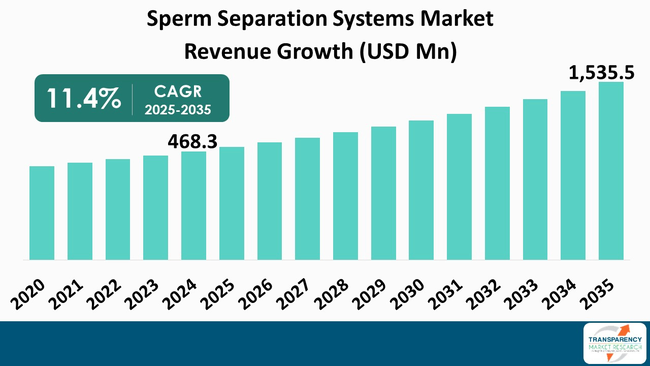
Favorable reimbursement frameworks and targeted public health priorities significantly influence clinical laboratories' decisions to invest in sperm separation solutions. The economies of scale in manufacturing and optimization of the supply chain have resulted in lower costs per unit for consumables; therefore, enabling an increasing number of mid-sized clinics to adopt these technologies. Collaborations between diagnostic technology providers and hospital networks lead to gaining access and fast deployment by intervening separation modules in pre-existing laboratory workflows. The performance demands of larger clinic networks and centralized laboratory services coupled with the need to enhance throughput are key drivers behind investments in semi-automated and automated systems that deliver consistent outputs while decreasing manual labor and processing time.
Recent market trends reflect the major unification between microfluidics and single-use cartridge platforms, therefore, gentler separation methods can be used to keep the sperm intact. Increasing number of manufacturers are not only offering hardware but also software analytics to provide traceability of the process and provide data-driven quality metrics that meet laboratory accreditation standards.
The competitive landscape is characterized by keen attention to market tactics that distinguish a company from others and rapid product development. The companies prioritize R&D investment to develop proprietary separation mechanisms and secure intellectual property, while also collaborating with clinical laboratories to validate products and enhance adoption. Several suppliers offer access to a full range of service ecosystems such as training, equipment updated contract, and data management subscription, in order to foster customer loyalty.
Sperm separation systems are specialized technologies designed to separate the motile and morphologically normal spermatozoa from the ejaculate of patients in order to apply the isolated samples to the methods of assisted reproduction (In vitro fertilization (IVF), Artificial insemination IU, etc.). These systems enable embryologists to physically remove dead sperms and the other cellular debris, so that fertilization is induced only through viable sperms.
Traditional sperm separation methods were primarily based on swim-up and density gradient centrifugation methods, which separate sperms based on their density and motility. However, these techniques can cause physical damage to the sperm cells, potentially compromising DNA integrity and sperm quality on the whole. Consequently, new systems have been developed for allowing sperm separation in a more efficient and gentler way.
Modern sperm separation systems employ electrophoresis, microfluidics, and filtration as a means of mimicking natural sperm selection processes. Such innovations minimize the requirement of centrifugation, which does lower the danger of mishandling, and elevate the yield of viable sperms for retrieval. Their precision and reproducibility allows them to be used in clinical as well as research settings in reproductive medicine.
Generally, the sperm separation systems contribute substantially to the safety, effectiveness, and positive outcomes of the Assisted Reproductive Technology. These represent a combination of biomedical engineering, reproductive science, and laboratory automation technologies.
| Attribute | Detail |
|---|---|
| Sperm Separation Systems Market Drivers |
|
Among the most significant reasons for sperm separation system market expansion is the increased rate of infertility among men worldwide. Stress, obesity, smoking, and pollution have all been contributing factors in weakening male reproductive health. Since infertility has come to be understood today as a mutual responsibility of both the individuals, diagnostic and curative action aimed at issues in male fertility has grown correspondingly. Consequently, the application of sperm separation has broadened to the clinics and laboratories.
Clinicians are now using these systems for separating motile, viable sperm from semen specimens of poor quality. This method is especially helpful for men with low sperm counts or decreased motility as it ensures the best possible chances of successful fertilization by selecting the best-quality sperm for assisted reproductive technology.
Furthermore, fertility clinics are employing advanced sperm selection devices for increasing the success rate of the treatment and minimizing risk of genetic abnormalities associated with low-quality sperm. As awareness of male infertility increases, both - patients and practitioners are prioritizing technologies that improve sperm quality and reduce procedural failure rates.
In conclusion, the worldwide rise in male infertility is a significant factor driving the implementation of sperm separation systems, thereby contributing to advancements in clinical applications, investment in reproductive technologies, and innovation.
Innovations in sperm separation technologies are amongst the primary reasons behind the growth of the sperm separation systems market. While traditional methods such as density gradient centrifugation and swim-up techniques have served the purpose, they tend to cause physical damage to sperm cells, which, in turn, may affect DNA integrity and overall sperm quality. On the other hand, modern technologies like electrophoresis, microfluidics, and filtration are gaining popularity due to their more efficient and less invasive features that allow the natural sperm selection processes to be reproduced.
Microfluidics, for instance, offers the ability of precisely controlling fluid at a small scale, and this advantage results in the separation of the motile sperm without the need for a long centrifugation process. In this way, the risk of sperm damage is minimized, and the number of sperms available for assisted reproductive procedures are increased. Further, electrophoresis, in which electric fields are used to differentiate sperm according to their charge and size, is another method that facilitates the selection of good-quality sperm by exerting less force on the cells.
These developments have resulted in high accuracy and reproducibility; thus sperm separation systems can be applied in hospitals as well as laboratory settings where in-vitro fertilization (IVF) experiments or the other studies are conducted. The advanced isolation technologies are important as they contribute significantly toward the success of ART.
The focus on diminishing mutations associated with sperm-related genetic issues have become a concern in recent times and is one of the reasons why fertility clinics have switched to these modern systems, thus driving market growth. New modifications in those technologies continuously improve treatment efficacies and make the patients as well as medical staff more confident of the effectiveness of the assisted procedures, and that, in turn, further pushes the sperm separation systems market expansion.
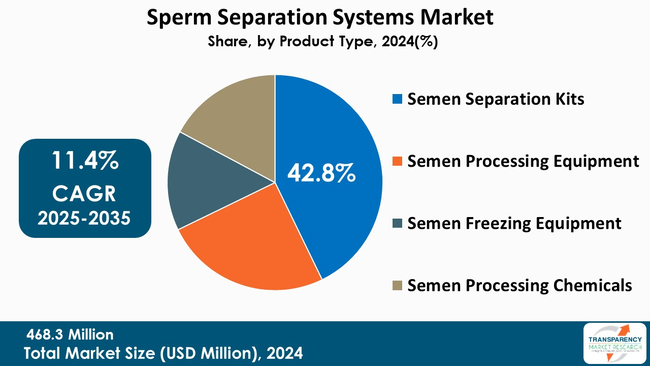
Semen separation kits are leading the sperm separation systems market. This can be attributed to the cost-effectiveness, user-friendliness, and compliance with standard laboratory protocols. With the help of these kits, clinics can easily extract the best quality of sperm with the help of methods, such as density gradient centrifugation and swim-up methods.
Moreover, their widespread use is also due to factors such as regulatory approval, a high degree of reproducibility, and minimal equipment requirements. When compared to automated or microfluidic systems, semen separation kits provide higher flexibility, quick turnaround time, and enhanced scalability, thus allowing laboratories to work with various volumes of samples without losing their performance in assisted reproductive procedures.
| Attribute | Detail |
|---|---|
| Leading Region |
|
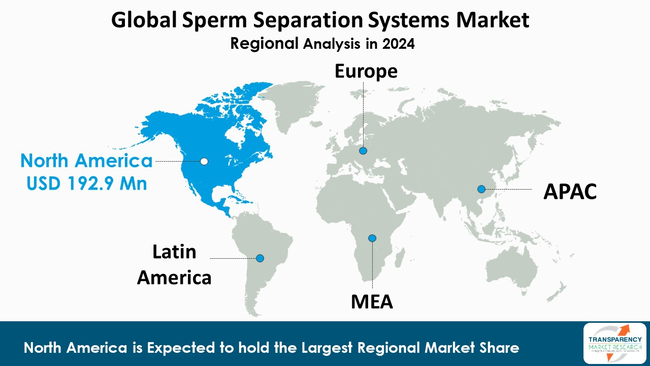
As per the latest sperm separation systems market analysis, North America dominated in 2024. This is due to the region’s remarkable healthcare infrastructure, a high level of awareness about fertility treatments, and a wide distribution of assisted reproductive technology (ART) centers. The region’s robust research ecosystem underpins ongoing innovation in sperm selection devices and clinical applications.
Moreover, the North America’s sperm separation systems market is propelled by supportive reimbursement policies, an increasing acceptance of fertility procedures, and significant investments in reproductive health. The partnerships between universities and biotech firms not only facilitate new product development but also amplify product market access, thus allowing North America to continue its dominance in the global market.
Companies operating in the sperm separation systems market focus on forging strategic collaborations, innovating their products, and validating the performance of their products across various clinical settings. These firms invest significantly in R&D pertaining to cutting-edge microfluidic and non-invasive techniques, broaden their distribution channels, and provide integrated service solutions to have a strong market presence and a high customer loyalty.
CooperSurgical, Inc., Vitrolife, Hamilton Thorne, Memphasys, NidaCon International AB, FertiPro N.V., FUJIFILM Irvine Scientific d/b/a FUJIFILM Biosciences, Lotus Bio (NYMPHAEA) Ltd., Merck & Co., Inc., Obex, Miltenyi Biotec, VetMotl, Inc., InVitroCare Inc., SperogenX Biosciences Pvt. Ltd., and Promega Corporation are some of the leading players operating in the global market.
Each of these players has been profiled in the sperm separation systems market research report based on parameters such as company overview, financial overview, business strategies, product portfolio, business segments, and recent developments.
| Attribute | Detail |
|---|---|
| Size in 2024 | US$ 468.3 Mn |
| Forecast Value in 2035 | US$ 1.5 Bn |
| CAGR | 11.4% |
| Forecast Period | 2025-2035 |
| Historical Data Available for | 2020-2023 |
| Quantitative Units | US$ Mn / Bn |
| Sperm Separation Systems Market Analysis | It includes segment analysis as well as regional level analysis. Moreover, qualitative analysis includes drivers, restraints, opportunities, key trends, value chain analysis, and key trend analysis. |
| Competition Landscape |
|
| Format | Electronic (PDF) + Excel |
| Segmentation | Product Type
|
| Regions Covered |
|
| Countries Covered |
|
| Companies Profiled |
|
| Customization Scope | Available upon request |
| Pricing | Available upon request |
The global sperm separation systems market was valued at US$ 468.3 Mn in 2024
The global sperm separation systems industry is projected to reach more than US$ 1.5 Bn by the end of 2035
The rising global rates of male infertility, increasing demand for assisted reproductive technologies (ART) like IVF and IUI, advancements in non-invasive technologies such as microfluidics and AI-driven sorting, and growing government support and consumer awareness about fertility treatments and reproductive health are some of the factors driving the expansion of sperm separation systems market.
The CAGR is anticipated to be 11.4% from 2025 to 2035
CooperSurgical, Inc., Vitrolife, Hamilton Thorne, Memphasys, NidaCon International AB, FertiPro N.V., FUJIFILM Irvine Scientific d/b/a FUJIFILM Biosciences, Lotus Bio (NYMPHAEA) Ltd., Merck & Co., Inc., Obex, Miltenyi Biotec, VetMotl, Inc., InVitroCare Inc., SperogenX Biosciences Pvt. Ltd., and Promega Corporation
Table 01: Global Sperm Separation Systems Market Value (US$ Bn) Forecast, By Product Type, 2020 to 2035
Table 02: Global Sperm Separation Systems Market Value (US$ Bn) Forecast, By Technology, 2020 to 2035
Table 03: Global Sperm Separation Systems Market Value (US$ Bn) Forecast, By Mode of Operation, 2020 to 2035
Table 04: Global Sperm Separation Systems Market Value (US$ Bn) Forecast, By Portability, 2020 to 2035
Table 05: Global Sperm Separation Systems Market Value (US$ Bn) Forecast, By Application, 2020 to 2035
Table 06: Global Sperm Separation Systems Market Value (US$ Bn) Forecast, By End-user, 2020 to 2035
Table 07: Global Sperm Separation Systems Market Value (US$ Bn) Forecast, By Region, 2020 to 2035
Table 08: North America Sperm Separation Systems Market Value (US$ Bn) Forecast, by Country, 2020-2035
Table 09: North America Sperm Separation Systems Market Value (US$ Bn) Forecast, By Product Type, 2020 to 2035
Table 10: North America Sperm Separation Systems Market Value (US$ Bn) Forecast, By Technology, 2020 to 2035
Table 11: North America Sperm Separation Systems Market Value (US$ Bn) Forecast, By Mode of Operation, 2020 to 2035
Table 12: North America Sperm Separation Systems Market Value (US$ Bn) Forecast, By Portability, 2020 to 2035
Table 13: North America Sperm Separation Systems Market Value (US$ Bn) Forecast, By Application, 2020 to 2035
Table 14: North America Sperm Separation Systems Market Value (US$ Bn) Forecast, By End-user, 2020 to 2035
Table 15: Europe Sperm Separation Systems Market Value (US$ Bn) Forecast, by Country/Sub-region, 2020-2035
Table 16: Europe Sperm Separation Systems Market Value (US$ Bn) Forecast, By Product Type, 2020 to 2035
Table 17: Europe Sperm Separation Systems Market Value (US$ Bn) Forecast, By Technology, 2020 to 2035
Table 18: Europe Sperm Separation Systems Market Value (US$ Bn) Forecast, By Mode of Operation, 2020 to 2035
Table 19: Europe Sperm Separation Systems Market Value (US$ Bn) Forecast, By Portability, 2020 to 2035
Table 20: Europe Sperm Separation Systems Market Value (US$ Bn) Forecast, By Application, 2020 to 2035
Table 21: Europe Sperm Separation Systems Market Value (US$ Bn) Forecast, By End-user, 2020 to 2035
Table 22: Asia Pacific Sperm Separation Systems Market Value (US$ Bn) Forecast, by Country/Sub-region, 2020-2035
Table 23: Asia Pacific Sperm Separation Systems Market Value (US$ Bn) Forecast, By Product Type, 2020 to 2035
Table 24: Asia Pacific Sperm Separation Systems Market Value (US$ Bn) Forecast, By Technology, 2020 to 2035
Table 25: Asia Pacific Sperm Separation Systems Market Value (US$ Bn) Forecast, By Mode of Operation, 2020 to 2035
Table 26: Asia Pacific Sperm Separation Systems Market Value (US$ Bn) Forecast, By Portability, 2020 to 2035
Table 27: Asia Pacific Sperm Separation Systems Market Value (US$ Bn) Forecast, By Application, 2020 to 2035
Table 28: Asia Pacific Sperm Separation Systems Market Value (US$ Bn) Forecast, By End-user, 2020 to 2035
Table 29: Latin America Sperm Separation Systems Market Value (US$ Bn) Forecast, by Country/Sub-region, 2020-2035
Table 30: Latin America Sperm Separation Systems Market Value (US$ Bn) Forecast, By Product Type, 2020 to 2035
Table 31: Latin America Sperm Separation Systems Market Value (US$ Bn) Forecast, By Technology, 2020 to 2035
Table 32: Latin America Sperm Separation Systems Market Value (US$ Bn) Forecast, By Mode of Operation, 2020 to 2035
Table 33: Latin America Sperm Separation Systems Market Value (US$ Bn) Forecast, By Portability, 2020 to 2035
Table 34: Latin America Sperm Separation Systems Market Value (US$ Bn) Forecast, By Application, 2020 to 2035
Table 35: Latin America Sperm Separation Systems Market Value (US$ Bn) Forecast, By End-user, 2020 to 2035
Table 36: Middle East & Africa Sperm Separation Systems Market Value (US$ Bn) Forecast, by Country/Sub-region, 2020-2035
Table 37: Middle East & Africa Sperm Separation Systems Market Value (US$ Bn) Forecast, By Product Type, 2020 to 2035
Table 38: Middle East & Africa Sperm Separation Systems Market Value (US$ Bn) Forecast, By Technology, 2020 to 2035
Table 39: Middle East & Africa Sperm Separation Systems Market Value (US$ Bn) Forecast, By Mode of Operation, 2020 to 2035
Table 40: Middle East & Africa Sperm Separation Systems Market Value (US$ Bn) Forecast, By Portability, 2020 to 2035
Table 41: Middle East & Africa Sperm Separation Systems Market Value (US$ Bn) Forecast, By Application, 2020 to 2035
Table 42: Middle East & Africa Sperm Separation Systems Market Value (US$ Bn) Forecast, By End-user, 2020 to 2035
Figure 01: Global Sperm Separation Systems Market Value Share Analysis, By Product Type, 2024 and 2035
Figure 02: Global Sperm Separation Systems Market Attractiveness Analysis, By Product Type, 2025 to 2035
Figure 03: Global Sperm Separation Systems Market Revenue (US$ Bn), by Semen Separation Kits, 2020 to 2035
Figure 04: Global Sperm Separation Systems Market Revenue (US$ Bn), by Semen Processing Equipment, 2020 to 2035
Figure 05: Global Sperm Separation Systems Market Revenue (US$ Bn), by Semen Freezing Equipment, 2020 to 2035
Figure 06: Global Sperm Separation Systems Market Revenue (US$ Bn), by Semen Processing Chemicals, 2020 to 2035
Figure 07: Global Sperm Separation Systems Market Value Share Analysis, By Technology, 2024 and 2035
Figure 08: Global Sperm Separation Systems Market Attractiveness Analysis, By Technology, 2025 to 2035
Figure 09: Global Sperm Separation Systems Market Revenue (US$ Bn), by Density Gradient Centrifugation, 2020 to 2035
Figure 10: Global Sperm Separation Systems Market Revenue (US$ Bn), by Modified Swim-Up Technique, 2020 to 2035
Figure 11: Global Sperm Separation Systems Market Revenue (US$ Bn), by Microfluidic Technology, 2020 to 2035
Figure 12: Global Sperm Separation Systems Market Revenue (US$ Bn), by Magnetic-Activated Cell Sorting (MACS), 2020 to 2035
Figure 13: Global Sperm Separation Systems Market Revenue (US$ Bn), by Laser-Activated Cell Sorting (LACS), 2020 to 2035
Figure 14: Global Sperm Separation Systems Market Revenue (US$ Bn), by Others, 2020 to 2035
Figure 15: Global Sperm Separation Systems Market Value Share Analysis, By Mode of Operation, 2024 and 2035
Figure 16: Global Sperm Separation Systems Market Attractiveness Analysis, By Mode of Operation, 2025 to 2035
Figure 17: Global Sperm Separation Systems Market Revenue (US$ Bn), by Manual Systems, 2020 to 2035
Figure 18: Global Sperm Separation Systems Market Revenue (US$ Bn), by Semi-Automated Systems, 2020 to 2035
Figure 19: Global Sperm Separation Systems Market Revenue (US$ Bn), by Fully Automated Systems, 2020 to 2035
Figure 20: Global Sperm Separation Systems Market Value Share Analysis, By Portability, 2024 and 2035
Figure 21: Global Sperm Separation Systems Market Attractiveness Analysis, By Portability, 2025 to 2035
Figure 22: Global Sperm Separation Systems Market Revenue (US$ Bn), by Mobile Systems, 2020 to 2035
Figure 23: Global Sperm Separation Systems Market Revenue (US$ Bn), by Stationary Systems, 2020 to 2035
Figure 24: Global Sperm Separation Systems Market Value Share Analysis, By Application, 2024 and 2035
Figure 25: Global Sperm Separation Systems Market Attractiveness Analysis, By Application, 2025 to 2035
Figure 26: Global Sperm Separation Systems Market Revenue (US$ Bn), by In Vitro Fertilization (IVF), 2020 to 2035
Figure 27: Global Sperm Separation Systems Market Revenue (US$ Bn), by Intracytoplasmic Sperm Injection (ICSI), 2020 to 2035
Figure 28: Global Sperm Separation Systems Market Revenue (US$ Bn), by Artificial Insemination, 2020 to 2035
Figure 29: Global Sperm Separation Systems Market Revenue (US$ Bn), by Others, 2020 to 2035
Figure 30: Global Sperm Separation Systems Market Value Share Analysis, By End-user, 2024 and 2035
Figure 31: Global Sperm Separation Systems Market Attractiveness Analysis, By End-user, 2025 to 2035
Figure 32: Global Sperm Separation Systems Market Revenue (US$ Bn), by Hospitals & Clinics, 2020 to 2035
Figure 33: Global Sperm Separation Systems Market Revenue (US$ Bn), by Cryobanks, 2020 to 2035
Figure 34: Global Sperm Separation Systems Market Revenue (US$ Bn), by Fertility Centers and IVF Laboratories, 2020 to 2035
Figure 35: Global Sperm Separation Systems Market Revenue (US$ Bn), by Others, 2020 to 2035
Figure 36: Global Sperm Separation Systems Market Value Share Analysis, By Region, 2024 and 2035
Figure 37: Global Sperm Separation Systems Market Attractiveness Analysis, By Region, 2025 to 2035
Figure 38: North America Sperm Separation Systems Market Value (US$ Bn) Forecast, 2020 to 2035
Figure 39: North America Sperm Separation Systems Market Value Share Analysis, by Country, 2024 and 2035
Figure 40: North America Sperm Separation Systems Market Attractiveness Analysis, by Country, 2025 to 2035
Figure 41: North America Sperm Separation Systems Market Value Share Analysis, By Product Type, 2024 and 2035
Figure 42: North America Sperm Separation Systems Market Attractiveness Analysis, By Product Type, 2025 to 2035
Figure 43: North America Sperm Separation Systems Market Value Share Analysis, By Technology, 2024 and 2035
Figure 44: North America Sperm Separation Systems Market Attractiveness Analysis, By Technology, 2025 to 2035
Figure 45: North America Sperm Separation Systems Market Value Share Analysis, By Mode of Operation, 2024 and 2035
Figure 46: North America Sperm Separation Systems Market Attractiveness Analysis, By Mode of Operation, 2025 to 2035
Figure 47: North America Sperm Separation Systems Market Value Share Analysis, By Portability, 2024 and 2035
Figure 48: North America Sperm Separation Systems Market Attractiveness Analysis, By Portability, 2025 to 2035
Figure 49: North America Sperm Separation Systems Market Value Share Analysis, By Application, 2024 and 2035
Figure 50: North America Sperm Separation Systems Market Attractiveness Analysis, By Application, 2025 to 2035
Figure 51: North America Sperm Separation Systems Market Value Share Analysis, By End-user, 2024 and 2035
Figure 52: North America Sperm Separation Systems Market Attractiveness Analysis, By End-user, 2025 to 2035
Figure 53: Europe Sperm Separation Systems Market Value (US$ Bn) Forecast, 2020 to 2035
Figure 54: Europe Sperm Separation Systems Market Value Share Analysis, by Country/Sub-region, 2024 and 2035
Figure 55: Europe Sperm Separation Systems Market Attractiveness Analysis, by Country/Sub-region, 2025 to 2035
Figure 56: Europe Sperm Separation Systems Market Value Share Analysis, By Product Type, 2024 and 2035
Figure 57: Europe Sperm Separation Systems Market Attractiveness Analysis, By Product Type, 2025 to 2035
Figure 58: Europe Sperm Separation Systems Market Value Share Analysis, By Technology, 2024 and 2035
Figure 59: Europe Sperm Separation Systems Market Attractiveness Analysis, By Technology, 2025 to 2035
Figure 60: Europe Sperm Separation Systems Market Value Share Analysis, By Mode of Operation, 2024 and 2035
Figure 61: Europe Sperm Separation Systems Market Attractiveness Analysis, By Mode of Operation, 2025 to 2035
Figure 62: Europe Sperm Separation Systems Market Value Share Analysis, By Portability, 2024 and 2035
Figure 63: Europe Sperm Separation Systems Market Attractiveness Analysis, By Portability, 2025 to 2035
Figure 64: Europe Sperm Separation Systems Market Value Share Analysis, By Application, 2024 and 2035
Figure 65: Europe Sperm Separation Systems Market Attractiveness Analysis, By Application, 2025 to 2035
Figure 66: Europe Sperm Separation Systems Market Value Share Analysis, By End-user, 2024 and 2035
Figure 67: Europe Sperm Separation Systems Market Attractiveness Analysis, By End-user, 2025 to 2035
Figure 68: Asia Pacific Sperm Separation Systems Market Value (US$ Bn) Forecast, 2020 to 2035
Figure 69: Asia Pacific Sperm Separation Systems Market Value Share Analysis, by Country/Sub-region, 2024 and 2035
Figure 70: Asia Pacific Sperm Separation Systems Market Attractiveness Analysis, by Country/Sub-region, 2025 to 2035
Figure 71: Asia Pacific Sperm Separation Systems Market Value Share Analysis, By Product Type, 2024 and 2035
Figure 72: Asia Pacific Sperm Separation Systems Market Attractiveness Analysis, By Product Type, 2025 to 2035
Figure 73: Asia Pacific Sperm Separation Systems Market Value Share Analysis, By Technology, 2024 and 2035
Figure 74: Asia Pacific Sperm Separation Systems Market Attractiveness Analysis, By Technology, 2025 to 2035
Figure 75: Asia Pacific Sperm Separation Systems Market Value Share Analysis, By Mode of Operation, 2024 and 2035
Figure 76: Asia Pacific Sperm Separation Systems Market Attractiveness Analysis, By Mode of Operation, 2025 to 2035
Figure 77: Asia Pacific Sperm Separation Systems Market Value Share Analysis, By Portability, 2024 and 2035
Figure 78: Asia Pacific Sperm Separation Systems Market Attractiveness Analysis, By Portability, 2025 to 2035
Figure 79: Asia Pacific Sperm Separation Systems Market Value Share Analysis, By Application, 2024 and 2035
Figure 80: Asia Pacific Sperm Separation Systems Market Attractiveness Analysis, By Application, 2025 to 2035
Figure 81: Asia Pacific Sperm Separation Systems Market Value Share Analysis, By End-user, 2024 and 2035
Figure 82: Asia Pacific Sperm Separation Systems Market Attractiveness Analysis, By End-user, 2025 to 2035
Figure 83: Latin America Sperm Separation Systems Market Value (US$ Bn) Forecast, 2020 to 2035
Figure 84: Latin America Sperm Separation Systems Market Value Share Analysis, by Country/Sub-region, 2024 and 2035
Figure 85: Latin America Sperm Separation Systems Market Attractiveness Analysis, by Country/Sub-region, 2025 to 2035
Figure 86: Latin America Sperm Separation Systems Market Value Share Analysis, By Product Type, 2024 and 2035
Figure 87: Latin America Sperm Separation Systems Market Attractiveness Analysis, By Product Type, 2025 to 2035
Figure 88: Latin America Sperm Separation Systems Market Value Share Analysis, By Technology, 2024 and 2035
Figure 89: Latin America Sperm Separation Systems Market Attractiveness Analysis, By Technology, 2025 to 2035
Figure 90: Latin America Sperm Separation Systems Market Value Share Analysis, By Mode of Operation, 2024 and 2035
Figure 91: Latin America Sperm Separation Systems Market Attractiveness Analysis, By Mode of Operation, 2025 to 2035
Figure 92: Latin America Sperm Separation Systems Market Value Share Analysis, By Portability, 2024 and 2035
Figure 93: Latin America Sperm Separation Systems Market Attractiveness Analysis, By Portability, 2025 to 2035
Figure 94: Latin America Sperm Separation Systems Market Value Share Analysis, By Application, 2024 and 2035
Figure 95: Latin America Sperm Separation Systems Market Attractiveness Analysis, By Application, 2025 to 2035
Figure 96: Latin America Sperm Separation Systems Market Value Share Analysis, By End-user, 2024 and 2035
Figure 97: Latin America Sperm Separation Systems Market Attractiveness Analysis, By End-user, 2025 to 2035
Figure 98: Middle East & Africa Sperm Separation Systems Market Value (US$ Bn) Forecast, 2020 to 2035
Figure 99: Middle East & Africa Sperm Separation Systems Market Value Share Analysis, by Country/Sub-region, 2024 and 2035
Figure 100: Middle East & Africa Sperm Separation Systems Market Attractiveness Analysis, by Country/Sub-region, 2025 to 2035
Figure 101: Middle East & Africa Sperm Separation Systems Market Value Share Analysis, By Product Type, 2024 and 2035
Figure 102: Middle East & Africa Sperm Separation Systems Market Attractiveness Analysis, By Product Type, 2025 to 2035
Figure 103: Middle East & Africa Sperm Separation Systems Market Value Share Analysis, By Technology, 2024 and 2035
Figure 104: Middle East & Africa Sperm Separation Systems Market Attractiveness Analysis, By Technology, 2025 to 2035
Figure 105: Middle East & Africa Sperm Separation Systems Market Value Share Analysis, By Mode of Operation, 2024 and 2035
Figure 106: Middle East & Africa Sperm Separation Systems Market Attractiveness Analysis, By Mode of Operation, 2025 to 2035
Figure 107: Middle East & Africa Sperm Separation Systems Market Value Share Analysis, By Portability, 2024 and 2035
Figure 108: Middle East & Africa Sperm Separation Systems Market Attractiveness Analysis, By Portability, 2025 to 2035
Figure 109: Middle East & Africa Sperm Separation Systems Market Value Share Analysis, By Application, 2024 and 2035
Figure 110: Middle East & Africa Sperm Separation Systems Market Attractiveness Analysis, By Application, 2025 to 2035
Figure 111: Middle East & Africa Sperm Separation Systems Market Value Share Analysis, By End-user, 2024 and 2035
Figure 112: Middle East & Africa Sperm Separation Systems Market Attractiveness Analysis, By End-user, 2025 to 2035
Copyright © Transparency Market Research, Inc. All Rights reserved
Trust Online


Sperm Separation Systems Market
