

Reports
Reports
The global physical therapy software market size was valued at US$ 1.3 Bn in 2024 and is projected to reach US$ 3.4 Bn by 2035, expanding at a CAGR of 9.2% from 2025 to 2035. The market growth is driven by growing prevalence of musculoskeletal disorders and rehabilitation needs, rising adoption of digital health technologies and growing need for streamlined practice management, efficient documentation and regulatory compliance.
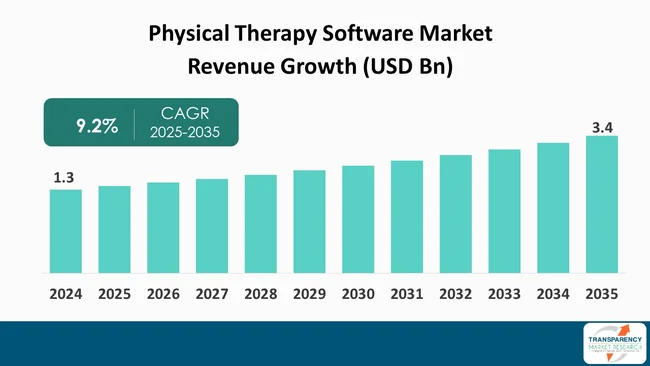
The increasing prevalence of musculoskeletal diseases has major implications on the physical therapy software market. Increased focus on value-based reimbursement and outcomes measure compels providers to invest in systems enabling standardized examination, longitudinal patient tracking, evidence based measures, and effective clinical decision support tools.
Greater interconnectivity with electronic health records and interoperability requirements prompt adoption of specialty physical therapy software for hassle-free data sharing and conformity with rules of privacy. Also, a growing emphasis by payers on evidence-based recorded functional gain and standardized outcome measures prompts adoption of analytics-driven platforms that prove clinical efficacy and justification for reimbursement.
Recent trends include the migration to cloud-native SaaS models, integration of wearable sensors for activity monitoring, and use of artificial intelligence for creating personalized exercise plans. Emphasis on patient engagement apps, outcome analytics, and enhanced cybersecurity measures is driving product roadmaps and accelerating platform differentiation.
Companies are focused on innovation in market competition, and the focus appears on API-based interoperability, modular product architectures, and collaborative development efforts with device manufacturers. The investments are focused on advanced analytics, regulatory frameworks for compliance, training programs for clinicians, and performance-based pricing for outcomes.
Physical therapy software refers to a computer-based solution that automates clinical, administrative, and operational tasks of physical therapy practices. The computer software in physical therapy enables patient data, treatment schedules, and improvement reports to be dealt with more effectively with centralized systems. Clinical processes are automated in such a way that paperwork is reduced while the correctness, accessibility, and coordination of data improve.
Electronic documentation is one of their primary features through which therapists can record evaluations, treatment, and outcomes electronically. These often come with customizable templates that are designed according to clinical guidelines so that practitioners can maintain patient records that are consistent, compliant, and complete. This, in turn, facilitates communication from one provider to another and the implementation of evidence-based practice.
Most physical therapy software programs include not only scheduling, billing, and reporting features but also clinical documentation. These features of the software are designed to assist clinics in managing their sessions and making the most of their resources. Some of the software’s can even automate filing insurance claims and billing and invoicing for appointments. In this way, as all the aspects of the software interact, the software is functioning as a well-oiled machine for the clinic, as well as limiting administrative mistakes.
Besides, through the contemporary physical therapy software, the practitioners have the probability of utilizing the tools of analytics, patient engagement, and the connection with the wearable devices or the electronic health records (EHRs). These innovations renew the methods of activities for the doctors by giving them the possibility to supervise the patients' progress from a distance, to change the regime of the rehabilitation, and to raise the patients' satisfaction level.
| Attribute | Detail |
|---|---|
| Market Drivers |
|
The emergence of telehealth and virtual rehabilitation is an essential driving factor for the physical therapy software market growth. As healthcare systems are adopting distant models of care, physical therapy software is becoming a fundamental enabler to enable clinicians to provide therapy sessions virtually without compromising standards of care and compliance.
Amalgamation of telehealth in these platforms enables therapists to conduct live video sessions, visually check the patient's movement, and provide immediate feedback. Hence, the virtual flexibility becomes a way to reach more patients, particularly those living in the countryside or having limited mobility.
Virtual rehab features supported by engaging software tools and the use of movement capture technology greatly increase the patients' motivation and willingness to follow the exercise programs. Physical therapy software solutions based on such functionality enable clinicians to remotely track results and refine treatment protocols based on real-time performance data, enhancing quality and satisfaction.
Also, the payment policies for telehealth have driven clinics to implement digital therapy systems. Therefore, the physical therapy software industry is poised to continue to grow due to growing demand for secure, scalable, intuitive systems that integrate telecommunication, analytics, and compliance capabilities, restructuring conventional rehabilitation as a hybrid, technology-enhanced model of care delivery.
The rising demand for operational efficiency of medical facilities is another significant factor driving the physical therapy software market. Clinics and rehabilitation centers are compelled to treat more patients while keeping their administrative load low, prompting them to use computerized solutions to make their work efficient and maximize the resource usage.
Physical therapy automates the routine administrative tasks such as scheduling, patient registration, billing, and claims processing. These systems are designed to remove manual work errors, save time and thus increase the productivity of personnel.
Furthermore, the development of interoperable systems that communicate with EHRs and insurance platforms with ease contributes to smoother information exchange. This further forms a level of connectivity where data silos have been eliminated, hence facilitating care coordination by different healthcare providers. As an organization continues to enhance efficiency and performance optimization, the demand for comprehensive physical therapy software solutions is increasing rapidly.
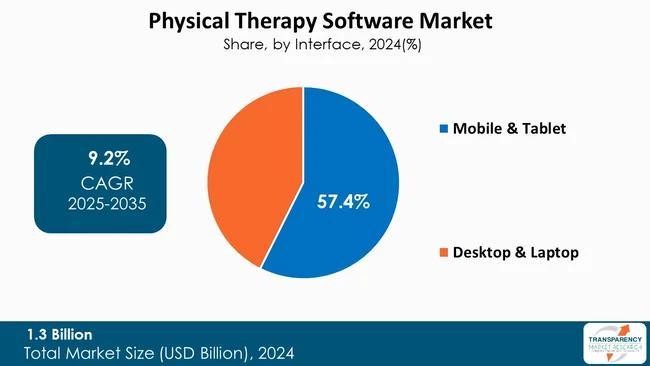
The physical therapy software market is led by the mobile and tablet segment, largely due to their portability, convenience, and accessibility in real-time. Therapists can handle patient records, check the progress, and give exercise instructions from anywhere, thus making it more flexible in both clinical and remote settings.
Moreover, the trend towards use of mobile apps coupled with wearable devices and telehealth tools is greatly facilitating remote monitoring and making therapy adjustments based on data. Besides that, the attractive and user-friendly interfaces of physical therapy software programs for mobile and tablets contribute to the better user-experience and prompt more clinicians and patients to adopt these solutions that are efficient, personalized, and technology-enabled.
| Attribute | Detail |
|---|---|
| Leading Region |
|
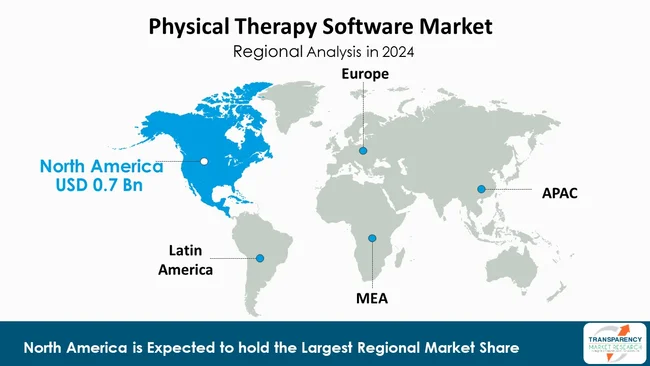
As per the latest physical therapy software market analysis, North America dominated in 2024, capturing a market share of 54.1%. This is due to their well-developed healthcare system, rapid utilization of digital health technologies and strong regulatory assistance for the integration of electronic health records (EHR). As the region is highly focused on data-driven healthcare and patient outcome tracking, it further utilizes such software solutions.
Moreover, a large number of software vendors and rising technological innovation in the region are further contributing in this region’s market growth. Besides, increased healthcare spending, rising elderly population and favorable reimbursement policies for digital rehab services are also contributing to North America’s leading position in physical therapy software industry.
The companies operating in the physical therapy software market focus on strategic partnerships, product innovations as well as integration of AI-driven analytics. They emphasize interoperability with EHR systems, mobile platform optimization, and have enhanced cybersecurity. In addition to that, organizations are investing in cloud-based deployments, international expansion, and customer training initiatives to strengthen their market position and to increase user engagement.
WebPT, AdvancedMD, Inc., ClinicSource, Raintree Systems, Ensora Health, EverHealth Solutions Inc., NXGN Management, LLC, Tebra Technologies, Inc, SmartPT Online Private Limited, MerlinWave, Inc., Netsmart Technologies, Inc., CleverDev Software, SPRY Therapeutics Inc., Medbridge Inc. and Rehametrics are some of the leading players operating in the global market.
Each of these players has been profiled in the physical therapy software industry research report based on parameters such as company overview, financial overview, business strategies, product portfolio, business segments, and recent developments.
| Attribute | Detail |
|---|---|
| Size in 2024 | US$ 1.3 Bn |
| Forecast Value in 2035 | US$ 3.4 Bn |
| CAGR | 9.2% |
| Forecast Period | 2025-2035 |
| Historical Data Available for | 2020-2023 |
| Quantitative Units | US$ Bn |
| Market Analysis | It includes segment analysis as well as regional level analysis. Moreover, qualitative analysis includes drivers, restraints, opportunities, key trends, value chain analysis, and key trend analysis. |
| Competition Landscape |
|
| Format | Electronic (PDF) + Excel |
| Segmentation | Software Type
|
| Regions Covered |
|
| Countries Covered |
|
| Companies Profiled |
|
| Customization Scope | Available upon request |
| Pricing | Available upon request |
The global physical therapy software market was valued at US$ 1.3 Bn in 2024
The global physical therapy software industry is projected to reach more than US$ 3.4 Bn by the end of 2035
The rise of telehealth and virtual rehabilitation, growing global geriatric population, increasing demand for efficient patient management, rising focus on outcome-based care and technological advancements, such as AI and cloud-based solutions are some of the factors driving the expansion of physical therapy software market.
The CAGR is anticipated to be 9.2% from 2025 to 2035
WebPT, AdvancedMD, Inc., ClinicSource, Raintree Systems, Ensora Health, EverHealth Solutions Inc., NXGN Management, LLC, Tebra Technologies, Inc, SmartPT Online Private Limited, MerlinWave, Inc., Netsmart Technologies, Inc., CleverDev Software, SPRY Therapeutics Inc., Medbridge Inc., and Rehametrics
Table 01: Global Physical Therapy Software Market Value (US$ Bn) Forecast, By Software Type, 2020 to 2035
Table 02: Global Physical Therapy Software Market Value (US$ Bn) Forecast, By Interface, 2020 to 2035
Table 03: Global Physical Therapy Software Market Value (US$ Bn) Forecast, By Deployment Mode, 2020 to 2035
Table 04: Global Physical Therapy Software Market Value (US$ Bn) Forecast, By Application, 2020 to 2035
Table 05: Global Physical Therapy Software Market Value (US$ Bn) Forecast, By End-user, 2020 to 2035
Table 06: Global Physical Therapy Software Market Value (US$ Bn) Forecast, By Region, 2020 to 2035
Table 07: North America Physical Therapy Software Market Value (US$ Bn) Forecast, by Country, 2020-2035
Table 08: North America Physical Therapy Software Market Value (US$ Bn) Forecast, By Software Type, 2020 to 2035
Table 09: North America Physical Therapy Software Market Value (US$ Bn) Forecast, By Interface, 2020 to 2035
Table 10: North America Physical Therapy Software Market Value (US$ Bn) Forecast, By Deployment Mode, 2020 to 2035
Table 11: North America Physical Therapy Software Market Value (US$ Bn) Forecast, By Application, 2020 to 2035
Table 12: North America Physical Therapy Software Market Value (US$ Bn) Forecast, By End-user, 2020 to 2035
Table 13: Europe Physical Therapy Software Market Value (US$ Bn) Forecast, by Country/Sub-region, 2020-2035
Table 14: Europe Physical Therapy Software Market Value (US$ Bn) Forecast, By Software Type, 2020 to 2035
Table 15: Europe Physical Therapy Software Market Value (US$ Bn) Forecast, By Interface, 2020 to 2035
Table 16: Europe Physical Therapy Software Market Value (US$ Bn) Forecast, By Deployment Mode, 2020 to 2035
Table 17: Europe Physical Therapy Software Market Value (US$ Bn) Forecast, By Application, 2020 to 2035
Table 18: Europe Physical Therapy Software Market Value (US$ Bn) Forecast, By End-user, 2020 to 2035
Table 19: Asia Pacific Physical Therapy Software Market Value (US$ Bn) Forecast, by Country/Sub-region, 2020-2035
Table 20: Asia Pacific Physical Therapy Software Market Value (US$ Bn) Forecast, By Software Type, 2020 to 2035
Table 21: Asia Pacific Physical Therapy Software Market Value (US$ Bn) Forecast, By Interface, 2020 to 2035
Table 22: Asia Pacific Physical Therapy Software Market Value (US$ Bn) Forecast, By Deployment Mode, 2020 to 2035
Table 23: Asia Pacific Physical Therapy Software Market Value (US$ Bn) Forecast, By Application, 2020 to 2035
Table 24: Asia Pacific Physical Therapy Software Market Value (US$ Bn) Forecast, By End-user, 2020 to 2035
Table 25: Latin America Physical Therapy Software Market Value (US$ Bn) Forecast, by Country/Sub-region, 2020-2035
Table 26: Latin America Physical Therapy Software Market Value (US$ Bn) Forecast, By Software Type, 2020 to 2035
Table 27: Latin America Physical Therapy Software Market Value (US$ Bn) Forecast, By Interface, 2020 to 2035
Table 28: Latin America Physical Therapy Software Market Value (US$ Bn) Forecast, By Deployment Mode, 2020 to 2035
Table 29: Latin America Physical Therapy Software Market Value (US$ Bn) Forecast, By Application, 2020 to 2035
Table 30: Latin America Physical Therapy Software Market Value (US$ Bn) Forecast, By End-user, 2020 to 2035
Table 31: Middle East & Africa Physical Therapy Software Market Value (US$ Bn) Forecast, by Country/Sub-region, 2020-2035
Table 32: Middle East & Africa Physical Therapy Software Market Value (US$ Bn) Forecast, By Software Type, 2020 to 2035
Table 33: Middle East & Africa Physical Therapy Software Market Value (US$ Bn) Forecast, By Interface, 2020 to 2035
Table 34: Middle East & Africa Physical Therapy Software Market Value (US$ Bn) Forecast, By Deployment Mode, 2020 to 2035
Table 35: Middle East & Africa Physical Therapy Software Market Value (US$ Bn) Forecast, By Application, 2020 to 2035
Table 36: Middle East & Africa Physical Therapy Software Market Value (US$ Bn) Forecast, By End-user, 2020 to 2035
Figure 01: Global Physical Therapy Software Market Value Share Analysis, By Software Type, 2024 and 2035
Figure 02: Global Physical Therapy Software Market Attractiveness Analysis, By Software Type, 2025 to 2035
Figure 03: Global Physical Therapy Software Market Revenue (US$ Bn), by Physical Therapy EMR Software, 2020 to 2035
Figure 04: Global Physical Therapy Software Market Revenue (US$ Bn), by Physical Therapy Documentation Software, 2020 to 2035
Figure 05: Global Physical Therapy Software Market Revenue (US$ Bn), by Physical Therapy Billing Software, 2020 to 2035
Figure 06: Global Physical Therapy Software Market Revenue (US$ Bn), by Physical Therapy Scheduling Software, 2020 to 2035
Figure 07: Global Physical Therapy Software Market Revenue (US$ Bn), by Physical Therapy Practice Management Software, 2020 to 2035
Figure 08: Global Physical Therapy Software Market Value Share Analysis, By Interface, 2024 and 2035
Figure 09: Global Physical Therapy Software Market Attractiveness Analysis, By Interface, 2025 to 2035
Figure 10: Global Physical Therapy Software Market Revenue (US$ Bn), by Mobile & Tablet, 2020 to 2035
Figure 11: Global Physical Therapy Software Market Revenue (US$ Bn), by Desktop & Laptop, 2020 to 2035
Figure 12: Global Physical Therapy Software Market Value Share Analysis, By Deployment Mode, 2024 and 2035
Figure 13: Global Physical Therapy Software Market Attractiveness Analysis, By Deployment Mode, 2025 to 2035
Figure 14: Global Physical Therapy Software Market Revenue (US$ Bn), by On-premises, 2020 to 2035
Figure 15: Global Physical Therapy Software Market Revenue (US$ Bn), by Cloud-based, 2020 to 2035
Figure 16: Global Physical Therapy Software Market Revenue (US$ Bn), by Hybrid, 2020 to 2035
Figure 17: Global Physical Therapy Software Market Value Share Analysis, By Application, 2024 and 2035
Figure 18: Global Physical Therapy Software Market Attractiveness Analysis, By Application, 2025 to 2035
Figure 19: Global Physical Therapy Software Market Revenue (US$ Bn), by Exercise Program Management, 2020 to 2035
Figure 20: Global Physical Therapy Software Market Revenue (US$ Bn), by Customized Treatment Planning, 2020 to 2035
Figure 21: Global Physical Therapy Software Market Revenue (US$ Bn), by Appointment Scheduling and Reminders, 2020 to 2035
Figure 22: Global Physical Therapy Software Market Revenue (US$ Bn), by Track Patient Progress, 2020 to 2035
Figure 23: Global Physical Therapy Software Market Revenue (US$ Bn), by Billing and Claims Management, 2020 to 2035
Figure 24: Global Physical Therapy Software Market Revenue (US$ Bn), by Staff Management, 2020 to 2035
Figure 25: Global Physical Therapy Software Market Revenue (US$ Bn), by Others, 2020 to 2035
Figure 26: Global Physical Therapy Software Market Value Share Analysis, By End-user, 2024 and 2035
Figure 27: Global Physical Therapy Software Market Attractiveness Analysis, By End-user, 2025 to 2035
Figure 28: Global Physical Therapy Software Market Revenue (US$ Bn), by Hospitals & Clinics, 2020 to 2035
Figure 29: Global Physical Therapy Software Market Revenue (US$ Bn), by Rehabilitation Centers, 2020 to 2035
Figure 30: Global Physical Therapy Software Market Revenue (US$ Bn), by Homecare Settings, 2020 to 2035
Figure 31: Global Physical Therapy Software Market Revenue (US$ Bn), by Private Physical Therapy Practitioners, 2020 to 2035
Figure 32: Global Physical Therapy Software Market Value Share Analysis, By Region, 2024 and 2035
Figure 33: Global Physical Therapy Software Market Attractiveness Analysis, By Region, 2025 to 2035
Figure 34: North America Physical Therapy Software Market Value (US$ Bn) Forecast, 2020 to 2035
Figure 35: North America Physical Therapy Software Market Value Share Analysis, by Country, 2024 and 2035
Figure 36: North America Physical Therapy Software Market Attractiveness Analysis, by Country, 2025 to 2035
Figure 37: North America Physical Therapy Software Market Value Share Analysis, By Software Type, 2024 and 2035
Figure 38: North America Physical Therapy Software Market Attractiveness Analysis, By Software Type, 2025 to 2035
Figure 39: North America Physical Therapy Software Market Value Share Analysis, By Interface, 2024 and 2035
Figure 40: North America Physical Therapy Software Market Attractiveness Analysis, By Interface, 2025 to 2035
Figure 41: North America Physical Therapy Software Market Value Share Analysis, By Deployment Mode, 2024 and 2035
Figure 42: North America Physical Therapy Software Market Attractiveness Analysis, By Deployment Mode, 2025 to 2035
Figure 43: North America Physical Therapy Software Market Value Share Analysis, By Application, 2024 and 2035
Figure 44: North America Physical Therapy Software Market Attractiveness Analysis, By Application, 2025 to 2035
Figure 45: North America Physical Therapy Software Market Value Share Analysis, By End-user, 2024 and 2035
Figure 46: North America Physical Therapy Software Market Attractiveness Analysis, By End-user, 2025 to 2035
Figure 47: Europe Physical Therapy Software Market Value (US$ Bn) Forecast, 2020 to 2035
Figure 48: Europe Physical Therapy Software Market Value Share Analysis, by Country/Sub-region, 2024 and 2035
Figure 49: Europe Physical Therapy Software Market Attractiveness Analysis, by Country/Sub-region, 2025 to 2035
Figure 50: Europe Physical Therapy Software Market Value Share Analysis, By Software Type, 2024 and 2035
Figure 51: Europe Physical Therapy Software Market Attractiveness Analysis, By Software Type, 2025 to 2035
Figure 52: Europe Physical Therapy Software Market Value Share Analysis, By Interface, 2024 and 2035
Figure 53: Europe Physical Therapy Software Market Attractiveness Analysis, By Interface, 2025 to 2035
Figure 54: Europe Physical Therapy Software Market Value Share Analysis, By Deployment Mode, 2024 and 2035
Figure 55: Europe Physical Therapy Software Market Attractiveness Analysis, By Deployment Mode, 2025 to 2035
Figure 56: Europe Physical Therapy Software Market Value Share Analysis, By Application, 2024 and 2035
Figure 57: Europe Physical Therapy Software Market Attractiveness Analysis, By Application, 2025 to 2035
Figure 58: Europe Physical Therapy Software Market Value Share Analysis, By End-user, 2024 and 2035
Figure 59: Europe Physical Therapy Software Market Attractiveness Analysis, By End-user, 2025 to 2035
Figure 60: Asia Pacific Physical Therapy Software Market Value (US$ Bn) Forecast, 2020 to 2035
Figure 61: Asia Pacific Physical Therapy Software Market Value Share Analysis, by Country/Sub-region, 2024 and 2035
Figure 62: Asia Pacific Physical Therapy Software Market Attractiveness Analysis, by Country/Sub-region, 2025 to 2035
Figure 63: Asia Pacific Physical Therapy Software Market Value Share Analysis, By Software Type, 2024 and 2035
Figure 64: Asia Pacific Physical Therapy Software Market Attractiveness Analysis, By Software Type, 2025 to 2035
Figure 65: Asia Pacific Physical Therapy Software Market Value Share Analysis, By Interface, 2024 and 2035
Figure 66: Asia Pacific Physical Therapy Software Market Attractiveness Analysis, By Interface, 2025 to 2035
Figure 67: Asia Pacific Physical Therapy Software Market Value Share Analysis, By Deployment Mode, 2024 and 2035
Figure 68: Asia Pacific Physical Therapy Software Market Attractiveness Analysis, By Deployment Mode, 2025 to 2035
Figure 69: Asia Pacific Physical Therapy Software Market Value Share Analysis, By Application, 2024 and 2035
Figure 70: Asia Pacific Physical Therapy Software Market Attractiveness Analysis, By Application, 2025 to 2035
Figure 71: Asia Pacific Physical Therapy Software Market Value Share Analysis, By End-user, 2024 and 2035
Figure 72: Asia Pacific Physical Therapy Software Market Attractiveness Analysis, By End-user, 2025 to 2035
Figure 73: Latin America Physical Therapy Software Market Value (US$ Bn) Forecast, 2020 to 2035
Figure 74: Latin America Physical Therapy Software Market Value Share Analysis, by Country/Sub-region, 2024 and 2035
Figure 75: Latin America Physical Therapy Software Market Attractiveness Analysis, by Country/Sub-region, 2025 to 2035
Figure 76: Latin America Physical Therapy Software Market Value Share Analysis, By Software Type, 2024 and 2035
Figure 77: Latin America Physical Therapy Software Market Attractiveness Analysis, By Software Type, 2025 to 2035
Figure 78: Latin America Physical Therapy Software Market Value Share Analysis, By Interface, 2024 and 2035
Figure 79: Latin America Physical Therapy Software Market Attractiveness Analysis, By Interface, 2025 to 2035
Figure 80: Latin America Physical Therapy Software Market Value Share Analysis, By Deployment Mode, 2024 and 2035
Figure 81: Latin America Physical Therapy Software Market Attractiveness Analysis, By Deployment Mode, 2025 to 2035
Figure 82: Latin America Physical Therapy Software Market Value Share Analysis, By Application, 2024 and 2035
Figure 83: Latin America Physical Therapy Software Market Attractiveness Analysis, By Application, 2025 to 2035
Figure 84: Latin America Physical Therapy Software Market Value Share Analysis, By End-user, 2024 and 2035
Figure 85: Latin America Physical Therapy Software Market Attractiveness Analysis, By End-user, 2025 to 2035
Figure 86: Middle East & Africa Physical Therapy Software Market Value (US$ Bn) Forecast, 2020 to 2035
Figure 87: Middle East & Africa Physical Therapy Software Market Value Share Analysis, by Country/Sub-region, 2024 and 2035
Figure 88: Middle East & Africa Physical Therapy Software Market Attractiveness Analysis, by Country/Sub-region, 2025 to 2035
Figure 89: Middle East & Africa Physical Therapy Software Market Value Share Analysis, By Software Type, 2024 and 2035
Figure 90: Middle East & Africa Physical Therapy Software Market Attractiveness Analysis, By Software Type, 2025 to 2035
Figure 91: Middle East & Africa Physical Therapy Software Market Value Share Analysis, By Interface, 2024 and 2035
Figure 92: Middle East & Africa Physical Therapy Software Market Attractiveness Analysis, By Interface, 2025 to 2035
Figure 93: Middle East & Africa Physical Therapy Software Market Value Share Analysis, By Deployment Mode, 2024 and 2035
Figure 94: Middle East & Africa Physical Therapy Software Market Attractiveness Analysis, By Deployment Mode, 2025 to 2035
Figure 95: Middle East & Africa Physical Therapy Software Market Value Share Analysis, By Application, 2024 and 2035
Figure 96: Middle East & Africa Physical Therapy Software Market Attractiveness Analysis, By Application, 2025 to 2035
Figure 97: Middle East & Africa Physical Therapy Software Market Value Share Analysis, By End-user, 2024 and 2035
Figure 98: Middle East & Africa Physical Therapy Software Market Attractiveness Analysis, By End-user, 2025 to 2035
Copyright © Transparency Market Research, Inc. All Rights reserved
Trust Online


Physical Therapy Software Market
