
Analysts’ Viewpoint on Market Scenario
Several pharmaceutical companies across the world are engaged in the development of biosimilars. The global biosimilars market has the potential to grow at a rapid pace. Large numbers of biological drugs are likely to go off patent. Therefore, lower healthcare costs and regulatory structure changes by governments are expected to drive the market during the forecast period. Usage of monoclonal antibodies in the treatment of COVID-19 has also renewed interest in the market. However, implementation of strict policies and market entry barriers for new players are likely to restrain the global market. Manufacturers are increasing their research capabilities to develop improved immunotherapy drugs. These drugs hold the potential to reduce the incidence of side effects in cancer patients. Rise in availability of insurance coverage for biosimilars is also creating a positive impact on the market.
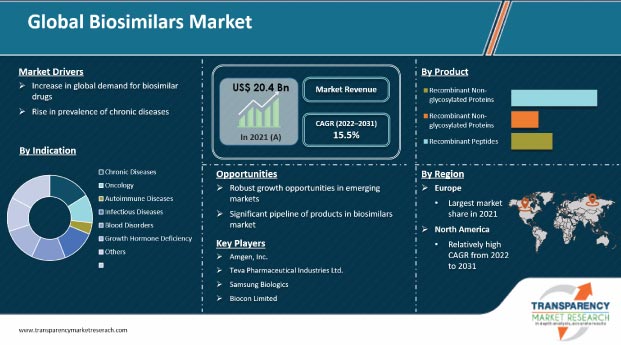
Biosimilar can be defined as a biologic medical product, which is considered very similar to an already-approved biologic. These biosimilars are approved based on their efficacy, quality, safety, and the standards of pharmaceutical quality that apply to all biologic medicines.
Biosimilars are generic versions of biologics that have passed their patent expiration date. The biosimilar market is expected to be driven by the patent expiration of well-known biologics. An increase in approval and sales of biosimilars has led to a significant decline in the sales of biologics that had a steady or growing demand.
The burden of chronic diseases has been rising across the globe. An increase in the prevalence of chronic diseases can be largely ascribed to the aging population and changing lifestyle of the people. Diabetes, hypertension, stroke, respiratory diseases, oral diseases, obesity, arthritis, and cancer are some of the common chronic diseases. On the other hand, biosimilar monoclonal antibodies are being extensively used in the treatment of rheumatoid arthritis and cancer.
Approvals of biosimilars have been increasing globally owing to changing regulations and the rise in pressure on healthcare systems to facilitate treatment for all patients. Biosimilars or copy biologics are being increasingly adopted by physicians, authorities, and patients, owing to the much-needed improvements in access to therapeutically viable options for the treatment of various diseases. Companies are increasing the production of biosimilar medicines, oncology biosimilars, and Remicade biosimilars to broaden their revenue streams.
Request a sample to get extensive insights into the Biosimilars Market
The rise in the prevalence of chronic diseases is augmenting the global market. Biosimilar drugs are becoming increasingly popular across the world because of their cost-effectiveness. An increase in cancer patients and chronic disease cases; and growth in the geriatric population are projected to fuel the demand for biosimilars during the forecast period.
Over half of the population of the U.S. is likely to suffer from at least one chronic disease during their lifetime. According to the WHO, chronic disease prevalence is expected to rise by 57% by 2020. Rapid population growth in emerging markets is expected to drive the prevalence of chronic diseases.
Cancer is the second leading cause of death globally, with over 70% of deaths occurring in low- and middle-income countries. The incidence of cancer increases with age, most likely due to the rise in the risk of specific cancers as people get older. Growth in the pipeline of biosimilar drugs for the treatment of chronic diseases is projected to propel the global market in the next few years. ABRILADA, a biosimilar to Humira, was approved by the U.S. Food and Drug Administration (FDA) in November 2019 for the treatment of rheumatoid arthritis, juvenile idiopathic arthritis, psoriatic arthritis, ankylosing spondylitis, adult Crohn's disease, ulcerative colitis, and plaque psoriasis.
In terms of product, the recombinant non-glycosylated proteins segment held a relatively large market share in 2021. The segment has been split into insulin, granulocyte colony-stimulating factor, recombinant human growth factor, and interferons.
Recombinant non-glycosylation involves the production of active substances in bacteria, which results in non-glycosylation, allowing the active substance to remain biologically active. The growth of the segment can be attributed to the rise in the prevalence of chronic diseases, which require recombinant non-glycosylated proteins biosimilars for treatment. Additionally, changing regulations and an increase in the focus of governments on the approval of biosimilars are anticipated to drive the recombinant non-glycosylated proteins segment during the forecast period.
Based on indication, the oncology segment held a large revenue share of the global biosimilars market in 2021. Growth in the prevalence of cancer and an increase in the number of ongoing studies in the biosimilar field across the world are likely to augment the segment during the forecast period.
Biologics are a broad category of products that include blood and blood components, vaccines, hormones, and allergens (anti-allergy medications). Monoclonal antibodies are important biologics; these are used to treat a range of diseases, including breast cancer, lymphoma, rheumatoid arthritis, psoriasis, ulcerative colitis, and Crohn's disease.
Advancements in biomedical technology have resulted in an increase in the commercialization of biologics in the last few decades. This has improved cancer care. Cancer treatment is expensive; therefore, the development of a biosimilar product with comparable clinical efficacy has led to lower healthcare costs and improved access to care. Hence, the oncology segment is expected to account for a significant share of the market during the forecast period.
Europe held more than 45% share of the global biosimilars market in 2021. It is projected to be a highly lucrative region of the global market, with a high market attractiveness index, during the forecast period.
The biosimilars market in Europe is the largest in the world, accounting for roughly 60% of the global market and growing steadily year after year. As of October 2019, 54 biosimilars of 15 originator biological medicines were approved for marketing in Europe. Countries in Europe provide valuable examples of different approaches to biosimilar policy, led by their large market and diverse healthcare systems.
Biosimilars sales reflect Europe's legislative and regulatory leadership in the market. The biosimilar market in the region is more mature than that in the U.S. However, opportunities for biosimilar companies in Europe are limited due to lower overall spending on biologicals.
Europe has set the standard, approving more treatments than any other continent. Currently, biosimilars account for 10% of the total biologics market in the region, with a majority (7%) occurring in the past five years. The percentage is significantly higher in terms of volume, reflecting the steadily increasing level of revenue savings as a result of the rise in biosimilar competition and penetration. More than 60 biosimilars have been approved for use in the European Union (EU) to date, with several more being evaluated. Therefore, the biosimilars market in Europe is expected to grow at a significant pace during the forecast period.
The biosimilars industry is consolidated, with a small number of leading players accounting for a relatively large share. Most companies are making significant investments in research & development activities. Diversification of product portfolios and mergers & acquisitions are important strategies adopted by key players in the global market for biosimilars. Pfizer, Inc., Intas Pharmaceuticals Ltd., Biocon, Dr. Reddy’s Laboratories Ltd., Teva Pharmaceutical Industries Ltd., Sandoz International GmbH (A Novartis Division), Celltrion, Inc., Amgen, Inc., STADA Arzneimittel AG, and Apotex, Inc. are the prominent players operating in the global market.
Request a custom report on Biosimilars Market
Each of these players has been profiled in the biosimilars market report based on parameters such as company overview, financial overview, business strategies, product portfolio, business segments, and recent developments.
|
Attribute |
Detail |
|
Market Size Value in 2021 |
US$ 20.4 Bn |
|
Market Forecast Value in 2031 |
More than US$ 85 Bn |
|
Growth Rate (CAGR) |
15.5% |
|
Forecast Period |
2022–2031 |
|
Historical Data Available for |
2017–2020 |
|
Quantitative Units |
US$ Bn for Value & Tons for Volume |
|
Market Analysis |
It includes cross segment analysis at global as well as regional level. Furthermore, qualitative analysis includes drivers, restraints, opportunities, key trends, Porter’s Five Forces analysis, value chain analysis, and key trend analysis. |
|
Competition Landscape |
|
|
Format |
Electronic (PDF) + Excel |
|
Market Segmentation |
|
|
Regions Covered |
|
|
Countries Covered |
|
|
Companies Profiled |
|
|
Customization Scope |
Available upon request |
|
Pricing |
Available upon request |
The global market was valued at US$ 20.4 Bn in 2021
The global market is projected to reach more than US$ 85 Bn by 2031
The global biosimilars market is anticipated to expand at a CAGR of 15.5% from 2022 to 2031.
Increase in approvals of biosimilars is expected to drive the global market.
Europe is expected to account for major share of the global biosimilars market during the forecast period.
Prominent players in the global biosimilars market include Pfizer, Inc., Intas Pharmaceuticals Ltd., Biocon, Dr. Reddy’s Laboratories Ltd., Teva Pharmaceutical Industries Ltd., Sandoz International GmbH (A Novartis Division), Celltrion, Inc., Amgen, Inc., STADA Arzneimittel AG, and Apotex, Inc.
1. Preface
1.1. Market Definition and Scope
1.2. Market Segmentation
1.3. Key Research Objectives
1.4. Research Highlights
2. Assumptions and Acronyms
3. Research Methodology
4. Executive Summary: Global Biosimilars Market
5. Market Overview
5.1. Definition
5.2. Market Indicators
5.3. Market Dynamics
5.3.1. Drivers
5.3.2. Restraints
5.3.3. Opportunities
6. Market Outlook
6.1. Global Biosimilars Market Analysis and Forecast, 2017–2031
6.2. Global Biosimilars Market Outlook
6.3. Entry Barriers to Biosimilars Market
6.4. Factors Driving the Adoption of Biosimilars
6.5. Pipeline Analysis
6.6. Regulatory Scenario Assessment
6.7. Key Industry Developments
7. Global Biosimilars Market Analysis and Forecast, by Product
7.1. Introduction
7.2. Biosimilars Market Value Forecast, by Product, 2017–2031
7.2.1. Recombinant Glycosylated Proteins
7.2.1.1. Monoclonal Antibodies
7.2.1.2. Erythropoietin
7.2.1.3. Others
7.2.2. Recombinant Non-glycosylated Proteins
7.2.2.1. Insulin
7.2.2.2. Granulocyte Colony Stimulating Factor
7.2.2.3. Recombinant Human Growth Factor
7.2.2.4. Interferons
7.2.3. Recombinant Peptides
7.3. Market Attractiveness Analysis, by Product
8. Global Biosimilars Market Analysis and Forecast, by Indication
8.1. Introduction
8.2. Biosimilars Market Value Forecast, by Indication, 2017–2031
8.2.1. Chronic Diseases
8.2.2. Oncology
8.2.3. Autoimmune Diseases
8.2.4. Infectious Diseases
8.2.5. Blood Disorders
8.2.6. Growth Hormone Deficiency
8.2.7. Others
8.3. Market Attractiveness Analysis, by Material
9. Global Biosimilars Market Analysis and Forecast, by Region
9.1. Regional Outlook
9.2. Global Scenario
9.3. Introduction
9.4. Biosimilars Market Value Forecast, by Region
9.4.1. North America
9.4.2. Europe
9.4.3. Asia Pacific
9.4.4. Latin America
9.4.5. Middle East & Africa
9.5. Market Attractiveness Analysis, by Region
10. North America Biosimilars Market Analysis and Forecast
10.1. Key Findings
10.2. North America Biosimilars Market Value Forecast, by Product, 2017–2031
10.2.1. Recombinant Glycosylated Proteins
10.2.1.1. Monoclonal Antibodies
10.2.1.2. Erythropoietin
10.2.1.3. Others
10.2.2. Recombinant Non-glycosylated Proteins
10.2.2.1. Insulin
10.2.2.2. Granulocyte Colony Stimulating Factor
10.2.2.3. Recombinant Human Growth Factor
10.2.2.4. Interferons
10.2.3. Recombinant Peptides
10.3. North America Biosimilars Market Value Forecast, by Indication, 2017–2031
10.3.1. Chronic Diseases
10.3.2. Oncology
10.3.3. Autoimmune Diseases
10.3.4. Infectious Diseases
10.3.5. Blood Disorders
10.3.6. Growth Hormone Deficiency
10.3.7. Others
10.4. North America Biosimilars Market Value Forecast, by Country, 2017–2031
10.4.1. U.S.
10.4.2. Canada
10.5. North America Biosimilars Market Attractiveness Analysis
10.5.1. By Product
10.5.2. By Indication
10.5.3. By Country
11. Europe Biosimilars Market Analysis and Forecast
11.1. Key Findings
11.2. Europe Biosimilars Market Value Forecast, by Product, 2017–2031
11.2.1. Recombinant Glycosylated Proteins
11.2.1.1. Monoclonal Antibodies
11.2.1.2. Erythropoietin
11.2.1.3. Others
11.2.2. Recombinant Non-glycosylated Proteins
11.2.2.1. Insulin
11.2.2.2. Granulocyte Colony Stimulating Factor
11.2.2.3. Recombinant Human Growth Factor
11.2.2.4. Interferons
11.2.3. Recombinant Peptides
11.3. Europe Biosimilars Market Value Forecast, by Indication, 2017–2031
11.3.1. Chronic Diseases
11.3.2. Oncology
11.3.3. Autoimmune Diseases
11.3.4. Infectious Diseases
11.3.5. Blood Disorders
11.3.6. Growth Hormone Deficiency
11.3.7. Others
11.4. Europe Biosimilars Market Value Forecast, by Country/Sub-region, 2017–2031
11.4.1. U.K.
11.4.2. Germany
11.4.3. France
11.4.4. Italy
11.4.5. Spain
11.4.6. Rest of Europe
11.5. Europe Biosimilars Market Attractiveness Analysis
11.5.1. By Product
11.5.2. By Indication
11.5.3. By Country/Sub-region
12. Asia Pacific Biosimilars Market Analysis and Forecast
12.1. Key Findings
12.2. Asia Pacific Biosimilars Market Value Forecast, by Product, 2017–2031
12.2.1. Recombinant Glycosylated Proteins
12.2.1.1. Monoclonal Antibodies
12.2.1.2. Erythropoietin
12.2.1.3. Others
12.2.2. Recombinant Non-glycosylated Proteins
12.2.2.1. Insulin
12.2.2.2. Granulocyte Colony Stimulating Factor
12.2.2.3. Recombinant Human Growth Factor
12.2.2.4. Interferons
12.2.3. Recombinant Peptides
12.3. Asia Pacific Biosimilars Market Value Forecast, by Indication, 2017–2031
12.3.1. Chronic Diseases
12.3.2. Oncology
12.3.3. Autoimmune Diseases
12.3.4. Infectious Diseases
12.3.5. Blood Disorders
12.3.6. Growth Hormone Deficiency
12.3.7. Others
12.4. Asia Pacific Biosimilars Market Value Forecast, by Country/Sub-region, 2017–2031
12.4.1. China
12.4.2. India
12.4.3. Japan
12.4.4. Australia & New Zealand
12.4.5. Rest of Asia Pacific
12.5. Asia Pacific Biosimilars Market Attractiveness Analysis
12.5.1. By Product
12.5.2. By Indication
12.5.3. By Country/Sub-region
13. Latin America Biosimilars Market Analysis and Forecast
13.1. Key Findings
13.2. Latin America Biosimilars Market Value Forecast, by Product, 2017–2031
13.2.1. Recombinant Glycosylated Proteins
13.2.1.1. Monoclonal Antibodies
13.2.1.2. Erythropoietin
13.2.1.3. Others
13.2.2. Recombinant Non-glycosylated Proteins
13.2.2.1. Insulin
13.2.2.2. Granulocyte Colony Stimulating Factor
13.2.2.3. Recombinant Human Growth Factor
13.2.2.4. Interferons
13.2.3. Recombinant Peptides
13.3. Latin America Biosimilars Market Value Forecast, by Indication, 2017–2031
13.3.1. Chronic Diseases
13.3.2. Oncology
13.3.3. Autoimmune Diseases
13.3.4. Infectious Diseases
13.3.5. Blood Disorders
13.3.6. Growth Hormone Deficiency
13.3.7. Others
13.4. Latin America Biosimilars Market Value Forecast, by Country/Sub-region, 2017–2031
13.4.1. Brazil
13.4.2. Mexico
13.4.3. Rest of Latin America
13.5. Latin America Biosimilars Market Attractiveness Analysis
13.5.1. By Product
13.5.2. By Indication
13.5.3. By Country/Sub-region
14. Middle East & Africa Biosimilars Market Analysis and Forecast
14.1. Key Findings
14.2. Middle East & Africa Biosimilars Market Value Forecast, by Product, 2017–2031
14.2.1. Recombinant Glycosylated Proteins
14.2.1.1. Monoclonal Antibodies
14.2.1.2. Erythropoietin
14.2.1.3. Others
14.2.2. Recombinant Non-glycosylated Proteins
14.2.2.1. Insulin
14.2.2.2. Granulocyte Colony Stimulating Factor
14.2.2.3. Recombinant Human Growth Factor
14.2.2.4. Interferons
14.2.3. Recombinant Peptides
14.3. Middle East & Africa Biosimilars Market Value Forecast, by Indication, 2017–2031
14.3.1. Chronic Diseases
14.3.2. Oncology
14.3.3. Autoimmune Diseases
14.3.4. Infectious Diseases
14.3.5. Blood Disorders
14.3.6. Growth Hormone Deficiency
14.3.7. Others
14.4. Middle East & Africa Biosimilars Market Value Forecast, by Country/Sub-region, 2017–2031
14.4.1. GCC Countries
14.4.2. South Africa
14.4.3. Rest of Middle East & Africa
14.5. Middle East & Africa Biosimilars Market Attractiveness Analysis
14.5.1. By Product
14.5.2. By Indication
14.5.3. By Country/Sub-region
15. Competition Landscape
15.1. Competition Matrix
15.2. Market Share Analysis, by Company, 2021
15.3. Company Profiles
15.3.1. Pfizer, Inc.
15.3.1.1. Company Overview (HQ, Business Segments, Employee Strength)
15.3.1.2. Financial Overview
15.3.1.3. Product Portfolio
15.3.1.4. Strategic Overview
15.3.1.5. SWOT Analysis
15.3.2. Intas Pharmaceuticals Ltd.
15.3.2.1. Company Overview (HQ, Business Segments, Employee Strength)
15.3.2.2. Financial Overview
15.3.2.3. Product Portfolio
15.3.2.4. Strategic Overview
15.3.2.5. SWOT Analysis
15.3.3. Biocon
15.3.3.1. Company Overview (HQ, Business Segments, Employee Strength)
15.3.3.2. Financial Overview
15.3.3.3. Product Portfolio
15.3.3.4. Strategic Overview
15.3.3.5. SWOT Analysis
15.3.4. Dr. Reddy’s Laboratories Ltd.
15.3.4.1. Company Overview (HQ, Business Segments, Employee Strength)
15.3.4.2. Financial Overview
15.3.4.3. Product Portfolio
15.3.4.4. Strategic Overview
15.3.4.5. SWOT Analysis
15.3.5. Teva Pharmaceutical Industries Ltd.
15.3.5.1. Company Overview (HQ, Business Segments, Employee Strength)
15.3.5.2. Financial Overview
15.3.5.3. Product Portfolio
15.3.5.4. Strategic Overview
15.3.5.5. SWOT Analysis
15.3.6. Sandoz International GmbH (A Novartis Division)
15.3.6.1. Company Overview (HQ, Business Segments, Employee Strength)
15.3.6.2. Financial Overview
15.3.6.3. Product Portfolio
15.3.6.4. Strategic Overview
15.3.6.5. SWOT Analysis
15.3.7. Celltrion, Inc.
15.3.7.1. Company Overview (HQ, Business Segments, Employee Strength)
15.3.7.2. Financial Overview
15.3.7.3. Product Portfolio
15.3.7.4. Strategic Overview
15.3.7.5. SWOT Analysis
15.3.8. Amgen, Inc.
15.3.8.1. Company Overview (HQ, Business Segments, Employee Strength)
15.3.8.2. Financial Overview
15.3.8.3. Product Portfolio
15.3.8.4. Strategic Overview
15.3.8.5. SWOT Analysis
15.3.9. STADA Arzneimittel AG
15.3.9.1. Company Overview (HQ, Business Segments, Employee Strength)
15.3.9.2. Financial Overview
15.3.9.3. Product Portfolio
15.3.9.4. Strategic Overview
15.3.9.5. SWOT Analysis
15.3.10. Apotex Inc. (Apobiologix)
15.3.10.1. Company Overview (HQ, Business Segments, Employee Strength)
15.3.10.2. Financial Overview
15.3.10.3. Product Portfolio
15.3.10.4. Strategic Overview
15.3.10.5. SWOT Analysis
List of Tables
Table 01: Pipeline Analysis - Biosimilars
Table 02: Global Biosimilars Market Value (US$ Bn) Forecast, by Product, 2017–2031
Table 03: Global Biosimilars Market Value (US$ Bn) Forecast, by Recombinant Glycosylated Proteins, 2017–2031
Table 04: Global Biosimilars Market Value (US$ Bn) Forecast, by Recombinant Non-glycosylated Proteins, 2017–2031
Table 05: Global Biosimilars Market Value (US$ Bn) Forecast, by Indication, 2017–2031
Table 06: Global Biosimilars Market Value (US$ Bn) Forecast, by Region, 2017–2031
Table 07: North America Biosimilars Market Value (US$ Bn) Forecast, by Country, 2017–2031
Table 08: North America Biosimilars Market Value (US$ Bn) Forecast, by Product Type, 2017–2031
Table 09: North America Biosimilars Market Value (US$ Bn) Forecast, by Recombinant Glycosylated Proteins, 2017–2031
Table 10: North America Biosimilars Market Value (US$ Bn) Forecast, by Recombinant Non-glycosylated Proteins, 2017–2031
Table 11: North America Biosimilars Market Value (US$ Bn) Forecast, by Indication, 2017–2031
Table 12: Europe Biosimilars Market Value (US$ Bn) Forecast, by Country/Sub-region, 2017–2031
Table 13: Europe Biosimilars Market Value (US$ Bn) Forecast, by Product Type, 2017–2031
Table 14: Europe Biosimilars Market Value (US$ Bn) Forecast, by Recombinant Glycosylated Proteins, 2017–2031
Table 15: Europe Biosimilars Market Value (US$ Bn) Forecast, by Recombinant Non-glycosylated Proteins, 2017–2031
Table 16: Europe Biosimilars Market Value (US$ Bn) Forecast, by Indication, 2017–2031
Table 17: Asia Pacific Biosimilars Market Value (US$ Bn) Forecast, by Country/Sub-region, 2017–2031
Table 18: Asia Pacific Biosimilars Market Value (US$ Bn) Forecast, by Product, 2017–2031
Table 19: Asia Pacific Biosimilars Market Value (US$ Bn) Forecast, by Recombinant Glycosylated Proteins, 2017–2031
Table 20: Asia Pacific Biosimilars Market Value (US$ Bn) Forecast, by Recombinant Non-glycosylated Proteins, 2017–2031
Table 21: Asia Pacific Biosimilars Market Value (US$ Bn) Forecast, by Indication, 2017–2031
Table 22: Latin America Biosimilars Market Value (US$ Bn) Forecast, by Country/Sub-region, 2017–2031
Table 23: Latin America Biosimilars Market Value (US$ Bn) Forecast, by Product, 2017–2031
Table 24: Latin America Biosimilars Market Value (US$ Bn) Forecast, by Recombinant Glycosylated Proteins, 2017–2031
Table 25: Latin America Biosimilars Market Value (US$ Bn) Forecast, by Recombinant Non-glycosylated Proteins, 2017–2031
Table 26: Latin America Biosimilars Market Value (US$ Bn) Forecast, by Indication, 2017–2031
Table 27: Middle East & Africa Biosimilars Market Value (US$ Bn) Forecast, by Country/Sub-region, 2017–2031
Table 28: Middle East & Africa Biosimilars Market Value (US$ Bn) Forecast, by Product, 2017–2031
Table 29: Middle East & Africa Biosimilars Market Value (US$ Bn) Forecast, by Recombinant Glycosylated Proteins, 2017–2031
Table 30: Middle East & Africa Biosimilars Market Value (US$ Bn) Forecast, by Recombinant Non-glycosylated Proteins, 2017–2031
Table 31: Middle East & Africa Biosimilars Market Value (US$ Bn) Forecast, by Indication, 2017–2031
List of Figures
Figure 01: Global Biosimilars Market Snapshot
Figure 02: Global Biosimilars Market Value (US$ Bn) by Region, 2021 and 2031
Figure 03: Global Biosimilars Market Value (US$ Bn) Forecast, 2021–2031
Figure 04: Global Biosimilars Market Value Share (%), by Product, 2021
Figure 05: Global Biosimilars Market Value Share (%), by Indication, 2021
Figure 06: Global Biosimilars Market Value Share (%), by Region, 2021
Figure 07: Entry Barriers to Biosimilars Market
Figure 08: Factors Driving the Adoption of Biosimilars
Figure 09: Biosimilar Approval Process - US
Figure 10: Data Requirements for Biosimilar Approval in Europe
Figure 11: Regulations for Biosimilar Approval in Japan
Figure 12: Regulations for Biosimilar Approval in India
Figure 13: Regulations for Biosimilar Approval in Brazil
Figure 14: Regulations for Biosimilar Approval in Saudi Arabia
Figure 15: Biosimilars Market - Key Product Launches
Figure 16: Global Biosimilars Market Value Share Analysis, by Product, 2021 and 2031
Figure 17: Global Biosimilars Market Value Share Analysis, by Recombinant Glycosylated Proteins, 2021 and 2031
Figure 18: Global Biosimilars Market Value Share Analysis, by Recombinant Non-glycosylated Proteins, 2021 and 2031
Figure 19: Global Biosimilars Market Value (US$ Bn) Forecast, by Recombinant Glycosylated Proteins, 2017–2031
Figure 20: Global Biosimilars Market Value (US$ Bn) Forecast, by Recombinant Non-glycosylated Proteins, 2017–2031
Figure 21: Global Biosimilars Market Value (US$ Bn) Forecast, by Recombinant Peptides, 2017–2031
Figure 22: Global Biosimilars Market Value (US$ Bn) Forecast, by Monoclonal Antibodies, 2017–2031
Figure 23: Global Biosimilars Market Value (US$ Bn) Forecast, by Erythropoietin, 2017–2031
Figure 24: Global Biosimilars Market Value (US$ Bn) Forecast, by Others, 2017–2031
Figure 25: Global Biosimilars Market Value (US$ Bn) Forecast, by Insulin, 2017–2031
Figure 26: Global Biosimilars Market Value (US$ Bn) Forecast, by Granulocyte Colony Stimulating Factor, 2017–2031
Figure 27: Global Biosimilars Market Value (US$ Bn) Forecast, by Recombinant Human Growth Factor, 2017–2031
Figure 28: Global Biosimilars Market Value (US$ Bn) Forecast, by Interferons, 2017–2031
Figure 29: Global Biosimilars Market Attractiveness Analysis, by Product, 2021 and 2031
Figure 30: Global Biosimilars Market Attractiveness Analysis, by Recombinant Glycosylated Proteins, 2021 and 2031
Figure 31: Global Biosimilars Market Attractiveness Analysis, by Recombinant Non-glycosylated Proteins, 2021 and 2031
Figure 32: Global Biosimilars Market Value Share Analysis, by Indication, 2021 and 2031
Figure 33: Global Biosimilars Market Value (US$ Bn) Forecast, by Chronic Diseases, 2017–2031
Figure 34: Global Biosimilars Market Value (US$ Bn) Forecast, by Oncology, 2017–2031
Figure 35: Global Biosimilars Market Value (US$ Bn) Forecast, by Autoimmune Diseases, 2017–2031
Figure 36: Global Biosimilars Market Value (US$ Bn) Forecast, by Infectious Diseases, 2017–2031
Figure 37: Global Biosimilars Market Value (US$ Bn) Forecast, by Blood Disorders, 2017–2031
Figure 38: Global Biosimilars Market Value (US$ Bn) Forecast, by Growth Hormone Deficiency, 2017–2031
Figure 39: Global Biosimilars Market Value (US$ Bn) Forecast, by Others, 2017–2031
Figure 40: Global Biosimilars Market Attractiveness Analysis, by Indication, 2021-2031
Figure 41: Global Biosimilars Market: Regional Outlook
Figure 42: Global Biosimilars Market Value Share Analysis, by Region, 2021 and 2031
Figure 43: Global Biosimilars Market Attractiveness Analysis, by Region, 2021-2031
Figure 44: North America Biosimilars Market Value (US$ Bn) Forecast, 2017–2031
Figure 45: North America Biosimilars Market Value Share Analysis, by Country, 2021 and 2031
Figure 46: North America Biosimilars Market Value Share Analysis, by Product, 2021 and 2031
Figure 47: North America Biosimilars Market Value Share Analysis, by Recombinant Glycosylated Proteins, 2021 and 2031
Figure 48: North America Biosimilars Market Value Share Analysis, by Recombinant Non-glycosylated Proteins, 2021 and 2031
Figure 49: North America Biosimilars Market Value Share Analysis, by Indication, 2021 and 2031
Figure 50: North America Biosimilars Market Attractiveness Analysis, by Product, 2021 and 2031
Figure 51: North America Biosimilars Market Attractiveness Analysis, by Recombinant Glycosylated Proteins, 2021 and 2031
Figure 52: North America Biosimilars Market Attractiveness Analysis, by Recombinant Non-glycosylated Proteins, 2021 and 2031
Figure 53: North America Biosimilars Market Attractiveness Analysis, by Indication, 2021 and 2031
Figure 54: North America Biosimilars Market Attractiveness Analysis, by Country, 2021 and 2031
Figure 55: Europe Biosimilars Market Value (US$ Bn) and Y-o-Y Growth (%) Forecast, 2017–2031
Figure 56: Europe Biosimilars Market Value Share Analysis, by Country/Sub-region, 2021 and 2031
Figure 57: Europe Biosimilars Market Value Share Analysis, by Product, 2021 and 2031
Figure 58: Europe Biosimilars Market Value Share Analysis, by Recombinant Glycosylated Proteins, 2021 and 2031
Figure 59: Europe Biosimilars Market Value Share Analysis, by Recombinant Non-glycosylated Proteins, 2021 and 2031
Figure 60: Europe Biosimilars Market Value Share Analysis, by Indication, 2021 and 2031
Figure 61: Europe Biosimilars Market Attractiveness Analysis, by Product, 2021 and 2031
Figure 62: Europe Biosimilars Market Attractiveness Analysis, by Recombinant Glycosylated Proteins, 2021 and 2031
Figure 63: Europe Biosimilars Market Attractiveness Analysis, by Recombinant Non-glycosylated Proteins, 2021 and 2031
Figure 64: Europe Biosimilars Market Attractiveness Analysis, by Indication, 2021 and 2031
Figure 65: Europe Biosimilars Market Attractiveness Analysis, by Country/Sub-region, 2021 and 2031
Figure 66: Asia Pacific Biosimilars Market Value (US$ Bn) and Y-o-Y Growth (%) Forecast, 2017–2031
Figure 67: Asia Pacific Biosimilars Market Value Share Analysis, by Country/Sub-region, 2021 and 2031
Figure 68: Asia Pacific Biosimilars Market Value Share Analysis, by Product, 2021 and 2031
Figure 69: Asia Pacific Biosimilars Market Value Share Analysis, by Recombinant Glycosylated Proteins, 2021 and 2031
Figure 70: Asia Pacific Biosimilars Market Value Share Analysis, by Recombinant Non-glycosylated Proteins, 2021 and 2031
Figure 71: Asia Pacific Biosimilars Market Value Share Analysis, by Indication, 2021 and 2031
Figure 72: Asia Pacific Biosimilars Market Attractiveness Analysis, by Product, 2021 and 2031
Figure 73: Asia Pacific Biosimilars Market Attractiveness Analysis, by Recombinant Glycosylated Proteins, 2021 and 2031
Figure 74: Asia Pacific Biosimilars Market Attractiveness Analysis, by Recombinant Non-glycosylated Proteins, 2021 and 2031
Figure 75: Asia Pacific Biosimilars Market Attractiveness Analysis, by Indication, 2021 and 2031
Figure 76: Asia Pacific Biosimilars Market Attractiveness Analysis, by Country/Sub-region, 2021 and 2031
Figure 77: Latin America Biosimilars Market Value (US$ Bn) and Y-o-Y Growth (%) Forecast, 2017–2031
Figure 78: Latin America Biosimilars Market Value Share Analysis, by Country/Sub-region, 2021 and 2031
Figure 79: Latin America Biosimilars Market Value Share Analysis, by Product, 2021 and 2031
Figure 80: Latin America Biosimilars Market Value Share Analysis, by Recombinant Glycosylated Proteins, 2021 and 2031
Figure 81: Latin America Biosimilars Market Value Share Analysis, by Recombinant Non-glycosylated Proteins, 2021 and 2031
Figure 82: Latin America Biosimilars Market Value Share Analysis, by Indication, 2021 and 2031
Figure 83: Latin America Biosimilars Market Attractiveness Analysis, by Product, 2021 and 2031
Figure 84: Latin America Biosimilars Market Attractiveness Analysis, by Recombinant Glycosylated Proteins, 2021 and 2031
Figure 85: Latin America Biosimilars Market Attractiveness Analysis, by Recombinant Non-glycosylated Proteins, 2021 and 2031
Figure 86: Latin America Biosimilars Market Attractiveness Analysis, by Indication, 2021 and 2031
Figure 87: Latin America Biosimilars Market Attractiveness Analysis, by Country/Sub-region, 2021 and 2031
Figure 88: Middle East & Africa Biosimilars Market Value (US$ Bn) and Y-o-Y Growth (%) Forecast, 2017–2031
Figure 89: Middle East & Africa Biosimilars Market Value Share Analysis, by Country/Sub-region, 2021 and 2031
Figure 90: Middle East & Africa Biosimilars Market Value Share Analysis, by Product, 2021 and 2031
Figure 91: Middle East & Africa Biosimilars Market Value Share Analysis, by Recombinant Glycosylated Proteins, 2021 and 2031
Figure 92: Middle East & Africa Biosimilars Market Value Share Analysis, by Recombinant Non-glycosylated Proteins, 2021 and 2031
Figure 93: Middle East & Africa Biosimilars Market Value Share Analysis, by Indication, 2021 and 2031
Figure 94: Middle East & Africa Biosimilars Market Attractiveness Analysis, by Product, 2021 and 2031
Figure 95: Middle East & Africa Biosimilars Market Attractiveness Analysis, by Recombinant Glycosylated Proteins, 2021 and 2031
Figure 96: Middle East & Africa Biosimilars Market Attractiveness Analysis, by Recombinant Non-glycosylated Proteins, 2021 and 2031
Figure 97: Middle East & Africa Biosimilars Market Attractiveness Analysis, by Indication, 2021 and 2031
Figure 98: Middle East & Africa Biosimilars Market Attractiveness Analysis, by Country/Sub-region, 2021 and 2031
Figure 99: Global Biosimilars Market Share Analysis, by Company, 2018
Copyright © Transparency Market Research, Inc. All Rights reserved
Trust Online

Biosimilars Market
 *86 figures and 60 tables includes