

Reports
Reports
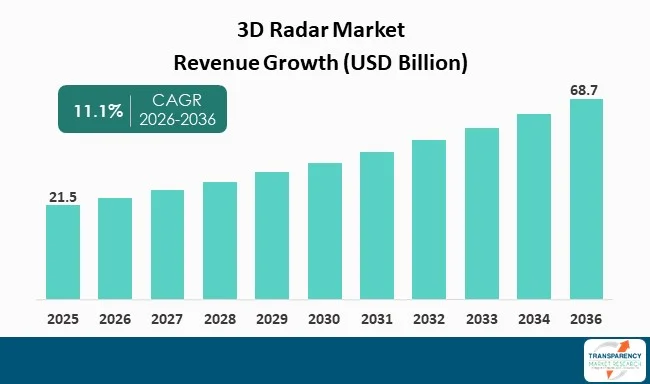
The global 3D radar market was valued at US$ 21.5 Bn in 2025 and is projected to reach US$ 68.7 Bn by 2036, expanding at a CAGR of 11.1% from 2026 to 2036. Intensifying defense modernization programs, growing air traffic volumes, and the accelerating deployment of unmanned aerial systems across civil and military domains are driving sustained investment in three-dimensional radar infrastructure.
Governments across North America, Europe, and Asia Pacific are upgrading legacy two-dimensional surveillance systems to 3D architectures capable of precise altitude measurement and simultaneous multi-target tracking. The integration of 3D radar with command-and-control networks, integrated air defense systems, and civilian airspace management platforms is reinforcing demand across the full forecast period.
The 3D radar market has evolved from a technology primarily associated with military air defense installations into a broad-spectrum surveillance and tracking capability deployed across border security, civil aviation, maritime monitoring, and unmanned traffic management.
The transition reflects both - the declining unit cost of phased array radar hardware and expansion of threat environments that require volumetric situational awareness rather than simple range-and-bearing data. This structural shift has widened the addressable customer base well beyond traditional defense ministries.
Procurement patterns across the largest defense markets indicate sustained capital commitment to 3D radar modernization through the mid-2030s. The United States Department of Defense, European NATO allies, and Indo-Pacific partner nations have all initiated multi-year radar replacement or upgrade programs since 2022.
Parallel commercial demand from airport operators, seaport authorities, and urban air mobility developers is adding a new civilian revenue stream that was negligible a decade ago. Venture and institutional investment in radar-integrated airspace management platforms reached an estimated US$ 900 Mn globally between 2023 and the base year, signaling growing commercial confidence in non-defense applications.
"The expansion of unmanned aerial system operations and the emergence of hypersonic threat vectors are compelling both defense and civil aviation stakeholders to accelerate 3D radar procurement cycles significantly beyond historical replacement timelines," say analysts at Transparency Market Research.
The competitive environment is consolidating around a smaller set of vertically integrated defense primes while simultaneously attracting specialist entrants focused on solid-state, software-defined radar architectures.
Prime contractors including RTX Corporation, Northrop Grumman, and Thales hold multi-year production contracts that provide revenue visibility through the forecast period. Alongside these incumbents, companies developing gallium nitride (GaN) solid-state radar and AI-integrated signal processing platforms are attracting defense innovation funding.
The defense electronics market and 3D radar share a significant portion of their customer base and supply chains, with procurement decisions in one segment directly influencing investment pipelines in the other.
Three-dimensional radar systems determine the range, azimuth, and elevation of targets within their surveillance volume, providing the altitude data that two-dimensional systems cannot supply. Military air defense networks require this altitude information to engage threats, discriminate between aircraft at different flight levels, and cue interceptor missiles to precise target coordinates.
Civil air traffic management systems use 3D radar to assign and verify flight level compliance, support instrument approach procedures, and detect unauthorized airspace penetrations.
Growth in the 3D radar industry is driven by a combination of threat environment changes and airspace complexity expansion. The proliferation of commercial drones, emergence of hypersonic glide vehicles as credible threats, and rapid expansion of urban air mobility operations each impose new requirements on radar surveillance networks.
Simultaneously, sovereign nations across Southeast Asia, the Middle East, and Eastern Europe are investing in domestic air defense infrastructure for the first time, creating greenfield radar demand. The convergence of these demand vectors across defense, civil aviation, and emerging mobility sectors supports above-trend market growth through the forecast period.
| Attribute | Detail |
|---|---|
| Key Growth Driver |
|
| Secondary Driver |
|
| Primary Restraint |
|
| Key Opportunity |
|
| Adoption Trend |
|
Defense ministries are executing the most extensive modernization of ground-based air defense infrastructure since the Cold War era. Threat environments now include low-observable cruise missiles, maneuvering hypersonic glide vehicles, loitering munitions, and swarms of small commercial drones.
Two-dimensional radar systems lack the elevation data needed to accurately engage these threats. The replacement and supplementation of legacy 2D surveillance radars with 3D AESA systems is a procurement priority for NATO members, Indo-Pacific allies, and Gulf Cooperation Council defense establishments.
The enlargement of NATO and the resulting security commitments of new and existing alliance members have generated substantial radar procurement requirements across Eastern and Northern Europe. Finland, Sweden, Poland, Romania, and the Baltic states have each launched multi-year programs to establish or expand layered air defense networks. These programs prioritize 3D medium-range and long-range surveillance radars capable of integrating with NATO's Air Command and Control System (ACCS).
The value of radar-related contracts issued across European NATO members exceeded US$ 3.2 Bn between 2023 and the start of the forecast period, according to published defense procurement disclosures.
The tactical lesson drawn from recent conventional conflicts regarding the effectiveness of drone and loitering munition attacks has further reinforced European procurement urgency. Air defense authorities require 3D radars capable of detecting small, low-altitude, slow-moving targets in cluttered terrain environments.
This is a more demanding detection scenario than large aircraft tracking, and it requires higher radar sensitivity, finer elevation resolution, and faster track update rates than most legacy systems can provide.
Australia, Japan, South Korea, Taiwan, India, and several Southeast Asian nations are all expanding air surveillance and air defense infrastructure as part of broader defense capability investment programs. Japan's five-year defense build-up program announced in December 2022 allocated approximately US$ 315 Bn in additional defense spending through fiscal year 2027, with radar and sensor network upgrades among the stated priorities.
Australia's Integrated air and missile defense program and India's Project Kusha medium-range surface-to-air missile system - both require significant numbers of 3D surveillance and fire-control radars.
In October 2024, RTX Corporation was awarded a contract valued at approximately US$ 1.1 Bn by an undisclosed Indo-Pacific allied nation for the supply of AN/TPY-4 transportable 3D surveillance radars. The systems were specified to provide wide-area air surveillance coverage integrated with the nation's existing command-and-control networks. RTX Corporation confirmed phased deliveries were scheduled to begin within twelve months of contract award.
The Gulf Cooperation Council members, particularly Saudi Arabia and the United Arab Emirates, continue with multi-year investment in layered air defense networks following the demonstrated threat from ballistic missiles and drone attacks on critical infrastructure. Three-dimensional radar systems form the sensor backbone of these layered defense architectures, and procurement from GCC states has represented a consistent revenue source for prime contractors across recent years.
The global expansion of unmanned aerial system operations across military, commercial, and recreational domains has created both - a threat context and a market development driver for 3D radar. Military UAS operations require 3D surveillance infrastructure for command and deconfliction. Commercial urban air mobility and drone delivery operations require volumetric airspace management.
Counter-unmanned aerial systems (C-UAS) programs have expanded the 3D radar customer base from military air defense units to include police forces, critical infrastructure operators, airports, correctional facilities, and stadium and venue security teams. Effective drone detection requires 3D radar that can separate small low-reflectivity targets from background clutter while resolving altitude precisely enough to cue electronic countermeasures or kinetic defeat systems. Phased array 3D radar systems optimized for this detection profile represent a new product category that several vendors developed specifically in response to C-UAS demand growth.
The United States Department of Homeland Security and the Federal Aviation Administration jointly estimated that over 1.7 million commercial drones were registered in the United States entering the forecast period, with unauthorized incursions near airports, nuclear facilities, and government buildings recorded at increasing frequency. European aviation safety authorities and national civil aviation regulators across Asia Pacific have issued parallel regulatory frameworks requiring 3D radar-based detection capability at designated sensitive locations. This regulatory push is converting discretionary security investment into compliance-driven procurement.
Urban air mobility platforms, including electric vertical takeoff and landing (eVTOL) aircraft, will require dedicated volumetric airspace surveillance infrastructure to operate safely at scale in urban environments. Civil aviation authorities in the United States, Europe, and Singapore have initiated advanced air mobility framework development programs that identify 3D radar as a component of the required surveillance architecture for lower airspace corridors.
Vertiport operators and urban air mobility network providers have begun engaging radar vendors to define the detection and tracking performance requirements for commercial-scale operations.
In December 2024, Joby Aviation and NASA jointly released findings from a series of urban air mobility corridor safety assessments conducted across the San Francisco Bay Area. The assessments identified 3D radar coverage gaps in sub-600-foot altitude corridors as a primary safety infrastructure requirement for commercial eVTOL network operations. The report recommended government investment in low-altitude 3D radar networks as a prerequisite for issuing commercial operating certificates to urban air mobility operators.
The unmanned aerial vehicle market is directly associated with 3D radar demand, as growth in civil drone operations, military UAS deployments, and advanced air mobility infrastructure each translate into new requirements for volumetric airspace surveillance. Radar vendors able to position products across both military air defense and civil UAS management applications benefit from a diversified and complementary demand base.
The integration of artificial intelligence and machine learning into 3D radar signal processing and target classification represents one of the most significant near-term commercial and capability development opportunities in the market. Traditional 3D radar systems detect and track targets but rely on human operators to classify threats and make engagement decisions. AI-enhanced processing layers can perform automated target recognition, discriminate between cooperative and non-cooperative aircraft, and differentiate UAS from birds or weather artifacts with greater accuracy and speed than manual workflows allow.
AI-based automatic target recognition (ATR) applied to 3D radar returns enables radar systems to classify detected objects by type, estimate intent, and prioritize tracks for human review without requiring analysis of every detected return by an operator. This capability is especially valuable in high-density surveillance environments such as major airports, contested airspace, or C-UAS deployments near critical infrastructure. Classification confidence scores assigned by AI models allow operators to focus attention on high-priority ambiguous tracks while routine cooperative traffic is handled autonomously.
Defense research agencies including DARPA, the UK Defence Science and Technology Laboratory (Dstl), and the French Direction Generale de l'Armement (DGA) have each funded radar AI integration programs since 2022. Industry participants including RTX Corporation, Leonardo DRS, and Saab AB have announced AI-radar integration capabilities as standard or optional features in current generation 3D radar product lines. The incorporation of AI-driven discrimination is also a key differentiator in competitive defense procurement responses.
Modern air defense and airspace management architectures are increasingly designed as sensor networks rather than standalone radar deployments. Three-dimensional radar contributes to the range, azimuth, elevation, and Doppler velocity data that complements inputs from electro-optical sensors, passive radio frequency detection systems, and acoustic sensors within a fused multi-sensor picture.
AI-powered fusion engines combine these data streams to produce target tracks and classification confidence levels that exceed what any individual sensor can achieve independently.
In November 2024, Thales Group unveiled the Ground Master 400 Alpha, a next-generation AESA 3D radar with integrated AI-driven target classification capability. The system incorporates an onboard AI processor capable of performing real-time automatic target recognition across air and low-altitude tracks. Thales reported initial operational evaluations with European NATO member air defense commands were scheduled for the first half of the forecast period, with full production deliveries from late 2026 onward.
The commercial airspace management sector is pursuing equivalent multi-sensor fusion architectures for unmanned traffic management. Regulatory bodies in the European Union, the United States, and Singapore are developing standards that require 3D radar data to be contributed as a certified input to centralized unmanned traffic management platforms, creating sustained equipment and data connectivity demand from system integrators and infrastructure operators.
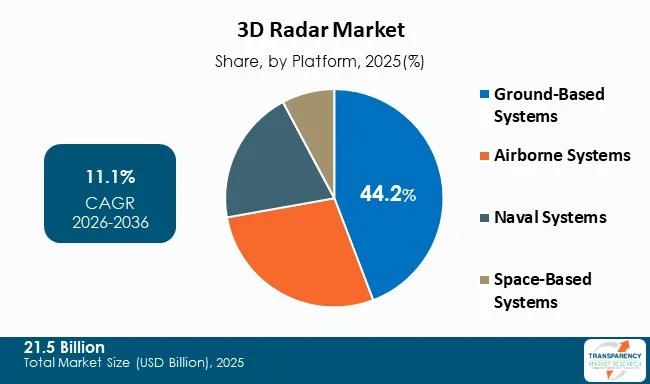
The 3D radar market segments by platform into ground-based systems, airborne systems, naval systems, and space-based systems. The ground-based systems segment held the dominant share of 44.2% entering the forecast period. Ground-based 3D radar underpins national air defense networks, airport surface and approach surveillance, border monitoring, and C-UAS installations. The relative cost-effectiveness of ground-based installations compared to airborne or naval platforms supports this segment's dominant position.
Ground-Based Systems leads because national air defense programs, the largest single demand driver in the market, almost exclusively procure ground-based radar infrastructure. Fixed and transportable ground-based 3D radars form the sensor layer of integrated air defense systems worldwide. The segment benefits from large multi-year production contracts with predictable delivery schedules and sustained lifecycle support revenue.
Airborne Systems represents the second-largest segment, covering 3D radar installed on fixed-wing aircraft, maritime patrol aircraft, and airborne early warning and control system (AWACS) platforms. Airborne 3D radar provides extended-range volumetric surveillance not constrained by terrain masking, and is a high-priority procurement item for air forces seeking to extend radar coverage into contested maritime and land domains.
Naval Systems encompasses ship-mounted 3D surveillance and fire-control radars, including both phased array systems integrated into naval combat management suites and standalone surveillance radars for smaller surface combatants. Growing naval shipbuilding programs across Asia Pacific and Europe are supporting this segment's growth through the forecast period.
Space-Based Systems remains the smallest segment by revenue but is the fastest-growing, driven by programs to deploy synthetic aperture and electronically scanned radar payloads on low Earth orbit satellites for persistent ground and maritime surveillance.
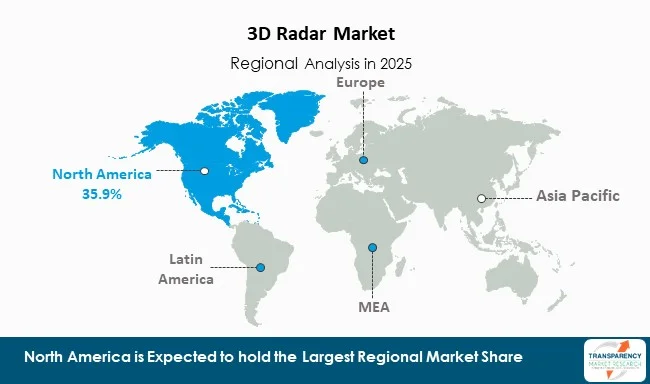
North America dominates the global 3D radar market with a 35.9% of revenue share entering the forecast period. The region's leadership reflects the scale of United States defense radar procurement, the sustained NORAD modernization program, and the regulatory requirements of the world's busiest civil airspace system. Canada contributes meaningfully to the regional total through joint NORAD investment and domestic defense radar upgrade programs.
The United States is the world's single largest procurer of military radar systems. Programs including the Multi-Mission Radar (MMR), the AN/TPY-4 tactical radar, the FAA's Terminal Doppler Weather Radar replacements, and the NORAD Over-the-Horizon Radar modernization effort collectively represent multi-billion-dollar 3D radar procurement pipelines.
The U.S. Army, Air Force, and Navy each operate distinct 3D radar acquisition programs, sustaining a domestic industrial base centered on RTX Corporation, Northrop Grumman, L3Harris Technologies, and General Dynamics.
Federal Aviation Administration infrastructure investment has driven parallel civil aviation radar upgrades across major hub airports. The U.S. also funds significant radar research and development through DARPA, the Air Force Research Laboratory, and the Army Research Laboratory, ensuring that domestic contractors maintain technology leadership in phased array, cognitive radar, and AI-integrated signal processing architectures.
Europe accounts for second largest global revenue share and is the fastest-growing region by incremental revenue value through the forecast period. NATO's collective defense commitments following the enlargement of the alliance have triggered radar procurement programs across nearly all European member states. The most significant single-country programs are concentrated in Poland, Germany, Romania, Finland, Sweden, and the Baltic states. France and Italy maintain large domestic defense radar industries through Thales and Leonardo, respectively, and supply both domestic programs and export markets. The air traffic management market in Europe is also transitioning to next-generation surveillance infrastructure, contributing civilian radar procurement to the regional total.
Asia Pacific also accounts for a significant share of the global revenues. Japan, South Korea, Australia, India, and Taiwan are executing the most significant regional radar investment programs. India's Project Kusha air defense program and the Indian Air Force's radar modernization initiative represent the largest single-country procurement pipeline in the region. China's domestic radar industry serves People's Liberation Army requirements while also supplying export markets in Southeast Asia and Africa. Australia's investment in over-the-horizon radar upgrades and integrated air and missile defense surveillance infrastructure contributes meaningfully to the regional total.
The Middle East, Africa, and Latin America account for smaller shares of the global revenue. Gulf Cooperation Council defense ministries, particularly Saudi Arabia, the United Arab Emirates, and Qatar, are sustained buyers of 3D radar systems as part of ongoing layered air defense infrastructure investment. Israel maintains a technologically advanced domestic radar industry serving both national defense and significant export markets. Latin American nations including Brazil and Colombia are investing in border surveillance radar networks with 3D detection capability.
| Attribute | Detail |
|---|---|
| Market Size (2025) | US$ 21.5 Bn |
| Forecast Value (2036) | US$ 68.7 Bn |
| CAGR (2026-2036) | 11.1% |
| Forecast Period | 2026-2036 |
| Historical Data Available for | 2021-2025 |
| Quantitative Units | US$ Bn |
| Dominant Region | North America (35.9% share) |
| Leading Segment | Ground-Based Systems (44.2% share) |
| Segmentation |
|
| Regions Covered | North America, Europe, Asia Pacific, Latin America, Middle East & Africa |
| Countries Covered | U.S., Canada, Germany, U.K., France, Italy, Spain, Switzerland, The Netherlands, China, India, Japan, South Korea, Australia and New Zealand, Brazil, Mexico, Argentina, GCC Countries, South Africa |
| Companies Profiled | RTX Corporation, Northrop Grumman Corporation, Thales Group, Leonardo S.p.A., BAE Systems plc, Lockheed Martin Corporation, L3Harris Technologies Inc., Saab AB, Hensoldt AG, Israel Aerospace Industries Ltd., Elta Systems Ltd., General Dynamics Corporation, Leonardo DRS Inc., Indra Sistemas S.A., Bharat Electronics Limited (BEL), ASELSAN A.S., SRC Inc., Other players |
| Format | Electronic (PDF) + Excel |
| Customization Scope | Available upon request |
| Pricing | Available upon request |
The global 3D radar industry was valued at US$ 21.5 Bn in 2025 and is projected to reach US$ 68.7 Bn by 2036, expanding at a CAGR of 11.1% from 2026 to 2036.
Defense modernization programs requiring volumetric air surveillance, the proliferation of unmanned aerial systems creating C-UAS demand, and civil aviation airspace surveillance upgrades are the primary growth drivers across the forecast period.
The ground-based systems segment held the dominant share of 44.2% entering the forecast period, supported by national air defense network buildouts and the expansion of fixed and transportable C-UAS radar installations at critical infrastructure and military sites.
North America dominated the market with a revenue share of 35.9% entering the forecast period, driven by U.S. defense radar procurement, NORAD modernization, and FAA civil aviation surveillance infrastructure investment.
The growth of commercial and military unmanned aerial system operations is driving demand for 3D radar capable of detecting small, low-altitude, slow-moving targets. This has expanded the customer base from military air defense units to include airport operators, critical infrastructure managers, and urban air mobility platform developers.
Key players include RTX Corporation, Northrop Grumman Corporation, Thales Group, Leonardo S.p.A., BAE Systems plc, Lockheed Martin Corporation, L3Harris Technologies Inc., Saab AB, Hensoldt AG, and Israel Aerospace Industries Ltd.
Counter-UAS and urban air mobility airspace management represent the fastest-growing application areas. Regulatory frameworks in the United States, European Union, and Singapore are establishing 3D radar coverage requirements for unmanned traffic management infrastructure, converting these emerging applications into compliance-driven procurement markets over the forecast period.
Table 01: Global 3D Radar Market Value (US$ Mn) Forecast, by Platform, 2021 to 2036
Table 02: Global 3D Radar Market Value (US$ Mn) Forecast, by End-use, 2021 to 2036
Table 03: Global 3D Radar Market Value (US$ Mn) Forecast, by Country/Sub-region, 2021 to 2036
Table 04: North America 3D Radar Market Value (US$ Mn) Forecast, by Platform, 2021 to 2036
Table 05: North America 3D Radar Market Value (US$ Mn) Forecast, by End-use, 2021 to 2036
Table 06: North America 3D Radar Market Value (US$ Mn) Forecast, by Country/Sub-region, 2021 to 2036
Table 07: U.S. 3D Radar Market Value (US$ Mn) Forecast, by Platform, 2021 to 2036
Table 08: U.S. 3D Radar Market Value (US$ Mn) Forecast, by End-use, 2021 to 2036
Table 09: Canada 3D Radar Market Value (US$ Mn) Forecast, by Platform, 2021 to 2036
Table 10: Canada 3D Radar Market Value (US$ Mn) Forecast, by End-use, 2021 to 2036
Table 11: Europe 3D Radar Market Value (US$ Mn) Forecast, by Platform, 2021 to 2036
Table 12: Europe 3D Radar Market Value (US$ Mn) Forecast, by End-use, 2021 to 2036
Table 13: Europe 3D Radar Market Value (US$ Mn) Forecast, by Country/Sub-region, 2021 to 2036
Table 14: Germany 3D Radar Market Value (US$ Mn) Forecast, by Platform, 2021 to 2036
Table 15: Germany 3D Radar Market Value (US$ Mn) Forecast, by End-use, 2021 to 2036
Table 16: U.K. 3D Radar Market Value (US$ Mn) Forecast, by Platform, 2021 to 2036
Table 17: U.K. 3D Radar Market Value (US$ Mn) Forecast, by End-use, 2021 to 2036
Table 18: France 3D Radar Market Value (US$ Mn) Forecast, by Platform, 2021 to 2036
Table 19: France 3D Radar Market Value (US$ Mn) Forecast, by End-use, 2021 to 2036
Table 20: Italy 3D Radar Market Value (US$ Mn) Forecast, by Platform, 2021 to 2036
Table 21: Italy 3D Radar Market Value (US$ Mn) Forecast, by End-use, 2021 to 2036
Table 22: Spain 3D Radar Market Value (US$ Mn) Forecast, by Platform, 2021 to 2036
Table 23: Spain 3D Radar Market Value (US$ Mn) Forecast, by End-use, 2021 to 2036
Table 24: Switzerland 3D Radar Market Value (US$ Mn) Forecast, by Platform, 2021 to 2036
Table 25: Switzerland 3D Radar Market Value (US$ Mn) Forecast, by End-use, 2021 to 2036
Table 26: The Netherlands 3D Radar Market Value (US$ Mn) Forecast, by Platform, 2021 to 2036
Table 27: The Netherlands 3D Radar Market Value (US$ Mn) Forecast, by End-use, 2021 to 2036
Table 28: Rest of Europe 3D Radar Market Value (US$ Mn) Forecast, by Platform, 2021 to 2036
Table 29: Rest of Europe 3D Radar Market Value (US$ Mn) Forecast, by End-use, 2021 to 2036
Table 30: Asia Pacific 3D Radar Market Value (US$ Mn) Forecast, by Platform, 2021 to 2036
Table 31: Asia Pacific 3D Radar Market Value (US$ Mn) Forecast, by End-use, 2021 to 2036
Table 32: Asia Pacific 3D Radar Market Value (US$ Mn) Forecast, by Country/Sub-region, 2021 to 2036
Table 33: China 3D Radar Market Value (US$ Mn) Forecast, by Platform, 2021 to 2036
Table 34: China 3D Radar Market Value (US$ Mn) Forecast, by End-use, 2021 to 2036
Table 35: Japan 3D Radar Market Value (US$ Mn) Forecast, by Platform, 2021 to 2036
Table 36: Japan 3D Radar Market Value (US$ Mn) Forecast, by End-use, 2021 to 2036
Table 37: India 3D Radar Market Value (US$ Mn) Forecast, by Platform, 2021 to 2036
Table 38: India 3D Radar Market Value (US$ Mn) Forecast, by End-use, 2021 to 2036
Table 39: South Korea 3D Radar Market Value (US$ Mn) Forecast, by Platform, 2021 to 2036
Table 40: South Korea 3D Radar Market Value (US$ Mn) Forecast, by End-use, 2021 to 2036
Table 41: Australia and New Zealand 3D Radar Market Value (US$ Mn) Forecast, by Platform, 2021 to 2036
Table 42: Australia and New Zealand 3D Radar Market Value (US$ Mn) Forecast, by End-use, 2021 to 2036
Table 43: Rest of Asia Pacific 3D Radar Market Value (US$ Mn) Forecast, by Platform, 2021 to 2036
Table 44: Rest of Asia Pacific 3D Radar Market Value (US$ Mn) Forecast, by End-use, 2021 to 2036
Table 45: Latin America 3D Radar Market Value (US$ Mn) Forecast, by Platform, 2021 to 2036
Table 46: Latin America 3D Radar Market Value (US$ Mn) Forecast, by End-use, 2021 to 2036
Table 47: Latin America 3D Radar Market Value (US$ Mn) Forecast, by Country/Sub-region, 2021 to 2036
Table 48: Brazil 3D Radar Market Value (US$ Mn) Forecast, by Platform, 2021 to 2036
Table 49: Brazil 3D Radar Market Value (US$ Mn) Forecast, by End-use, 2021 to 2036
Table 50: Mexico 3D Radar Market Value (US$ Mn) Forecast, by Platform, 2021 to 2036
Table 51: Mexico 3D Radar Market Value (US$ Mn) Forecast, by End-use, 2021 to 2036
Table 52: Argentina 3D Radar Market Value (US$ Mn) Forecast, by Platform, 2021 to 2036
Table 53: Argentina 3D Radar Market Value (US$ Mn) Forecast, by End-use, 2021 to 2036
Table 54: Rest of Latin America 3D Radar Market Value (US$ Mn) Forecast, by Platform, 2021 to 2036
Table 55: Rest of Latin America 3D Radar Market Value (US$ Mn) Forecast, by End-use, 2021 to 2036
Table 56: Middle East and Africa 3D Radar Market Value (US$ Mn) Forecast, by Platform, 2021 to 2036
Table 57: Middle East and Africa 3D Radar Market Value (US$ Mn) Forecast, by End-use, 2021 to 2036
Table 58: Middle East and Africa 3D Radar Market Value (US$ Mn) Forecast, by Country/Sub-region, 2021 to 2036
Table 59: GCC Countries 3D Radar Market Value (US$ Mn) Forecast, by Platform, 2021 to 2036
Table 60: GCC Countries 3D Radar Market Value (US$ Mn) Forecast, by End-use, 2021 to 2036
Table 61: South Africa 3D Radar Market Value (US$ Mn) Forecast, by Platform, 2021 to 2036
Table 62: South Africa 3D Radar Market Value (US$ Mn) Forecast, by End-use, 2021 to 2036
Table 63: Rest of Middle East and Africa 3D Radar Market Value (US$ Mn) Forecast, by Platform, 2021 to 2036
Table 64: Rest of Middle East and Africa 3D Radar Market Value (US$ Mn) Forecast, by End-use, 2021 to 2036
Figure 01: Global 3D Radar Market Value (US$ Mn) Forecast, 2021 to 2036
Figure 02: Global 3D Radar Market Value Share Analysis, by Platform, 2025 and 2036
Figure 03: Global 3D Radar Market Attractiveness Analysis, by Platform, 2026 to 2036
Figure 04: Global 3D Radar Market Revenue (US$ Mn), by Ground-Based Systems, 2021 to 2036
Figure 05: Global 3D Radar Market Revenue (US$ Mn), by Airborne Systems, 2021 to 2036
Figure 06: Global 3D Radar Market Revenue (US$ Mn), by Naval Systems, 2021 to 2036
Figure 07: Global 3D Radar Market Revenue (US$ Mn), by Space-Based Systems, 2021 to 2036
Figure 08: Global 3D Radar Market Value Share Analysis, by End-use, 2025 and 2036
Figure 09: Global 3D Radar Market Attractiveness Analysis, by End-use, 2026 to 2036
Figure 10: Global 3D Radar Market Revenue (US$ Mn), by Military Air Defense, 2021 to 2036
Figure 11: Global 3D Radar Market Revenue (US$ Mn), by Civil Air Traffic Management, 2021 to 2036
Figure 12: Global 3D Radar Market Revenue (US$ Mn), by Border Surveillance, 2021 to 2036
Figure 13: Global 3D Radar Market Revenue (US$ Mn), by Counter-UAS, 2021 to 2036
Figure 14: Global 3D Radar Market Revenue (US$ Mn), by Naval Surface Warfare, 2021 to 2036
Figure 15: Global 3D Radar Market Revenue (US$ Mn), by Urban Air Mobility Infrastructure, 2021 to 2036
Figure 16: Global 3D Radar Market Value Share Analysis, by Country/Sub-region, 2025 and 2036
Figure 17: Global 3D Radar Market Attractiveness Analysis, by Country/Sub-region, 2026 to 2036
Figure 18: North America 3D Radar Market Value (US$ Mn) Forecast, 2021 to 2036
Figure 19: North America 3D Radar Market Value Share Analysis, by Platform, 2025 and 2036
Figure 20: North America 3D Radar Market Attractiveness Analysis, by Platform, 2026 to 2036
Figure 21: North America 3D Radar Market Value Share Analysis, by End-use, 2025 and 2036
Figure 22: North America 3D Radar Market Attractiveness Analysis, by End-use, 2026 to 2036
Figure 23: North America 3D Radar Market Value Share Analysis, by Country/Sub-region, 2025 and 2036
Figure 24: North America 3D Radar Market Attractiveness Analysis, by Country/Sub-region, 2026 to 2036
Figure 25: U.S. 3D Radar Market Value (US$ Mn) Forecast, 2021 to 2036
Figure 26: U.S. 3D Radar Market Value Share Analysis, by Platform, 2025 and 2036
Figure 27: U.S. 3D Radar Market Attractiveness Analysis, by Platform, 2026 to 2036
Figure 28: U.S. 3D Radar Market Value Share Analysis, by End-use, 2025 and 2036
Figure 29: U.S. 3D Radar Market Attractiveness Analysis, by End-use, 2026 to 2036
Figure 30: Canada 3D Radar Market Value (US$ Mn) Forecast, 2021 to 2036
Figure 31: Canada 3D Radar Market Value Share Analysis, by Platform, 2025 and 2036
Figure 32: Canada 3D Radar Market Attractiveness Analysis, by Platform, 2026 to 2036
Figure 33: Canada 3D Radar Market Value Share Analysis, by End-use, 2025 and 2036
Figure 34: Canada 3D Radar Market Attractiveness Analysis, by End-use, 2026 to 2036
Figure 35: Europe 3D Radar Market Value (US$ Mn) Forecast, 2021 to 2036
Figure 36: Europe 3D Radar Market Value Share Analysis, by Platform, 2025 and 2036
Figure 37: Europe 3D Radar Market Attractiveness Analysis, by Platform, 2026 to 2036
Figure 38: Europe 3D Radar Market Value Share Analysis, by End-use, 2025 and 2036
Figure 39: Europe 3D Radar Market Attractiveness Analysis, by End-use, 2026 to 2036
Figure 40: Europe 3D Radar Market Value Share Analysis, by Country/Sub-region, 2025 and 2036
Figure 41: Europe 3D Radar Market Attractiveness Analysis, by Country/Sub-region, 2026 to 2036
Figure 42: Germany 3D Radar Market Value (US$ Mn) Forecast, 2021 to 2036
Figure 43: Germany 3D Radar Market Value Share Analysis, by Platform, 2025 and 2036
Figure 44: Germany 3D Radar Market Attractiveness Analysis, by Platform, 2026 to 2036
Figure 45: Germany 3D Radar Market Value Share Analysis, by End-use, 2025 and 2036
Figure 46: Germany 3D Radar Market Attractiveness Analysis, by End-use, 2026 to 2036
Figure 47: U.K. 3D Radar Market Value (US$ Mn) Forecast, 2021 to 2036
Figure 48: U.K. 3D Radar Market Value Share Analysis, by Platform, 2025 and 2036
Figure 49: U.K. 3D Radar Market Attractiveness Analysis, by Platform, 2026 to 2036
Figure 50: U.K. 3D Radar Market Value Share Analysis, by End-use, 2025 and 2036
Figure 51: U.K. 3D Radar Market Attractiveness Analysis, by End-use, 2026 to 2036
Figure 52: France 3D Radar Market Value (US$ Mn) Forecast, 2021 to 2036
Figure 53: France 3D Radar Market Value Share Analysis, by Platform, 2025 and 2036
Figure 54: France 3D Radar Market Attractiveness Analysis, by Platform, 2026 to 2036
Figure 55: France 3D Radar Market Value Share Analysis, by End-use, 2025 and 2036
Figure 56: France 3D Radar Market Attractiveness Analysis, by End-use, 2026 to 2036
Figure 57: Italy 3D Radar Market Value (US$ Mn) Forecast, 2021 to 2036
Figure 58: Italy 3D Radar Market Value Share Analysis, by Platform, 2025 and 2036
Figure 59: Italy 3D Radar Market Attractiveness Analysis, by Platform, 2026 to 2036
Figure 60: Italy 3D Radar Market Value Share Analysis, by End-use, 2025 and 2036
Figure 61: Italy 3D Radar Market Attractiveness Analysis, by End-use, 2026 to 2036
Figure 62: Spain 3D Radar Market Value (US$ Mn) Forecast, 2021 to 2036
Figure 63: Spain 3D Radar Market Value Share Analysis, by Platform, 2025 and 2036
Figure 64: Spain 3D Radar Market Attractiveness Analysis, by Platform, 2026 to 2036
Figure 65: Spain 3D Radar Market Value Share Analysis, by End-use, 2025 and 2036
Figure 66: Spain 3D Radar Market Attractiveness Analysis, by End-use, 2026 to 2036
Figure 67: Switzerland 3D Radar Market Value (US$ Mn) Forecast, 2021 to 2036
Figure 68: Switzerland 3D Radar Market Value Share Analysis, by Platform, 2025 and 2036
Figure 69: Switzerland 3D Radar Market Attractiveness Analysis, by Platform, 2026 to 2036
Figure 70: Switzerland 3D Radar Market Value Share Analysis, by End-use, 2025 and 2036
Figure 71: Switzerland 3D Radar Market Attractiveness Analysis, by End-use, 2026 to 2036
Figure 72: The Netherlands 3D Radar Market Value (US$ Mn) Forecast, 2021 to 2036
Figure 73: The Netherlands 3D Radar Market Value Share Analysis, by Platform, 2025 and 2036
Figure 74: The Netherlands 3D Radar Market Attractiveness Analysis, by Platform, 2026 to 2036
Figure 75: The Netherlands 3D Radar Market Value Share Analysis, by End-use, 2025 and 2036
Figure 76: The Netherlands 3D Radar Market Attractiveness Analysis, by End-use, 2026 to 2036
Figure 77: Rest of Europe 3D Radar Market Value (US$ Mn) Forecast, 2021 to 2036
Figure 78: Rest of Europe 3D Radar Market Value Share Analysis, by Platform, 2025 and 2036
Figure 79: Rest of Europe 3D Radar Market Attractiveness Analysis, by Platform, 2026 to 2036
Figure 80: Rest of Europe 3D Radar Market Value Share Analysis, by End-use, 2025 and 2036
Figure 81: Rest of Europe 3D Radar Market Attractiveness Analysis, by End-use, 2026 to 2036
Figure 82: Asia Pacific 3D Radar Market Value (US$ Mn) Forecast, 2021 to 2036
Figure 83: Asia Pacific 3D Radar Market Value Share Analysis, by Platform, 2025 and 2036
Figure 84: Asia Pacific 3D Radar Market Attractiveness Analysis, by Platform, 2026 to 2036
Figure 85: Asia Pacific 3D Radar Market Value Share Analysis, by End-use, 2025 and 2036
Figure 86: Asia Pacific 3D Radar Market Attractiveness Analysis, by End-use, 2026 to 2036
Figure 87: Asia Pacific 3D Radar Market Value Share Analysis, by Country/Sub-region, 2025 and 2036
Figure 88: Asia Pacific 3D Radar Market Attractiveness Analysis, by Country/Sub-region, 2026 to 2036
Figure 89: China 3D Radar Market Value (US$ Mn) Forecast, 2021 to 2036
Figure 90: China 3D Radar Market Value Share Analysis, by Platform, 2025 and 2036
Figure 91: China 3D Radar Market Attractiveness Analysis, by Platform, 2026 to 2036
Figure 92: China 3D Radar Market Value Share Analysis, by End-use, 2025 and 2036
Figure 93: China 3D Radar Market Attractiveness Analysis, by End-use, 2026 to 2036
Figure 94: Japan 3D Radar Market Value (US$ Mn) Forecast, 2021 to 2036
Figure 95: Japan 3D Radar Market Value Share Analysis, by Platform, 2025 and 2036
Figure 96: Japan 3D Radar Market Attractiveness Analysis, by Platform, 2026 to 2036
Figure 97: Japan 3D Radar Market Value Share Analysis, by End-use, 2025 and 2036
Figure 98: Japan 3D Radar Market Attractiveness Analysis, by End-use, 2026 to 2036
Figure 99: India 3D Radar Market Value (US$ Mn) Forecast, 2021 to 2036
Figure 100: India 3D Radar Market Value Share Analysis, by Platform, 2025 and 2036
Figure 101: India 3D Radar Market Attractiveness Analysis, by Platform, 2026 to 2036
Figure 102: India 3D Radar Market Value Share Analysis, by End-use, 2025 and 2036
Figure 103: India 3D Radar Market Attractiveness Analysis, by End-use, 2026 to 2036
Figure 104: South Korea 3D Radar Market Value (US$ Mn) Forecast, 2021 to 2036
Figure 105: South Korea 3D Radar Market Value Share Analysis, by Platform, 2025 and 2036
Figure 106: South Korea 3D Radar Market Attractiveness Analysis, by Platform, 2026 to 2036
Figure 107: South Korea 3D Radar Market Value Share Analysis, by End-use, 2025 and 2036
Figure 108: South Korea 3D Radar Market Attractiveness Analysis, by End-use, 2026 to 2036
Figure 109: Australia and New Zealand 3D Radar Market Value (US$ Mn) Forecast, 2021 to 2036
Figure 110: Australia and New Zealand 3D Radar Market Value Share Analysis, by Platform, 2025 and 2036
Figure 111: Australia and New Zealand 3D Radar Market Attractiveness Analysis, by Platform, 2026 to 2036
Figure 112: Australia and New Zealand 3D Radar Market Value Share Analysis, by End-use, 2025 and 2036
Figure 113: Australia and New Zealand 3D Radar Market Attractiveness Analysis, by End-use, 2026 to 2036
Figure 114: Rest of Asia Pacific 3D Radar Market Value (US$ Mn) Forecast, 2021 to 2036
Figure 115: Rest of Asia Pacific 3D Radar Market Value Share Analysis, by Platform, 2025 and 2036
Figure 116: Rest of Asia Pacific 3D Radar Market Attractiveness Analysis, by Platform, 2026 to 2036
Figure 117: Rest of Asia Pacific 3D Radar Market Value Share Analysis, by End-use, 2025 and 2036
Figure 118: Rest of Asia Pacific 3D Radar Market Attractiveness Analysis, by End-use, 2026 to 2036
Figure 119: Latin America 3D Radar Market Value (US$ Mn) Forecast, 2021 to 2036
Figure 120: Latin America 3D Radar Market Value Share Analysis, by Platform, 2025 and 2036
Figure 121: Latin America 3D Radar Market Attractiveness Analysis, by Platform, 2026 to 2036
Figure 122: Latin America 3D Radar Market Value Share Analysis, by End-use, 2025 and 2036
Figure 123: Latin America 3D Radar Market Attractiveness Analysis, by End-use, 2026 to 2036
Figure 124: Latin America 3D Radar Market Value Share Analysis, by Country/Sub-region, 2025 and 2036
Figure 125: Latin America 3D Radar Market Attractiveness Analysis, by Country/Sub-region, 2026 to 2036
Figure 126: Brazil 3D Radar Market Value (US$ Mn) Forecast, 2021 to 2036
Figure 127: Brazil 3D Radar Market Value Share Analysis, by Platform, 2025 and 2036
Figure 128: Brazil 3D Radar Market Attractiveness Analysis, by Platform, 2026 to 2036
Figure 129: Brazil 3D Radar Market Value Share Analysis, by End-use, 2025 and 2036
Figure 130: Brazil 3D Radar Market Attractiveness Analysis, by End-use, 2026 to 2036
Figure 131: Mexico 3D Radar Market Value (US$ Mn) Forecast, 2021 to 2036
Figure 132: Mexico 3D Radar Market Value Share Analysis, by Platform, 2025 and 2036
Figure 133: Mexico 3D Radar Market Attractiveness Analysis, by Platform, 2026 to 2036
Figure 134: Mexico 3D Radar Market Value Share Analysis, by End-use, 2025 and 2036
Figure 135: Mexico 3D Radar Market Attractiveness Analysis, by End-use, 2026 to 2036
Figure 136: Argentina 3D Radar Market Value (US$ Mn) Forecast, 2021 to 2036
Figure 137: Argentina 3D Radar Market Value Share Analysis, by Platform, 2025 and 2036
Figure 138: Argentina 3D Radar Market Attractiveness Analysis, by Platform, 2026 to 2036
Figure 139: Argentina 3D Radar Market Value Share Analysis, by End-use, 2025 and 2036
Figure 140: Argentina 3D Radar Market Attractiveness Analysis, by End-use, 2026 to 2036
Figure 141: Rest of Latin America 3D Radar Market Value (US$ Mn) Forecast, 2021 to 2036
Figure 142: Rest of Latin America 3D Radar Market Value Share Analysis, by Platform, 2025 and 2036
Figure 143: Rest of Latin America 3D Radar Market Attractiveness Analysis, by Platform, 2026 to 2036
Figure 144: Rest of Latin America 3D Radar Market Value Share Analysis, by End-use, 2025 and 2036
Figure 145: Rest of Latin America 3D Radar Market Attractiveness Analysis, by End-use, 2026 to 2036
Figure 146: Middle East and Africa 3D Radar Market Value (US$ Mn) Forecast, 2021 to 2036
Figure 147: Middle East and Africa 3D Radar Market Value Share Analysis, by Platform, 2025 and 2036
Figure 148: Middle East and Africa 3D Radar Market Attractiveness Analysis, by Platform, 2026 to 2036
Figure 149: Middle East and Africa 3D Radar Market Value Share Analysis, by End-use, 2025 and 2036
Figure 150: Middle East and Africa 3D Radar Market Attractiveness Analysis, by End-use, 2026 to 2036
Figure 151: Middle East and Africa 3D Radar Market Value Share Analysis, by Country/Sub-region, 2025 and 2036
Figure 152: Middle East and Africa 3D Radar Market Attractiveness Analysis, by Country/Sub-region, 2026 to 2036
Figure 153: GCC Countries 3D Radar Market Value (US$ Mn) Forecast, 2021 to 2036
Figure 154: GCC Countries 3D Radar Market Value Share Analysis, by Platform, 2025 and 2036
Figure 155: GCC Countries 3D Radar Market Attractiveness Analysis, by Platform, 2026 to 2036
Figure 156: GCC Countries 3D Radar Market Value Share Analysis, by End-use, 2025 and 2036
Figure 157: GCC Countries 3D Radar Market Attractiveness Analysis, by End-use, 2026 to 2036
Figure 158: South Africa 3D Radar Market Value (US$ Mn) Forecast, 2021 to 2036
Figure 159: South Africa 3D Radar Market Value Share Analysis, by Platform, 2025 and 2036
Figure 160: South Africa 3D Radar Market Attractiveness Analysis, by Platform, 2026 to 2036
Figure 161: South Africa 3D Radar Market Value Share Analysis, by End-use, 2025 and 2036
Figure 162: South Africa 3D Radar Market Attractiveness Analysis, by End-use, 2026 to 2036
Figure 163: Rest of Middle East and Africa 3D Radar Market Value (US$ Mn) Forecast, 2021 to 2036
Figure 164: Rest of Middle East and Africa 3D Radar Market Value Share Analysis, by Platform, 2025 and 2036
Figure 165: Rest of Middle East and Africa 3D Radar Market Attractiveness Analysis, by Platform, 2026 to 2036
Figure 166: Rest of Middle East and Africa 3D Radar Market Value Share Analysis, by End-use, 2025 and 2036
Figure 167: Rest of Middle East and Africa 3D Radar Market Attractiveness Analysis, by End-use, 2026 to 2036
Copyright © Transparency Market Research, Inc. All Rights reserved
Trust Online


3D Radar Market
