

Reports
Reports
The global Chlor-alkali market size was valued at USD 79.5 Billion in 2025 and is projected to reach USD 127.8 Billion by 2036, expanding at a CAGR of 4.4% from 2026 to 2036. The market growth is driven by Robust Alumina Production Driving Sustained Caustic Soda Demand
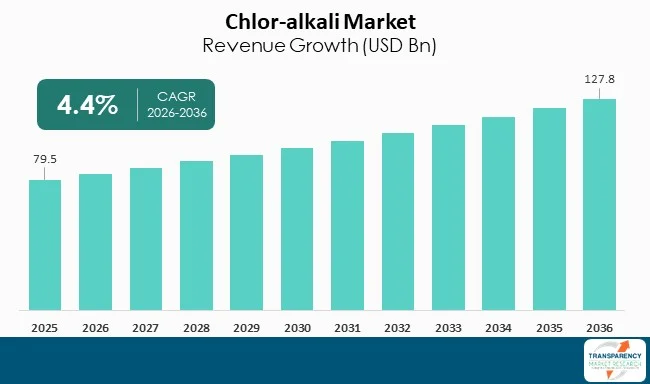
The chlor-alkali market continues to be a structurally essential industry. It is mainly propelled by the steady requirements of PVC, alumina refining, chemicals, and water treatment. Chlorine consumption is affected mainly by the construction and sanitation sectors whereas caustic soda serves as the main economic impetus since it is widely used in various industries. Nowadays, the change to membrane cell technology that is not only more energy-efficient but also more environmentally friendly is the main factor directing the industry's development.
Electricity, being the biggest component, is still leading the regional competitiveness with the result that production shifts are being made to low-cost energy areas. New government policies that phase-out mercury cells and encourage cleaner production have further prompted this change.
Greater attention is being paid by the suppliers to improving operational efficiency, producing high-purity chemicals, and offering products that are closely integrated with user needs. Besides these, sustainability efforts like using renewable energy sources for electrolysis and making use of hydrogen are coming to the forefront. On the other hand, strategies aimed at competition see an increased focus on vertical integration and cost leadership which are a departure from mainly producing commodities towards collaborating with energy-optimized and integrated business models.
Polyvinyl chloride (PVC) remain one of the main reasons for increased chlorine usage as they strongly influence the decisions related to the extent of use of already available capacity and the planning of new investments in the chlor-alkali industry. Traditionally, the lion's share of chlorine has been transformed into ethylene dichloride (EDC) and vinyl chloride monomer (VCM), the precursors of PVC. Actually, the dependence is such that whenever the demand for PVC goes up, there is always a corresponding increase in chlorine consumption, and the two are almost equal in size. Building and major development activities are the largest end-users of PVC. This is due in great part to the fact that besides being highly economical, PVC also has other very attractive qualities such as being very durable, capable of resisting rust, and can be easily converted into different forms like pipes connectors windows, electric cable covers, floorings, etc.
| Attribute | Detail |
|---|---|
| Chlor-alkali Market Drivers |
|
The chlor-alkali sector gets its raw materials from the electrochemical process of brine (saltwater) electrolysis, which generates three primary products: chlorine, caustic soda (sodium hydroxide), and hydrogen. Usually, in this process membrane cell technology is used, as it grants isolation of these products efficiently and at the same time reduces energy consumption and environmental effects. Chlorine is the major component for making PVC, disinfecting and water treating, on the other hand, caustic soda is used practically in alumina pulp paper, textile and chemical manufacturing. Hydrogen that is derived as a by-product has become a significant energy and refining sectors. Chlor-alkali products, for example, industrially manufactured chlor-alkali chemicals have extremely high reactive properties, caustic soda possesses high alkalinity, and chlorine is a strong disinfectant. It is a significant industrial chemical sector, whose market demand is mainly driven by infrastructure, manufacturing, and environmental legislations.
The market in this way will give chlor-alkali manufacturers a steady, big-volume demand source, especially in areas where there is a lot of alumina refining capacity like China, Australia, and India. More unlike chlorine, which is limited by logistics and tieins downstream, caustic soda is part of global trade flows, which allow producers to match their output with the areas of demand. This is the reason why alumina stands out as the balancing industry for chlor-alkali production levels, in particular, when there is a decrease in the demand for chlorine derivatives.
Long-term supply contracts between alumina refiners and chlor-alkali producers certainly provide nice visibility and pricing stability to the demand side. At the same time, this reliance makes the market vulnerable to cyclical risks coming from the fluctuations of aluminum prices, energy costs, and mining and refining activities being subjected to stricter environmental regulations. A greater push towards greener aluminum production could actually change the way that caustic soda is demanded as a result of refiners switching to more environmentally friendly technologies. The alumina industry basically remains the main driver that ensures demand is reliable and allows the chlor-alkali industry to do its strategic planning.
Polyvinyl chloride (PVC) is, by far, the most important driver of increased chlorine demand. Therefore, future chlor-alkali capacity utilization and new investments are largely influenced by the anticipated development of the PVC market. For a long time, chlorines have essentially been the primary material for manufacturing ethylene dichloride (EDC) and vinyl chloride monomer (VCM) that finally produce PVC. In fact, PVC industry is so heavily dependent on chlorine that any growth or expansion in PVC demand automatically brings about a corresponding increased demand for chlorine, and the volume of increased chlorine usage is almost the same as the raise in PVC demand. Construction and major refurbishment projects are the primary forms of consumption of PVC mainly because, apart from being fairly inexpensive, the latter has various attractive qualities like being extremely long-lasting, not susceptible to corrosion, and can be easily converted into such diverse forms as pipes connectors windows, electric cable coverings, floorings, etc.
One of the biggest reasons for the growing demand for PVC is the fast pace of urbanization, rising population, and the escalation in infrastructure spending among the emerging economies in the Asia-Pacific, the Middle East, and Africa. Development initiatives led by governments in the areas of housing, water, and sanitation infrastructure are also major factors in driving the increasing need for chlorine. The difficulty in transportation and storage of chlorine, unlike caustic soda, makes it of utmost importance for chlor-alkali manufacturers to either have downstream integration or be close to PVC production facilities. The focus has been putting in place integrated chlor-alkali and PVC complexes which can help to balance co-product economics and also improve margins.
The replacement of water infrastructure that has by now aged, as well as modernization of buildings, are examples of how the demand for renovation in developed markets is still providing support for the baseline consumption of PVC. The chlorine-PVC connection also means that this industry is subject to the cycles of the economy, because the construction sector, which is a big consumer of these products, is very sensitive to macroeconomic conditions, changes in interest rates and government spending cycles. Notwithstanding these threats, on a structural level, the future looks quite positive and PVC is expected to continue displacing traditional materials as it has performance and cost advantages. As a result, increased demand for PVC is going to play an important role in how the utilization rates of chlorine change as well as overall stability of the chlor-alkali market
| Attribute | Detail |
|---|---|
| Opportunity |
|
The move to sustainable and low carbon chlor-alkali production is a major growth opportunity in the changing global market. This is because more and more industries are putting their focus on the environment and reducing their carbon footprint. Conventional chlor-alkali production that mainly uses the mercury or diaphragm process have the drawbacks of high energy consumption and massive CO2 emissions. Companies going for membrane cell technology complemented by renewable energy get the benefit of significantly reducing their power consumption and greenhouse gas emissions. Besides tackling tough environmental rules in places like Europe and North America, this change also enables producers to get the reputation as environmentally concerned market leaders. Apart from bettering brand image, going green will help companies lure clients who care for the environment and will open the door to obtaining benefits like carbon credits and renewable energy subsidies along with government grants. This opens up chlor-alkali producers to the whole net-zero global theme, when needed for industries like paper, textiles, and water treatment, chemical sourcing is one of the areas that are going to be sustainable.
The commercial aspect of low-carbon chlor-alkali production opens up possibilities for differentiating the products and getting premium prices. Environmentally friendly caustic soda, chlorine, and PVC feedstocks which have less carbon emission can fetch higher prices in the markets that emphasize ESG compliance. Companies using energy-saving technologies like advanced electrolysis cells or hybrid renewable systems, will on the other hand, over time, be able to lower their production cost and thus increase their profit. Besides, chemical buyers and distributors worldwide are increasingly giving preference to those suppliers who have sustainability certificates that can be proved, thereby giving a market lead to those who implement these changes first. Partnerships with providers of renewable energy, technology licensors as well as industry consortia can very well work together towards the largescale implementation of low-carbon solutions making sure that production is not reduced. Hence, producing chlor-alkali in a sustainable way not only responds to the need of the environment but at the same time turns the producers into the more competitive ones in the market allowing them to satisfy the new market requirements effectively and enhancing their financial strength and competitiveness at the global level
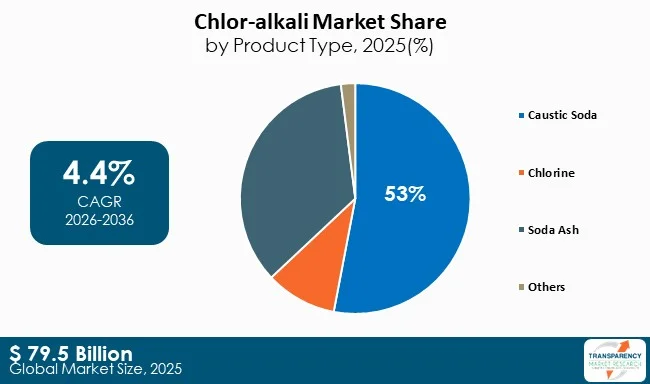
Caustic soda dominates the chlor-alkali market with the largest share as it is widely utilized in industries such as pulp & paper textile alumina refining, and chemicals. Its requirement is continuously increasing with the development in the sectors of construction, packaging, and water treatment. The growing production of alumina and the heightened demand for chemical intermediates have led to an increase in the consumption of caustic soda, thereby establishing it as the most dominant and fastest-growing segment of the chlor-alkali industry.
| Attribute | Detail |
|---|---|
| Leading Region |
|
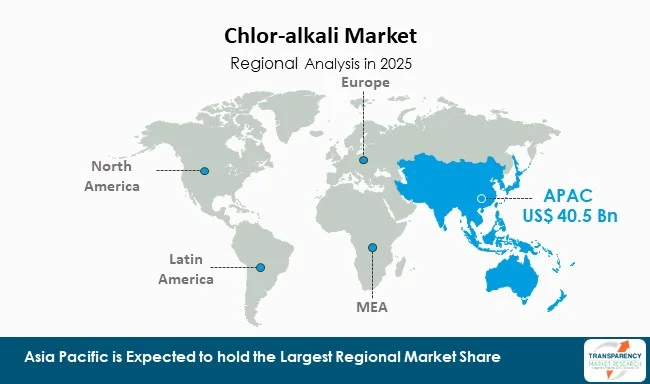
The Asia Pacific region is the leading chlor-alkali market due to rapid industrialization, increasing use of textiles, chemicals, and pulp & paper, and big alumina production. In North America and Europe, the development is driven by stable demand in water treatment and mature chemical sectors. On the other hand, the Middle East and Africa are prospering with the help of increasing infrastructure and petrochemical investments, while Latin America is gradually growing through widening industrial and water treatment applications.
Olin Corporation, Occidental Petroleum Corporation (OxyChem), Formosa Plastics Corporation, and Westlake Corporation are some of the top chlor-alkali producers who primarily supply chlorine, caustic soda, and hydrogen. Alongside, these companies manufacture various derivatives such as EDC VCM PVC, chlorinated solvents, and bleach, with the help of extensive vertical integration in the petrochemical and vinyl value chains which serve construction, water treatment, packaging, and industrial uses.
INEOS, Tata Chemicals Ltd., Solvay SA, and Tosoh Corporation play a major role in the consolidated Chlor-alkali market, with a competitive landscape governed by innovation and productivity.
Each of these players has been profiled in the Chlor-alkali market research report based on parameters such as company overview, financial overview, business strategies, product portfolio, business segments, and recent developments
| Attribute | Detail |
|---|---|
| Market Size Value in 2025 | USD 79.5 Billion |
| Market Forecast Value in 2036 | USD 127.8 Billion |
| Growth Rate (CAGR) | 4.4% |
| Forecast Period | 2026-2036 |
| Historical Data Available for | 2021-2024 |
| Quantitative Units | USD Billion for Value and tons for Volume |
| Chlor-alkali Market Analysis | It includes cross-segment analysis at the global as well as regional level. Furthermore, the qualitative analysis includes drivers, restraints, Carbon Fiber market opportunities, key trends, Porter’s Five Forces analysis, value chain analysis, and key trend analysis. |
| Competition Landscape |
|
| Format | Electronic (PDF) + Excel |
| Market Segmentation | By Product
|
| Regions Covered |
|
| Countries Covered |
|
| Companies Profiled |
|
| Customization Scope | Available upon request |
| Pricing | Available upon request |
The Chlor-alkali market stood at USD 79.5 Billion in 2025
The Chlor-alkali industry is expected to grow at a CAGR of 4.4% from 2026 to 2036
Robust Alumina Production Driving Sustained Caustic Soda Demand and Rising PVC Demand Fueling Chlorine Consumption in Construction and Infrastructure
Caustic soda held the largest share under Product Type segment in 2025
Asia pacific was the most lucrative region of the Chlor-alkali market in 2025
Occidental Petroleum Corporation, Olin Corporation, Tata Chemicals Ltd., Aditya Birla Chemicals, INEOS, Nobian, NIRMA, Formosa Plastics Corporation, Kemira, Tosoh Corporation, Hanwha Chemical Corporation, Vynova Group, DCM Shriram, and AGC Inc.
Table 1 Global Chlor-alkali Market Volume (Tons) Forecast, by Product, 2026 to 2036
Table 2 Global Chlor-alkali Market Value (US$ Billion) Forecast, by Product, 2026 to 2036
Table 3 Global Chlor-alkali Market Volume (Tons) Forecast, by Application, 2026 to 2036
Table 4 Global Chlor-alkali Market Value (US$ Billion) Forecast, by Application, 2026 to 2036
Table 5 Global Chlor-alkali Market Volume (Tons) Forecast, by Region, 2026 to 2036
Table 6 Global Chlor-alkali Market Value (US$ Billion) Forecast, by Region, 2026 to 2036
Table 7 North America Chlor-alkali Market Volume (Tons) Forecast, by Product, 2026 to 2036
Table 8 North America Chlor-alkali Market Value (US$ Billion) Forecast, by Product, 2026 to 2036
Table 9 North America Chlor-alkali Market Volume (Tons) Forecast, by Application, 2026 to 2036
Table 10 North America Chlor-alkali Market Value (US$ Billion) Forecast, by Application, 2026 to 2036
Table 11 North America Chlor-alkali Market Volume (Tons) Forecast, by Country, 2026 to 2036
Table 12 North America Chlor-alkali Market Value (US$ Billion) Forecast, by Country, 2026 to 2036
Table 13 USA Chlor-alkali Market Volume (Tons) Forecast, by Product, 2026 to 2036
Table 14 USA Chlor-alkali Market Value (US$ Billion) Forecast, by Product, 2026 to 2036
Table 15 USA Chlor-alkali Market Volume (Tons) Forecast, by Application, 2026 to 2036
Table 16 USA Chlor-alkali Market Value (US$ Billion) Forecast, by Application, 2026 to 2036
Table 17 Canada Chlor-alkali Market Volume (Tons) Forecast, by Product, 2026 to 2036
Table 18 Canada Chlor-alkali Market Value (US$ Billion) Forecast, by Product, 2026 to 2036
Table 19 Canada Chlor-alkali Market Volume (Tons) Forecast, by Application, 2026 to 2036
Table 20 Canada Chlor-alkali Market Value (US$ Billion) Forecast, by Application 2026 to 2036
Table 21 Europe Chlor-alkali Market Volume (Tons) Forecast, by Product, 2026 to 2036
Table 22 Europe Chlor-alkali Market Value (US$ Billion) Forecast, by Product, 2026 to 2036
Table 23 Europe Chlor-alkali Market Volume (Tons) Forecast, by Application, 2026 to 2036
Table 24 Europe Chlor-alkali Market Value (US$ Billion) Forecast, by Application 2026 to 2036
Table 25 Europe Chlor-alkali Market Volume (Tons) Forecast, by Country and Sub-region, 2026 to 2036
Table 26 Europe Chlor-alkali Market Value (US$ Billion) Forecast, by Country and Sub-region, 2026 to 2036
Table 27 Germany Chlor-alkali Market Volume (Tons) Forecast, by Product, 2026 to 2036
Table 28 Germany Chlor-alkali Market Value (US$ Billion) Forecast, by Product, 2026 to 2036
Table 29 Germany Chlor-alkali Market Volume (Tons) Forecast, by Application, 2026 to 2036
Table 30 Germany Chlor-alkali Market Value (US$ Billion) Forecast, by Application 2026 to 2036
Table 31 France Chlor-alkali Market Volume (Tons) Forecast, by Product, 2026 to 2036
Table 32 France Chlor-alkali Market Value (US$ Billion) Forecast, by Product, 2026 to 2036
Table 33 France Chlor-alkali Market Volume (Tons) Forecast, by Application, 2026 to 2036
Table 34 France Chlor-alkali Market Value (US$ Billion) Forecast, by Application 2026 to 2036
Table 35 UK Chlor-alkali Market Volume (Tons) Forecast, by Product, 2026 to 2036
Table 36 UK Chlor-alkali Market Value (US$ Billion) Forecast, by Product, 2026 to 2036
Table 37 UK Chlor-alkali Market Volume (Tons) Forecast, by Application, 2026 to 2036
Table 38 UK Chlor-alkali Market Value (US$ Billion) Forecast, by Application 2026 to 2036
Table 39 Italy Chlor-alkali Market Volume (Tons) Forecast, by Product, 2026 to 2036
Table 40 Italy Chlor-alkali Market Value (US$ Billion) Forecast, by Product, 2026 to 2036
Table 41 Italy Chlor-alkali Market Volume (Tons) Forecast, by Application, 2026 to 2036
Table 42 Italy Chlor-alkali Market Value (US$ Billion) Forecast, by Application 2026 to 2036
Table 43 Spain Chlor-alkali Market Volume (Tons) Forecast, by Product, 2026 to 2036
Table 44 Spain Chlor-alkali Market Value (US$ Billion) Forecast, by Product, 2026 to 2036
Table 45 Spain Chlor-alkali Market Volume (Tons) Forecast, by Application, 2026 to 2036
Table 46 Spain Chlor-alkali Market Value (US$ Billion) Forecast, by Application 2026 to 2036
Table 47 Russia & CIS Chlor-alkali Market Volume (Tons) Forecast, by Product, 2026 to 2036
Table 48 Russia & CIS Chlor-alkali Market Value (US$ Billion) Forecast, by Product, 2026 to 2036
Table 49 Russia & CIS Chlor-alkali Market Volume (Tons) Forecast, by Application, 2026 to 2036
Table 50 Russia & CIS Chlor-alkali Market Value (US$ Billion) Forecast, by Application 2026 to 2036
Table 51 Rest of Europe Chlor-alkali Market Volume (Tons) Forecast, by Product, 2026 to 2036
Table 52 Rest of Europe Chlor-alkali Market Value (US$ Billion) Forecast, by Product, 2026 to 2036
Table 53 Rest of Europe Chlor-alkali Market Volume (Tons) Forecast, by Application, 2026 to 2036
Table 54 Rest of Europe Chlor-alkali Market Value (US$ Billion) Forecast, by Application 2026 to 2036
Table 55 Asia Pacific Chlor-alkali Market Volume (Tons) Forecast, by Product, 2026 to 2036
Table 56 Asia Pacific Chlor-alkali Market Value (US$ Billion) Forecast, by Product, 2026 to 2036
Table 57 Asia Pacific Chlor-alkali Market Volume (Tons) Forecast, by Application, 2026 to 2036
Table 58 Asia Pacific Chlor-alkali Market Value (US$ Billion) Forecast, by Application 2026 to 2036
Table 59 Asia Pacific Chlor-alkali Market Volume (Tons) Forecast, by Country and Sub-region, 2026 to 2036
Table 60 Asia Pacific Chlor-alkali Market Value (US$ Billion) Forecast, by Country and Sub-region, 2026 to 2036
Table 61 China Chlor-alkali Market Volume (Tons) Forecast, by Product, 2026 to 2036
Table 62 China Chlor-alkali Market Value (US$ Billion) Forecast, by Product 2026 to 2036
Table 63 China Chlor-alkali Market Volume (Tons) Forecast, by Application, 2026 to 2036
Table 64 China Chlor-alkali Market Value (US$ Billion) Forecast, by Application 2026 to 2036
Table 65 Japan Chlor-alkali Market Volume (Tons) Forecast, by Product, 2026 to 2036
Table 66 Japan Chlor-alkali Market Value (US$ Billion) Forecast, by Product, 2026 to 2036
Table 67 Japan Chlor-alkali Market Volume (Tons) Forecast, by Application, 2026 to 2036
Table 68 Japan Chlor-alkali Market Value (US$ Billion) Forecast, by Application 2026 to 2036
Table 69 India Chlor-alkali Market Volume (Tons) Forecast, by Product, 2026 to 2036
Table 70 India Chlor-alkali Market Value (US$ Billion) Forecast, by Product, 2026 to 2036
Table 71 India Chlor-alkali Market Volume (Tons) Forecast, by Application, 2026 to 2036
Table 72 India Chlor-alkali Market Value (US$ Billion) Forecast, by Application 2026 to 2036
Table 73 ASEAN Chlor-alkali Market Volume (Tons) Forecast, by Product, 2026 to 2036
Table 74 ASEAN Chlor-alkali Market Value (US$ Billion) Forecast, by Product, 2026 to 2036
Table 75 ASEAN Chlor-alkali Market Volume (Tons) Forecast, by Application, 2026 to 2036
Table 76 ASEAN Chlor-alkali Market Value (US$ Billion) Forecast, by Application 2026 to 2036
Table 77 Rest of Asia Pacific Chlor-alkali Market Volume (Tons) Forecast, by Product, 2026 to 2036
Table 78 Rest of Asia Pacific Chlor-alkali Market Value (US$ Billion) Forecast, by Product, 2026 to 2036
Table 79 Rest of Asia Pacific Chlor-alkali Market Volume (Tons) Forecast, by Application, 2026 to 2036
Table 80 Rest of Asia Pacific Chlor-alkali Market Value (US$ Billion) Forecast, by Application 2026 to 2036
Table 81 Latin America Chlor-alkali Market Volume (Tons) Forecast, by Product, 2026 to 2036
Table 82 Latin America Chlor-alkali Market Value (US$ Billion) Forecast, by Product, 2026 to 2036
Table 83 Latin America Chlor-alkali Market Volume (Tons) Forecast, by Application, 2026 to 2036
Table 84 Latin America Chlor-alkali Market Value (US$ Billion) Forecast, by Application 2026 to 2036
Table 85 Latin America Chlor-alkali Market Volume (Tons) Forecast, by Country and Sub-region, 2026 to 2036
Table 86 Latin America Chlor-alkali Market Value (US$ Billion) Forecast, by Country and Sub-region, 2026 to 2036
Table 87 Brazil Chlor-alkali Market Volume (Tons) Forecast, by Product, 2026 to 2036
Table 88 Brazil Chlor-alkali Market Value (US$ Billion) Forecast, by Product, 2026 to 2036
Table 89 Brazil Chlor-alkali Market Volume (Tons) Forecast, by Application, 2026 to 2036
Table 90 Brazil Chlor-alkali Market Value (US$ Billion) Forecast, by Application 2026 to 2036
Table 91 Mexico Chlor-alkali Market Volume (Tons) Forecast, by Product, 2026 to 2036
Table 92 Mexico Chlor-alkali Market Value (US$ Billion) Forecast, by Product, 2026 to 2036
Table 93 Mexico Chlor-alkali Market Volume (Tons) Forecast, by Application, 2026 to 2036
Table 94 Mexico Chlor-alkali Market Value (US$ Billion) Forecast, by Application 2026 to 2036
Table 95 Rest of Latin America Chlor-alkali Market Volume (Tons) Forecast, by Product, 2026 to 2036
Table 96 Rest of Latin America Chlor-alkali Market Value (US$ Billion) Forecast, by Product, 2026 to 2036
Table 97 Rest of Latin America Chlor-alkali Market Volume (Tons) Forecast, by Application, 2026 to 2036
Table 98 Rest of Latin America Chlor-alkali Market Value (US$ Billion) Forecast, by Application 2026 to 2036
Table 99 Middle East & Africa Chlor-alkali Market Volume (Tons) Forecast, by Product, 2026 to 2036
Table 100 Middle East & Africa Chlor-alkali Market Value (US$ Billion) Forecast, by Product, 2026 to 2036
Table 101 v Chlor-alkali Market Volume (Tons) Forecast, by Application, 2026 to 2036
Table 102 Middle East & Africa Chlor-alkali Market Value (US$ Billion) Forecast, by Application 2026 to 2036
Table 103 Middle East & Africa Chlor-alkali Market Volume (Tons) Forecast, by Country and Sub-region, 2026 to 2036
Table 104 Middle East & Africa Chlor-alkali Market Value (US$ Billion) Forecast, by Country and Sub-region, 2026 to 2036
Table 105 GCC Chlor-alkali Market Volume (Tons) Forecast, by Product, 2026 to 2036
Table 106 GCC Chlor-alkali Market Value (US$ Billion) Forecast, by Product, 2026 to 2036
Table 107 GCC Chlor-alkali Market Volume (Tons) Forecast, by Application, 2026 to 2036
Table 108 GCC Chlor-alkali Market Value (US$ Billion) Forecast, by Application 2026 to 2036
Table 109 South Africa Chlor-alkali Market Volume (Tons) Forecast, by Product, 2026 to 2036
Table 110 South Africa Chlor-alkali Market Value (US$ Billion) Forecast, by Product, 2026 to 2036
Table 111 South Africa Chlor-alkali Market Volume (Tons) Forecast, by Application, 2026 to 2036
Table 112 South Africa Chlor-alkali Market Value (US$ Billion) Forecast, by Application 2026 to 2036
Table 113 Rest of Middle East & Africa Chlor-alkali Market Volume (Tons) Forecast, by Product, 2026 to 2036
Table 114 Rest of Middle East & Africa Chlor-alkali Market Value (US$ Billion) Forecast, by Product, 2026 to 2036
Table 115 Rest of Middle East & Africa Chlor-alkali Market Volume (Tons) Forecast, by Application, 2026 to 2036
Table 116 Rest of Middle East & Africa Chlor-alkali Market Value (US$ Billion) Forecast, by Application 2026 to 2036
Figure 1 Global Chlor-alkali Market Volume Share Analysis, by Product, 2025, 2027, and 2036
Figure 2 Global Chlor-alkali Market Attractiveness, by Product
Figure 3 Global Chlor-alkali Market Volume Share Analysis, by Application, 2025, 2027, and 2036
Figure 4 Global Chlor-alkali Market Attractiveness, by Application
Figure 5 Global Chlor-alkali Market Volume Share Analysis, by Region, 2025, 2027, and 2036
Figure 6 Global Chlor-alkali Market Attractiveness, by Region
Figure 7 North America Chlor-alkali Market Volume Share Analysis, by Product, 2025, 2027, and 2036
Figure 8 North America Chlor-alkali Market Attractiveness, by Product
Figure 9 North America Chlor-alkali Market Attractiveness, by Product
Figure 10 North America Chlor-alkali Market Volume Share Analysis, by Application, 2025, 2027, and 2036
Figure 11 North America Chlor-alkali Market Attractiveness, by Application
Figure 12 North America Chlor-alkali Market Attractiveness, by Country and Sub-region
Figure 13 Europe Chlor-alkali Market Volume Share Analysis, by Product, 2025, 2027, and 2036
Figure 14 Europe Chlor-alkali Market Attractiveness, by Product
Figure 15 Europe Chlor-alkali Market Volume Share Analysis, by Application, 2025, 2027, and 2036
Figure 16 Europe Chlor-alkali Market Attractiveness, by Application
Figure 17 Europe Chlor-alkali Market Volume Share Analysis, by Country and Sub-region, 2025, 2027, and 2036
Figure 18 Europe Chlor-alkali Market Attractiveness, by Country and Sub-region
Figure 19 Asia Pacific Chlor-alkali Market Volume Share Analysis, by Product, 2025, 2027, and 2036
Figure 20 Asia Pacific Chlor-alkali Market Attractiveness, by Product
Figure 21 Asia Pacific Chlor-alkali Market Volume Share Analysis, by Application, 2025, 2027, and 2036
Figure 22 Asia Pacific Chlor-alkali Market Attractiveness, by Application
Figure 23 Asia Pacific Chlor-alkali Market Volume Share Analysis, by Country and Sub-region, 2025, 2027, and 2036
Figure 24 Asia Pacific Chlor-alkali Market Attractiveness, by Country and Sub-region
Figure 25 Latin America Chlor-alkali Market Volume Share Analysis, by Product, 2025, 2027, and 2036
Figure 26 Latin America Chlor-alkali Market Attractiveness, by Product
Figure 27 Latin America Chlor-alkali Market Volume Share Analysis, by Application, 2025, 2027, and 2036
Figure 28 Latin America Chlor-alkali Market Attractiveness, by Application
Figure 29 Latin America Chlor-alkali Market Volume Share Analysis, by Country and Sub-region, 2025, 2027, and 2036
Figure 30 Latin America Chlor-alkali Market Attractiveness, by Country and Sub-region
Figure 31 Middle East & Africa Chlor-alkali Market Volume Share Analysis, by Product, 2025, 2027, and 2036
Figure 32 Middle East & Africa Chlor-alkali Market Attractiveness, by Product
Figure 33 Middle East & Africa Chlor-alkali Market Volume Share Analysis, by Application, 2025, 2027, and 2036
Figure 34 Middle East & Africa Chlor-alkali Market Attractiveness, by Application
Figure 35 Middle East & Africa Chlor-alkali Market Volume Share Analysis, by Country and Sub-region, 2025, 2027, and 2036
Figure 36 Middle East & Africa Chlor-alkali Market Attractiveness, by Country and Sub-region
Copyright © Transparency Market Research, Inc. All Rights reserved
Trust Online


Chlor-alkali Market
