

Reports
Reports
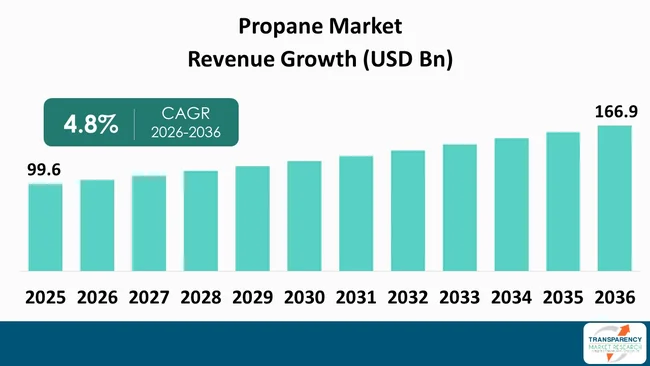
The global propane market size was valued at US$ 99.6 Billion in 2025 and is projected to reach US$ 166.9 Billion by 2036, expanding at a CAGR of 4.8% from 2026 to 2036. The market is expected to be driven by structural growth in natural gas liquids supply and expanding role of propane as a petrochemical feedstock.
The propane market is witnessing steadiness with the growth of end-use demand on the supply side and the supply-side abundance. Increasing shale gas extraction and making the best of the gas from associating the oil field, natural gas production is the main source of the supply of propane as a by-product, which makes a steady supply and competitive pricing possible. The usage is still high in the residential as well as commercial sectors for heating, cooking, and water heating, especially in rural and off, grid places where there is inadequate supply of pipeline gas or access to electricity.
Propane is also used in the industrial sector for metal cutting, drying, and powering forklifts and it is in general considered as a dependable source of energy in the manufacturing sector.
One of the growth drivers is the increased use of propane as a petrochemical feedstock where the conversion of propane into propylene by propane dehydrogenation (PDH) is the basis of the production of plastics and chemicals. The supply chain starts with the recovery that takes place during gas processing and refining and this is followed by fractionation, storage, and distribution through bulk tanks, cylinders, pipelines, and marine transport.
The market players strive to develop their business by making investments in gas processing plants, PDH plants, export terminals, and storage facilities. The use of long-term supply contracts, placing propane as a cleaner, burning substitute for coal and fuel oil, and logistics optimization are additional measures that help to increase the sales of the product.
Propane gas is widely used as a clean-burning fuel for space heating, cooking, and water heating in commercial and residential establishments, especially in areas where there is no access to natural gas pipelines.
In the industrial settings, it is used for supporting metal cutting, drying, and forklift operations owing to its portability and high energy efficiency. Propane is also a significant petrochemical feedstock, which is further processed into propylene through propane dehydrogenation technology for producing plastics and chemicals.
| Attribute | Detail |
|---|---|
| Drivers |
|
The propane market has directly benefited from the continuous growth in natural gas production, as propane is extracted as a by-product of gas processing and crude oil refining. The growth in shale gas production and associated gas production from oil fields has altered the fundamentals of NGLs production, thereby ensuring a stable propane supply base. This has helped stabilize the supply chain and made propane a stable energy source for various end-use industries.
From a technical perspective, propane is extracted as a by-product of natural gas processing by fractionation, along with ethane, butane, and the other NGLs. Upgrades in gas processing plants, fractionators, and storage facilities have enhanced the efficiency and capacity utilization of propane recovery. With the growing overall capacity in the upstream and midstream industries, the propane supply base will increase without the need for specific production, thereby ensuring the positive cost economics for the downstream industries.
The major players in the industry are enhancing this factor by investing in gas gathering infrastructure, fractionation capacity, and logistics networks. Increased pipelines, storage capacity, and export facilities enable easy distribution of excess propane to demand markets. These measures collectively ensure stable growth in the propane market.
One of the most influential demand-side factors in the propane market is the increasing usage of propane as a petrochemical feedstock, particularly for propylene production. Propane dehydrogenation (PDH) technology is used for producing propylene from propane, which is a major building block for the production of polypropylene plastics, packaging materials, consumer products, and automotive parts. The growing demand for plastics globally and the shift toward non-traditional naphtha-based feedstock have elevated the vitality of propane as a petrochemical feedstock.
The propane dehydrogenation process also has some advantages, which include flexibility in the type of feedstock, economic viability in propane-rich regions, and the ability to work with lighter feedstock concepts. This has resulted in an increase in the use of propane as a chemical feedstock, especially in areas where NGLs are in abundance. With the petrochemical market participants looking to unlock the highest possible value and less dependency on crude oil prices, propane chains are becoming increasingly attractive.
To take advantage of this new trend, market participants are investing in new PDH capacity, expansion, and comprehensive propane supply agreements. The long-term off-take agreement, integration, and development around the PDH hubs are ensuring that demand and prices are stabilized. This new trend is further cementing the position of propane beyond its current status as a fuel and making it a material.
| Attribute | Detail |
|---|---|
| Opportunity |
|
The expansion of PDH capacity presents a strong opportunity for the propane market, especially in emerging economies with growing demand for plastics and chemicals. Rapid urbanization, infrastructure development, and manufacturing of consumer goods are driving propylene consumption, encouraging petrochemical producers to invest in propane-based feedstock routes. The PDH plants offer greater feedstock flexibility and reduced dependency on crude-linked naphtha, thereby improving margin stability. Regions with access to competitively priced propane imports are increasingly attractive for various PDH investments. As governments support domestic chemical production and industrial self-reliance, novel PDH projects are expected to generate stable, long-term propane demand, thereby strengthening its role as a strategic industrial raw material rather than only a fuel.
| Attribute | Detail |
|---|---|
| Leading Region |
|
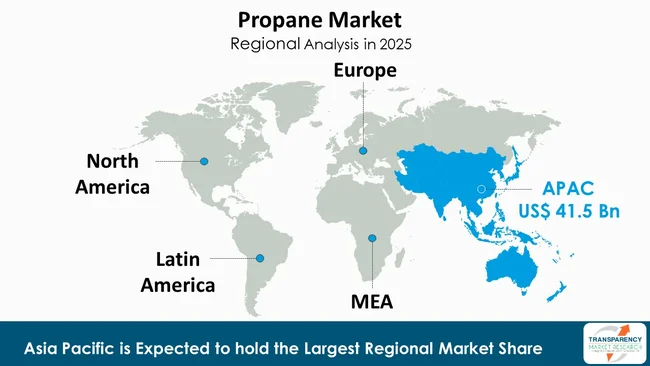
In terms of value, Asia Pacific held the major share of 41.7% of the global market in 2025. It is one of the fastest growing markets for propane. The market in the region is estimated to grow at a CAGR of 4.4% during the forecast period. Increase in demand for cooking gas in Asia Pacific is a key factor driving the propane market in the region. Rise in population and implementation of cooking gas subsidy in countries such as India are key factors propelling the demand for propane in Asia Pacific. Increase in demand for automotive vehicles is also fueling the demand for propane in the region.
Europe is one of the leading regions of the global propane market owing to the presence of well-established economies and rise in commercial and industrial usage of propane in the region. North America is a mature market for propane. It one of the leading producers of propane gas across the world. Growth in usage of heating appliances and burning stoves is a key factor propelling the market in North America.
The global propane market is consolidated, with a few number of large-scale vendors controlling a majority of the share. Most of the firms are spending significantly on comprehensive research and development activities, primarily to develop their infrastructure and operations. Expansion of product portfolios and mergers and acquisitions are major strategies adopted by key players. AmeriGas Propane, Inc., DCC Plc, China Petroleum & Chemical Corporation (SINOPEC), Ferrell Gas, Saudi Arabian Oil co., Gazprom, Air Liquid, GAIL (India) Limited, Indian oil corporation Ltd, Suburban Propane, L.P., Lykins Energy solutions, Marsh L.P. Gas Co. Inc., Sparlings, and Thompson Gas are the prominent entities operating in the market.
Each of these players has been profiled in the propane market research report based on parameters such as company overview, financial overview, business strategies, product portfolio, business segments, and recent developments
| Attribute | Detail |
|---|---|
| Market Size Value in 2025 | US$ 99.6 Bn |
| Market Forecast Value in 2036 | US$ 166.9 Bn |
| Growth Rate (CAGR) | 4.8% |
| Forecast Period | 2026-2036 |
| Historical Data Available for | 2021-2025 |
| Quantitative Units | US$ Bn for Value and Kilo Tons for Volume |
| Market Analysis | It includes cross-segment analysis at the global as well as regional level. Furthermore, the qualitative analysis includes drivers, restraints, propane market opportunities, key trends, Porter’s Five Forces analysis, value chain analysis, and key trend analysis. |
| Competition Landscape |
|
| Format | Electronic (PDF) + Excel |
| Market Segmentation | Grade
|
| Regions Covered |
|
| Countries Covered |
|
| Companies Profiled |
|
| Customization Scope | Available upon request |
| Pricing | Available upon request |
The propane market was valued at US$ 99.6 Bn in 2025
The propane industry is expected to grow at a CAGR of 4.8% from 2026 to 2036
Structural growth in natural gas liquids (NGL) supply and expanding role of propane as a petrochemical feedstock.
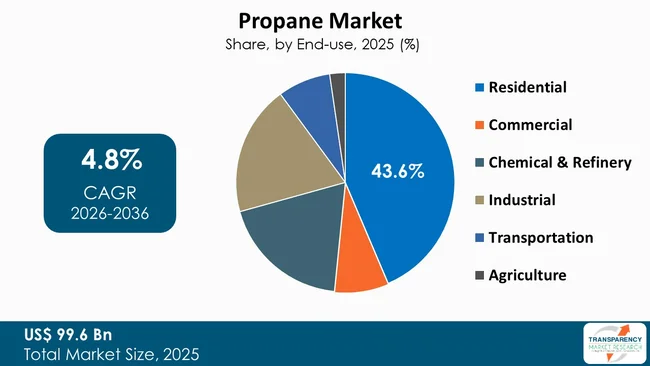
Residential was the largest end-use segment and its value is anticipated to grow at a CAGR of 5.2% during the forecast period
Asia Pacific was the most lucrative region in 2025
AmeriGas Propane, Inc., DCC Plc, China Petroleum & Chemical Proportion (SINOPEC), Ferrellgas, Saudi Arabian Oil Co., Gazprom, Air Liquide, GAIL (India) Limited, India Oil Corporation ltd, Suburban Propane, L.P., Lykins Energy Solutions, Marsh L.P. Gas Co. Inc., Sparlings, and Thompson Gas are the major players in the propane market
Table 1 Global Propane Market Volume (Kilo Tons) Forecast, by Grade, 2026 to 2036
Table 2 Global Propane Market Value (US$ Bn) Forecast, by Grade, 2026 to 2036
Table 3 Global Propane Market Volume (Kilo Tons) Forecast, by End-use, 2026 to 2036
Table 4 Global Propane Market Value (US$ Bn) Forecast, by End-use, 2026 to 2036
Table 5 Global Propane Market Volume (Kilo Tons) Forecast, by Region, 2026 to 2036
Table 6 Global Propane Market Value (US$ Bn) Forecast, by Region, 2026 to 2036
Table 7 North America Propane Market Volume (Kilo Tons) Forecast, by Grade, 2026 to 2036
Table 8 North America Propane Market Value (US$ Bn) Forecast, by Grade, 2026 to 2036
Table 9 North America Propane Market Volume (Kilo Tons) Forecast, by End-use, 2026 to 2036
Table 10 North America Propane Market Value (US$ Bn) Forecast, by End-use, 2026 to 2036
Table 11 North America Propane Market Volume (Kilo Tons) Forecast, by Country, 2026 to 2036
Table 12 North America Propane Market Value (US$ Bn) Forecast, by Country, 2026 to 2036
Table 13 U.S. Propane Market Volume (Kilo Tons) Forecast, by Grade, 2026 to 2036
Table 14 U.S. Propane Market Value (US$ Bn) Forecast, by Grade, 2026 to 2036
Table 15 U.S. Propane Market Volume (Kilo Tons) Forecast, by End-use, 2026 to 2036
Table 16 U.S. Propane Market Value (US$ Bn) Forecast, by End-use, 2026 to 2036
Table 17 Canada Propane Market Volume (Kilo Tons) Forecast, by Grade, 2026 to 2036
Table 18 Canada Propane Market Value (US$ Bn) Forecast, by Grade, 2026 to 2036
Table 19 Canada Propane Market Volume (Kilo Tons) Forecast, by End-use, 2026 to 2036
Table 20 Canada Propane Market Value (US$ Bn) Forecast, by End-use, 2026 to 2036
Table 21 Europe Propane Market Volume (Kilo Tons) Forecast, by Grade, 2026 to 2036
Table 22 Europe Propane Market Value (US$ Bn) Forecast, by Grade, 2026 to 2036
Table 23 Europe Propane Market Volume (Kilo Tons) Forecast, by End-use, 2026 to 2036
Table 24 Europe Propane Market Value (US$ Bn) Forecast, by End-use, 2026 to 2036
Table 25 Europe Propane Market Volume (Kilo Tons) Forecast, by Country and Sub-region, 2026 to 2036
Table 26 Europe Propane Market Value (US$ Bn) Forecast, by Country and Sub-region, 2026 to 2036
Table 27 Germany Propane Market Volume (Kilo Tons) Forecast, by Grade, 2026 to 2036
Table 28 Germany Propane Market Value (US$ Bn) Forecast, by Grade, 2026 to 2036
Table 29 Germany Propane Market Volume (Kilo Tons) Forecast, by End-use, 2026 to 2036
Table 30 Germany Propane Market Value (US$ Bn) Forecast, by End-use, 2026 to 2036
Table 31 U.K. Propane Market Volume (Kilo Tons) Forecast, by Grade, 2026 to 2036
Table 32 U.K. Propane Market Value (US$ Bn) Forecast, by Grade, 2026 to 2036
Table 33 U.K. Propane Market Volume (Kilo Tons) Forecast, by End-use, 2026 to 2036
Table 34 U.K. Propane Market Value (US$ Bn) Forecast, by End-use, 2026 to 2036
Table 35 France Propane Market Volume (Kilo Tons) Forecast, by Grade, 2026 to 2036
Table 36 France Propane Market Value (US$ Bn) Forecast, by Grade, 2026 to 2036
Table 37 France Propane Market Volume (Kilo Tons) Forecast, by End-use, 2026 to 2036
Table 38 France Propane Market Value (US$ Bn) Forecast, by End-use, 2026 to 2036
Table 39 Spain Propane Market Volume (Kilo Tons) Forecast, by Grade, 2026 to 2036
Table 40 Spain Propane Market Value (US$ Bn) Forecast, by Grade, 2026 to 2036
Table 41 Spain Propane Market Volume (Kilo Tons) Forecast, by End-use, 2026 to 2036
Table 42 Spain Propane Market Value (US$ Bn) Forecast, by End-use, 2026 to 2036
Table 43 Italy Propane Market Volume (Kilo Tons) Forecast, by Grade, 2026 to 2036
Table 44 Italy Propane Market Value (US$ Bn) Forecast, by Grade, 2026 to 2036
Table 45 Italy Propane Market Volume (Kilo Tons) Forecast, by End-use, 2026 to 2036
Table 46 Italy Propane Market Value (US$ Bn) Forecast, by End-use, 2026 to 2036
Table 47 Russia & CIS Propane Market Volume (Kilo Tons) Forecast, by Grade, 2026 to 2036
Table 48 Russia & CIS Propane Market Value (US$ Bn) Forecast, by Grade, 2026 to 2036
Table 49 Russia & CIS Propane Market Volume (Kilo Tons) Forecast, by End-use, 2026 to 2036
Table 50 Russia & CIS Propane Market Value (US$ Bn) Forecast, by End-use, 2026 to 2036
Table 51 Rest of Europe Propane Market Volume (Kilo Tons) Forecast, by Grade, 2026 to 2036
Table 52 Rest of Europe Propane Market Value (US$ Bn) Forecast, by Grade, 2026 to 2036
Table 53 Rest of Europe Propane Market Volume (Kilo Tons) Forecast, by End-use, 2026 to 2036
Table 54 Rest of Europe Propane Market Value (US$ Bn) Forecast, by End-use, 2026 to 2036
Table 55 Asia Pacific Propane Market Volume (Kilo Tons) Forecast, by Grade, 2026 to 2036
Table 56 Asia Pacific Propane Market Value (US$ Bn) Forecast, by Grade, 2026 to 2036
Table 57 Asia Pacific Propane Market Volume (Kilo Tons) Forecast, by End-use, 2026 to 2036
Table 58 Asia Pacific Propane Market Value (US$ Bn) Forecast, by End-use, 2026 to 2036
Table 59 Asia Pacific Propane Market Volume (Kilo Tons) Forecast, by Country and Sub-region, 2026 to 2036
Table 60 Asia Pacific Propane Market Value (US$ Bn) Forecast, by Country and Sub-region, 2026 to 2036
Table 61 China Propane Market Volume (Kilo Tons) Forecast, by Grade, 2026 to 2036
Table 62 China Propane Market Value (US$ Bn) Forecast, by Grade 2026 to 2036
Table 63 China Propane Market Volume (Kilo Tons) Forecast, by End-use, 2026 to 2036
Table 64 China Propane Market Value (US$ Bn) Forecast, by End-use, 2026 to 2036
Table 65 India Propane Market Volume (Kilo Tons) Forecast, by Grade, 2026 to 2036
Table 66 India Propane Market Value (US$ Bn) Forecast, by Grade, 2026 to 2036
Table 67 India Propane Market Volume (Kilo Tons) Forecast, by End-use, 2026 to 2036
Table 68 India Propane Market Value (US$ Bn) Forecast, by End-use, 2026 to 2036
Table 69 Japan Propane Market Volume (Kilo Tons) Forecast, by Grade, 2026 to 2036
Table 70 Japan Propane Market Value (US$ Bn) Forecast, by Grade, 2026 to 2036
Table 71 Japan Propane Market Volume (Kilo Tons) Forecast, by End-use, 2026 to 2036
Table 72 Japan Propane Market Value (US$ Bn) Forecast, by End-use, 2026 to 2036
Table 73 ASEAN Propane Market Volume (Kilo Tons) Forecast, by Grade, 2026 to 2036
Table 74 ASEAN Propane Market Value (US$ Bn) Forecast, by Grade, 2026 to 2036
Table 75 ASEAN Propane Market Volume (Kilo Tons) Forecast, by End-use, 2026 to 2036
Table 76 ASEAN Propane Market Value (US$ Bn) Forecast, by End-use, 2026 to 2036
Table 77 Rest of Asia Pacific Propane Market Volume (Kilo Tons) Forecast, by Grade, 2026 to 2036
Table 78 Rest of Asia Pacific Propane Market Value (US$ Bn) Forecast, by Grade, 2026 to 2036
Table 79 Rest of Asia Pacific Propane Market Volume (Kilo Tons) Forecast, by End-use, 2026 to 2036
Table 80 Rest of Asia Pacific Propane Market Value (US$ Bn) Forecast, by End-use, 2026 to 2036
Table 81 Latin America Propane Market Volume (Kilo Tons) Forecast, by Grade, 2026 to 2036
Table 82 Latin America Propane Market Value (US$ Bn) Forecast, by Grade, 2026 to 2036
Table 83 Latin America Propane Market Volume (Kilo Tons) Forecast, by End-use, 2026 to 2036
Table 84 Latin America Propane Market Value (US$ Bn) Forecast, by End-use, 2026 to 2036
Table 85 Latin America Propane Market Volume (Kilo Tons) Forecast, by Country and Sub-region, 2026 to 2036
Table 86 Latin America Propane Market Value (US$ Bn) Forecast, by Country and Sub-region, 2026 to 2036
Table 87 Brazil Propane Market Volume (Kilo Tons) Forecast, by Grade, 2026 to 2036
Table 88 Brazil Propane Market Value (US$ Bn) Forecast, by Grade, 2026 to 2036
Table 89 Brazil Propane Market Volume (Kilo Tons) Forecast, by End-use, 2026 to 2036
Table 90 Brazil Propane Market Value (US$ Bn) Forecast, by End-use, 2026 to 2036
Table 91 Mexico Propane Market Volume (Kilo Tons) Forecast, by Grade, 2026 to 2036
Table 92 Mexico Propane Market Value (US$ Bn) Forecast, by Grade, 2026 to 2036
Table 93 Mexico Propane Market Volume (Kilo Tons) Forecast, by End-use, 2026 to 2036
Table 94 Mexico Propane Market Value (US$ Bn) Forecast, by End-use, 2026 to 2036
Table 95 Rest of Latin America Propane Market Volume (Kilo Tons) Forecast, by Grade, 2026 to 2036
Table 96 Rest of Latin America Propane Market Value (US$ Bn) Forecast, by Grade, 2026 to 2036
Table 97 Rest of Latin America Propane Market Volume (Kilo Tons) Forecast, by End-use, 2026 to 2036
Table 98 Rest of Latin America Propane Market Value (US$ Bn) Forecast, by End-use, 2026 to 2036
Table 99 Middle East & Africa Propane Market Volume (Kilo Tons) Forecast, by Grade, 2026 to 2036
Table 100 Middle East & Africa Propane Market Value (US$ Bn) Forecast, by Grade, 2026 to 2036
Table 101 Middle East & Africa Propane Market Volume (Kilo Tons) Forecast, by End-use, 2026 to 2036
Table 102 Middle East & Africa Propane Market Value (US$ Bn) Forecast, by End-use, 2026 to 2036
Table 103 Middle East & Africa Propane Market Volume (Kilo Tons) Forecast, by Country and Sub-region, 2026 to 2036
Table 104 Middle East & Africa Propane Market Value (US$ Bn) Forecast, by Country and Sub-region, 2026 to 2036
Table 105 GCC Propane Market Volume (Kilo Tons) Forecast, by Grade, 2026 to 2036
Table 106 GCC Propane Market Value (US$ Bn) Forecast, by Grade, 2026 to 2036
Table 107 GCC Propane Market Volume (Kilo Tons) Forecast, by End-use, 2026 to 2036
Table 108 GCC Propane Market Value (US$ Bn) Forecast, by End-use, 2026 to 2036
Table 109 South Africa Propane Market Volume (Kilo Tons) Forecast, by Grade, 2026 to 2036
Table 110 South Africa Propane Market Value (US$ Bn) Forecast, by Grade, 2026 to 2036
Table 111 South Africa Propane Market Volume (Kilo Tons) Forecast, by End-use, 2026 to 2036
Table 112 South Africa Propane Market Value (US$ Bn) Forecast, by End-use, 2026 to 2036
Table 113 Rest of Middle East & Africa Propane Market Volume (Kilo Tons) Forecast, by Grade, 2026 to 2036
Table 114 Rest of Middle East & Africa Propane Market Value (US$ Bn) Forecast, by Grade, 2026 to 2036
Table 115 Rest of Middle East & Africa Propane Market Volume (Kilo Tons) Forecast, by End-use, 2026 to 2036
Table 116 Rest of Middle East & Africa Propane Market Value (US$ Bn) Forecast, by End-use, 2026 to 2036
Figure 1 Global Propane Market Volume Share Analysis, by Grade, 2025, 2029, and 2036
Figure 2 Global Propane Market Attractiveness, by Grade
Figure 3 Global Propane Market Volume Share Analysis, by End-use, 2025, 2029, and 2036
Figure 4 Global Propane Market Attractiveness, by End-use
Figure 5 Global Propane Market Volume Share Analysis, by Region, 2025, 2029, and 2036
Figure 6 Global Propane Market Attractiveness, by Region
Figure 7 North America Propane Market Volume Share Analysis, by Grade, 2025, 2029, and 2036
Figure 8 North America Propane Market Attractiveness, by Grade
Figure 9 North America Propane Market Attractiveness, by Grade
Figure 10 North America Propane Market Volume Share Analysis, by End-use, 2025, 2029, and 2036
Figure 11 North America Propane Market Attractiveness, by End-use
Figure 12 North America Propane Market Attractiveness, by Country and Sub-region
Figure 13 Europe Propane Market Volume Share Analysis, by Grade, 2025, 2029, and 2036
Figure 14 Europe Propane Market Attractiveness, by Grade
Figure 15 Europe Propane Market Volume Share Analysis, by End-use, 2025, 2029, and 2036
Figure 16 Europe Propane Market Attractiveness, by End-use
Figure 17 Europe Propane Market Volume Share Analysis, by Country and Sub-region, 2025, 2029, and 2036
Figure 18 Europe Propane Market Attractiveness, by Country and Sub-region
Figure 19 Asia Pacific Propane Market Volume Share Analysis, by Grade, 2025, 2029, and 2036
Figure 20 Asia Pacific Propane Market Attractiveness, by Grade
Figure 21 Asia Pacific Propane Market Volume Share Analysis, by End-use, 2025, 2029, and 2036
Figure 22 Asia Pacific Propane Market Attractiveness, by End-use
Figure 23 Asia Pacific Propane Market Volume Share Analysis, by Country and Sub-region, 2025, 2029, and 2036
Figure 24 Asia Pacific Propane Market Attractiveness, by Country and Sub-region
Figure 25 Latin America Propane Market Volume Share Analysis, by Grade, 2025, 2029, and 2036
Figure 26 Latin America Propane Market Attractiveness, by Grade
Figure 27 Latin America Propane Market Volume Share Analysis, by End-use, 2025, 2029, and 2036
Figure 28 Latin America Propane Market Attractiveness, by End-use
Figure 29 Latin America Propane Market Volume Share Analysis, by Country and Sub-region, 2025, 2029, and 2036
Figure 30 Latin America Propane Market Attractiveness, by Country and Sub-region
Figure 31 Middle East & Africa Propane Market Volume Share Analysis, by Grade, 2025, 2029, and 2036
Figure 32 Middle East & Africa Propane Market Attractiveness, by Grade
Figure 33 Middle East & Africa Propane Market Volume Share Analysis, by End-use, 2025, 2029, and 2036
Figure 34 Middle East & Africa Propane Market Attractiveness, by End-use
Figure 35 Middle East & Africa Propane Market Volume Share Analysis, by Country and Sub-region, 2025, 2029, and 2036
Figure 36 Middle East & Africa Propane Market Attractiveness, by Country and Sub-region
Copyright © Transparency Market Research, Inc. All Rights reserved
Trust Online


Propane Market
