

Reports
Reports
Australia benchtop laboratory water purifier market size was valued at US$ 20.8 Mn in 2025 and is projected to reach US$ 41.1 Mn by 2036, expanding at a CAGR of 6.5% from 2026 to 2036. The market growth is driven by increase in demand for ultrapure water in end-use industries, and rise in regulatory scrutiny & quality control standards.
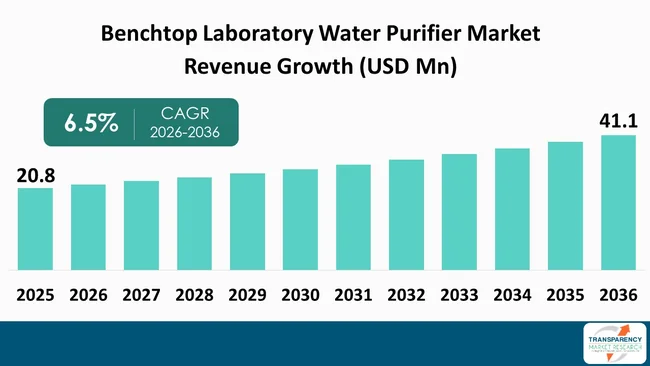
Australia has established strict rules for water quality monitoring and scientific standard compliance. The entire testing process requires high-purity water that serves as the essential base for all chemical, biological, and biochemical tests that scientists conduct from environmental assessments to pharmaceutical research.
The Australian Drinking Water Guidelines establish a comprehensive scientific framework that enables drinking water quality assessment and analytical result evaluation while serving as a reference point for laboratory instrument calibration and testing methods. The guidelines that regulators and scientific organizations widely use establish measurement standards that allow laboratories to achieve uniformity in results across various regions.
The market demand responds to increased requirements that demand research outcomes to demonstrate both - precise results, consistent performance, and complete adherence to regulations. The standard analytical requirement for scientific workflows that operate in universities, industrial research and development units, diagnostic laboratories, and environmental testing facilities now needs benchtop purifiers as an essential component. The national trend toward water quality science excellence is bound to drive laboratories to invest in advanced purification platforms as quality assurance processes develop and laboratories need to increase their testing capacity.
Benchtop laboratory water purifiers are systems that provide laboratories with purified water that meets their testing requirements because the systems eliminate all potential contaminating substances. The systems use reverse osmosis, deionization, and advanced filtration systems to create water that meets high purity standards for analytical chemistry and biological assays and instrument conditioning. The scientific community uses benchtop purifiers to achieve essential water purity standards which protect their research results.
Australian researchers use high-purity water for academic research purposes and medical diagnostic testing and environmental monitoring and industrial quality control testing. The scientific community has adopted the systems as research activity increases and environmental water quality research expands and institutions need to meet strict analytical testing requirements. The laboratories use benchtop water purifiers as essential equipment that provides them with clean results for their different scientific research activities.
| Attribute | Detail |
|---|---|
| Market Drivers |
|
The Australian pharmaceutical manufacturing sector is experiencing substantial growth as new GMP-certified facilities are starting their operations. The TGA Good Manufacturing Practice guidelines require water for injection and purified water as essential components that must meet their specified limits for microbial contamination and chemical purity.
All pharmaceutical manufacturing facilities must install validated benchtop water purification systems for their new production lines to fulfill their regulatory requirements. The TGA now accepts Cold WFI that creates new business possibilities for advanced purification systems that decrease power usage yet preserve operational standards. The Go8 universities spend US$ 8.5 Bn each year on research infrastructure, which results in equipment purchasing cycles for their research activities.
CROs and biotechnology companies need ultrapure water for their cell culture and molecular biology and genetic research work. These sectors need water that meets their strict quality requirements as it must be free from endotoxins and all trace organics. The regulatory environment needs validated systems that provide complete traceability as this requirement needs advanced benchtop purifiers.
Laboratories that conduct high-performance liquid chromatography (HPLC) and mass spectrometry and environmental testing need Type I ultrapure water that meets ASTM D1193 standards. The testing quality of laboratories, environmental facilities, and industrial testing centers relies on stable water purity. The need for dependable benchtop water systems across particular fields continues to grow due to increased demand for food safety testing and environmental compliance monitoring and chemical analysis.
The Therapeutic Goods Administration enforces strict Good Manufacturing Practice regulations that require formal testing of all water purification systems used in pharmaceutical manufacturing. Benchtop water purifiers must prove their capacity to function consistently through three methods including validation studies and testing protocols and permanent electronic data recording. The high regulatory requirements of this system force companies to update their equipment that creates ongoing market demand. Manufacturers must follow all regulations because their non-compliance will lead to accreditation suspension, which serves as an absolute requirement for compliance.
The National Association of Testing Authorities (NATA) requires all accredited laboratories to maintain water quality suitable for their specific testing scope. The NATA assessors perform regular audits of maintenance records and water quality documentation for purification systems, and any failure to comply with standards will lead to loss of accreditation. The regulatory framework establishes a direct relationship between accreditation status and water purifier quality, which requires all 3,500 NATA-accredited facilities in Australia to invest in equipment upgrades and compliance monitoring.
The Clinical Laboratory Standards Institute (CLSI) guidelines establish specific requirements for Clinical Laboratory Reagent Water (CLRW) that address both - microbial contamination and particulate matter restrictions. The ISO 3696:1987 standard establishes three water grades for analytical testing that laboratories must use to test their systems against the corresponding grades. Laboratories must acquire systems that meet their specific testing requirements through the standards-based purchasing process. Purchasing decisions now prioritize compliance with regulatory requirements.
The water quality standards set by regulatory agencies undergo continuous updates to match the changes in analytical testing methods. The development of new pharmaceutical processes and diagnostic techniques requires organizations to implement system upgrades as they demand higher purity standards than existing equipment can deliver. The changing regulatory framework creates a situation where organizations need to replace equipment frequently while vendors create systems that surpass existing standards.
The adoption of benchtop laboratory water purifiers faces a major obstacle through their high maintenance needs and expensive consumable replacement requirements that especially affect institutions with limited financial resources. The system needs replacement cartridges which require scheduled changes based on actual usage patterns and all consumable materials create significant financial burdens which accumulate throughout the equipment's operational lifespan. Benchtop systems require regular preventive maintenance including calibration, sanitization, and performance validation, adding recurring expenses to institutional budgets.
Smaller laboratories and university departments that operate under tight budget restrictions tend to postpone equipment upgrades while selecting lower-cost options that fail to meet required standards. Larger institutions must allocate substantial operational budgets for water purification system maintenance, which restricts their ability to purchase essential laboratory equipment and conduct research operations. The total cost of ownership creates a major obstacle for customers because it represents their main expense beyond the initial product cost, which prevents budget-conscious facilities from entering the market.
The transition to decentralized laboratory systems creates substantial business opportunities for benchtop water purification systems. Current laboratory practices utilize point-of-use testing methods together with remote diagnostic tools and multiple site satellite laboratory operations instead of traditional centralized systems. The distributed laboratory system functions optimally with benchtop purifiers because of their small size and simple setup process and their capability to operate without extensive building works.
Small-scale facilities including veterinary clinics, agricultural testing centers, remote industrial sites, and specialized analytical labs can now achieve laboratory-grade water quality without extensive building modifications or complex plumbing infrastructure. The industry increasingly needs portable water purification systems which can deliver compact and flexible solutions due to the growing adoption of "lab-on-a-chip" technologies and portable analytical devices. The establishment of regional quality control laboratories by pharmaceutical companies and the launch of decentralized systems by biotechnology startups in secondary cities create new business opportunities for this market segment. The market benefits from system vendors who provide easy-to-use products that need little upkeep, while their customers can access strong local support structures.
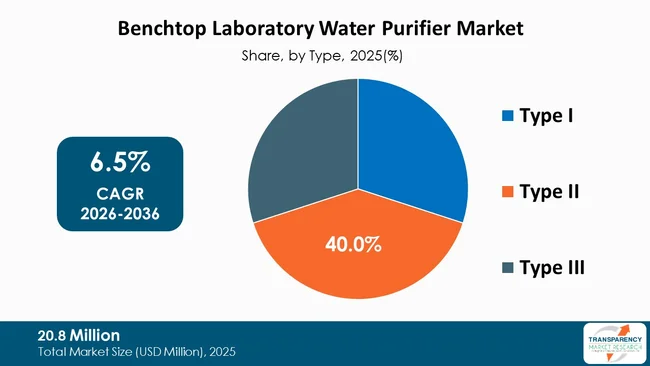
The market presence of Type II systems in Australia benchtop laboratory water purifiers reaches 40.0% as they represent the most common system design used in laboratory settings. These systems are widely preferred for general laboratory applications where moderate-to-high purity water is required for analytical, preparatory, and routine testing tasks. Type II purifiers deliver water quality that meets the requirements of spectrophotometry and reagent preparation and cell culture support without needing to meet Type I systems' ultrapure water specifications. Research and quality assurance laboratories which operate in academic and environmental and industrial fields can benefit from these systems as they provide flexible performance capabilities at an optimal cost.
The operational efficiency of Type II systems together with their ability to work with various analytical instruments creates a strong demand for these systems. The purifiers provide laboratories with their primary water supply because they function as the main water source for daily testing needs which decreases their need for bottled water and lower-quality municipal water.
The systems provide laboratories with a solution that enables them to produce consistent results while maintaining budget limits because they deliver an affordable level of performance. The adaptability of Type II benchtop purifiers together with their wide-ranging analytical application will enable them to maintain their top market position in Australian research because scientific and environmental research practices are developing.
BIOBASE Group, Labconco Corporation, membraPure GmbH, Merck, RephiLe Bioscience Ltd., Sartorius AG, Scitek Global Co., Ltd., Stakpure, Thermo Fisher Scientific, Veolia, Xylem, Yamato Scientific Co., Ltd and others are some of the leading manufacturers operating in Australia Benchtop Laboratory Water Purifier market.
Each of these companies has been profiled in Australia benchtop laboratory water purifier market report based on parameters such as company overview, business strategies, financial overview, business segments, product portfolio, and recent developments.
| Attribute | Detail |
|---|---|
| Market Size Value in 2025 (Base Year) | US$ 20.8 Mn |
| Market Forecast Value in 2036 | US$ 41.1 Mn |
| Growth Rate (CAGR 2026 to 2036) | 6.5% |
| Forecast Period | 2026-2036 |
| Historical data Available for | 2021-2023 |
| Quantitative Units | US$ Mn for Value and Thousand Units for Volume |
| Market Analysis | Global qualitative analysis includes drivers, restraints, opportunities, key trends, key market indicators, Porter’s Five Forces analysis, value chain analysis, SWOT analysis, etc. Furthermore, at the regional level, qualitative analysis includes key trends, price trends, and key supplier analysis. |
| Competition Landscape | Market Player - Competition Dashboard and Revenue Share Analysis 2025 Company Profiles (Details - Company Overview, Sales Area/Geographical Presence, Revenue, Strategy & Business Overview) |
| Format | Electronic (PDF) + Excel |
| Market Segmentations | By Type
|
| Country Covered |
|
| Companies Profiled |
|
| Customization Scope | Available upon Request |
| Pricing | Available upon Request |
Australia benchtop laboratory water purifier market was valued at US$ 20.8 Mn in 2025
Australia benchtop laboratory water purifier industry is projected to reach at US$ 41.1 Mn by the end of 2036
Increase in demand for ultrapure water in end-use industries, and rise in regulatory scrutiny & quality control standards, are some of the driving factors for this market
The CAGR is anticipated to be 6.5% from 2026 to 2036
BIOBASE Group, Labconco Corporation, membraPure GmbH, Merck, RephiLe Bioscience Ltd., Sartorius AG, Scitek Global Co., Ltd., Stakpure, Thermo Fisher Scientific, Veolia, Xylem, Yamato Scientific Co., Ltd., and others
Table 01: Australia Benchtop Laboratory Water Purifier Market Value (US$ Mn) Projection, By Type 2021 to 2036
Table 02: Australia Benchtop Laboratory Water Purifier Market Volume (Thousand Units) Projection, By Type 2021 to 2036
Table 03: Australia Benchtop Laboratory Water Purifier Market Value (US$ Mn) Projection, By Water Production (L/h) 2021 to 2036
Table 04: Australia Benchtop Laboratory Water Purifier Market Volume (Thousand Units) Projection, By Water Production (L/h) 2021 to 2036
Table 05: Australia Benchtop Laboratory Water Purifier Market Value (US$ Mn) Projection, By Technology 2021 to 2036
Table 06: Australia Benchtop Laboratory Water Purifier Market Volume (Thousand Units) Projection, By Technology 2021 to 2036
Table 07: Australia Benchtop Laboratory Water Purifier Market Value (US$ Mn) Projection, By Automation Grade 2021 to 2036
Table 08: Australia Benchtop Laboratory Water Purifier Market Volume (Thousand Units) Projection, By Automation Grade 2021 to 2036
Table 09: Australia Benchtop Laboratory Water Purifier Market Value (US$ Mn) Projection, By End-use 2021 to 2036
Table 10: Australia Benchtop Laboratory Water Purifier Market Volume (Thousand Units) Projection, By End-use 2021 to 2036
Table 11: Australia Benchtop Laboratory Water Purifier Market Value (US$ Mn) Projection, By Distribution Channel 2021 to 2036
Table 12: Australia Benchtop Laboratory Water Purifier Market Volume (Thousand Units) Projection, By Distribution Channel 2021 to 2036
Figure 01: Australia Benchtop Laboratory Water Purifier Market Value (US$ Mn) Projection, By Type 2021 to 2036
Figure 02: Australia Benchtop Laboratory Water Purifier Market Volume (Thousand Units) Projection, By Type 2021 to 2036
Figure 03: Australia Benchtop Laboratory Water Purifier Market Incremental Opportunities (US$ Mn) Forecast, By Type 2026 to 2036
Figure 04: Australia Benchtop Laboratory Water Purifier Market Value (US$ Mn) Projection, By Water Production (L/h) 2021 to 2036
Figure 05: Australia Benchtop Laboratory Water Purifier Market Volume (Thousand Units) Projection, By Water Production (L/h) 2021 to 2036
Figure 06: Australia Benchtop Laboratory Water Purifier Market Incremental Opportunities (US$ Mn) Forecast, By Water Production (L/h) 2026 to 2036
Figure 07: Australia Benchtop Laboratory Water Purifier Market Value (US$ Mn) Projection, By Technology 2021 to 2036
Figure 08: Australia Benchtop Laboratory Water Purifier Market Volume (Thousand Units) Projection, By Technology 2021 to 2036
Figure 09: Australia Benchtop Laboratory Water Purifier Market Incremental Opportunities (US$ Mn) Forecast, By Technology 2026 to 2036
Figure 10: Australia Benchtop Laboratory Water Purifier Market Value (US$ Mn) Projection, By Automation Grade 2021 to 2036
Figure 11: Australia Benchtop Laboratory Water Purifier Market Volume (Thousand Units) Projection, By Automation Grade 2021 to 2036
Figure 12: Australia Benchtop Laboratory Water Purifier Market Incremental Opportunities (US$ Mn) Forecast, By Automation Grade 2026 to 2036
Figure 13: Australia Benchtop Laboratory Water Purifier Market Value (US$ Mn) Projection, By End-use 2021 to 2036
Figure 14: Australia Benchtop Laboratory Water Purifier Market Volume (Thousand Units) Projection, By End-use 2021 to 2036
Figure 15: Australia Benchtop Laboratory Water Purifier Market Incremental Opportunities (US$ Mn) Forecast, By End-use 2026 to 2036
Figure 16: Australia Benchtop Laboratory Water Purifier Market Value (US$ Mn) Projection, By Distribution Channel 2021 to 2036
Figure 17: Australia Benchtop Laboratory Water Purifier Market Volume (Thousand Units) Projection, By Distribution Channel 2021 to 2036
Figure 18: Australia Benchtop Laboratory Water Purifier Market Incremental Opportunities (US$ Mn) Forecast, By Distribution Channel 2026 to 2036
Copyright © Transparency Market Research, Inc. All Rights reserved
Trust Online


Australia Benchtop Laboratory Water Purifier Market
