

Reports
Reports
The global sustainable construction materials market was valued at USD 272.4 Billion in 2025 and is projected to reach USD 875.7 Billion by 2036, expanding at a CAGR of 11.2% from 2026 to 2036. The market is driven by rising demand for low-carbon and circular construction solutions.
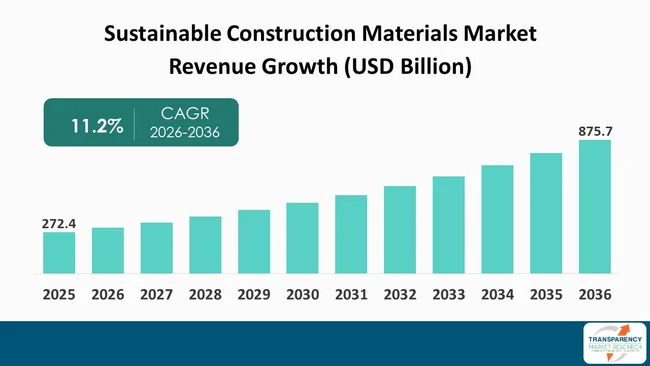
The sustainable construction materials market is set to experience sustained growth as construction firms, government agencies, and developers become more focused on reducing carbon content, improving resource efficiency, promoting circularity, and implementing green building codes. Key growth factors include urbanization, carbon-reduction regulations, rising demand for low-carbon buildings, increasing construction and demolition waste, and growing adoption of recycled, bio-based, and energy-efficient materials. This transition involves replacing conventional high-carbon materials with alternatives such as low-clinker cement, recycled aggregates, supplementary cementitious materials, sustainable timber, and recycled metals. The manufacturers are also innovating in terms of energy sources, waste recovery, material efficiency, and life-cycle assessment.
Key industry participants are supporting market growth through product innovation, investment in recycling infrastructure, and decarbonization initiatives. For instance, ECOPlanet low-carbon cement by Holcim uses alternative raw materials and reduces carbon dioxide emissions from cement production by at least 30%, whereas ECOCycle technology from the company uses recycled construction and demolition materials in its products.
Sustainable construction materials are designed to reduce environmental impact while maintaining the strength, durability, and performance required for construction applications. Examples include low-carbon cement and concrete, recycled aggregates, recycled metals, sustainable timber, and recycled plastics. Sustainable construction materials are applied in all sorts of projects, whether residential, commercial, industrial, or infrastructure projects. Their production typically involves sourcing renewable, recycled, or low-impact raw materials, using energy-efficient manufacturing technologies, and reducing waste and greenhouse gas emissions throughout the product life cycle. Some of the sustainable construction materials contain industrial wastes such as fly ash, slag, and silica fume for reducing the consumption of clinker or virgin material.
| Attribute | Detail |
|---|---|
| Sustainable Construction Materials Market Drivers |
|
Governments and regulators worldwide are increasingly adopting stringent policies to curtail greenhouse gas emissions within the construction industry and manufacturing industry of building materials. Building materials such as cement, concrete, steel, glass, and insulation contribute significantly to embodied carbon emissions, increasing regulatory focus on carbon performance, environmental declarations, energy efficiency, and sustainable procurement. All these have led construction firms to adopt environmentally friendly materials irrespective of their initial cost. It has therefore led to increased demand for low embodied carbon emitting materials, recycling and sustainability.
The expansion of green building rating systems has also increased demand for sustainable construction materials. An increasing number of property owners and developers are adopting certification systems such as LEED, BREEAM, and WELL among others in order to improve building performance and asset values. Sustainable materials may be able to help meet criteria for energy efficiency, responsible material sourcing, waste management, recycled content, and life-cycle impacts. With certification becoming increasingly important to commercial real estate, institutional construction, infrastructure development, and high-end residential construction, there will be motivation for sustainable material development.
The pressure from regulations is also pushing manufacturers towards developing more environmentally-friendly production processes and innovations in product development. The manufacturers of cement have increased the use of supplementary cementitious materials, alternative fuels, recycling of raw materials, and low clinker content. Manufacturers of steel have started producing steel from scrap through electric arc furnaces and exploring the use of hydrogen-based processes. Manufacturers of products such as insulation, flooring, roofing, among others have also increased the amount of recycled and bio-based materials used.
Growing awareness of embodied carbon and resource scarcity is driving the construction industry toward low-carbon and circular materials. The conventional construction industry relies on primary resources and high-energy material manufacturing for raw materials such as cement, steel, aggregates, glass, and bricks. Huge amounts of waste materials are created during construction and demolition. High resource consumption and waste generation are increasing interest in circular construction practices such as reuse, recycling, and material recovery. Recycled aggregates, recycled metals, reclaimed timber, low-carbon concrete, recycled plastics, and by-product materials are becoming commercially significant.
The circular building model focuses on maintaining the value and usability of materials and components for as long as possible. The concept entails such practices as concrete recycling from demolished buildings, turning the material into recycled aggregates, inclusion of by-products from industries in cementitious materials and using recycled steel as opposed to virgin steel. Additionally, producers are adopting innovative designs that facilitate easier reuse of the materials and reduce material usage. Identification and recycling of the construction materials through digital material tracking, building information modeling, design for disassembly and material passports is becoming increasingly possible.
Circular construction provides both environmental and economic benefits for market participants. Using more secondary raw materials may help avoid reliance on volatile prices of virgin materials, lessen needs for landfills, and even decrease the footprint from production emissions. The developers can additionally improve their reputation as sustainable players under increased pressure from customers, investors, and regulators. As a result, large construction materials producers are extending their line of recycled products, creating waste processing facilities, establishing take-back schemes, and building relationships between demolition, recycling, manufacturing, and construction industries.
| Attribute | Detail |
|---|---|
| Sustainable Construction Materials Market Opportunity |
|
The shift towards low carbon and circular construction offers significant opportunity for the manufacturers of sustainable construction materials. The growing focus on reducing carbon footprints is increasing demand for low-clinker cement, recycled aggregates, recycled steel, low-carbon concrete, and materials incorporating industrial by-products. The circular approach to construction is leading to the recovery and reuse of construction materials in the process of deconstruction of buildings. Manufacturers can capitalize on this trend by developing products with high recycled content, establishing material-recovery and recycling infrastructure, and implementing take-back programs.
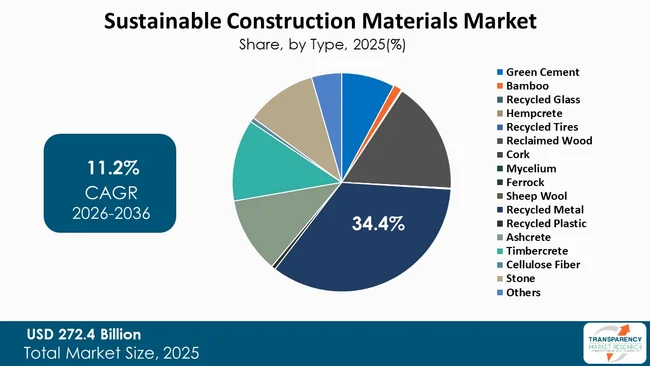
The recycled metal segment dominated the global sustainable construction materials market in 2025, accounting for approximately 37.9% of total market revenue. This leading position is supported by high recyclability, established collection infrastructure, and a lower environmental impact compared with primary metal production. Steel and aluminum can be recycled several times without any change in their effectiveness. The use of recycled metals can reduce energy consumption, virgin material extraction, waste generation, and carbon emissions. Green buildings and circular construction trends have been encouraging the demand for this type of material.
Recycled metals are recovered from post-consumer, post-industrial, and construction and demolition waste before being sorted, processed, melted, and fabricated into new construction products. In the sustainable construction materials market, it includes recycled steel, aluminum, copper, and other metals in structural frames, reinforcements, roof, façade, door, window, and building materials applications.
| Attribute | Detail |
|---|---|
| Leading Region |
|
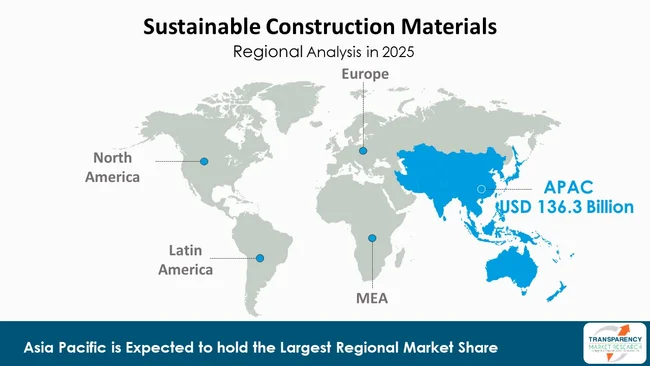
Asia Pacific dominated the global sustainable construction materials market in 2025, accounting for approximately 50.0% of total market revenue, owing to factors such as urbanization, development of infrastructure, population growth, and extensive construction in countries including China, India, Southeast Asia, and others. Government policies encouraging the use of green buildings, resource efficiency, and low-carbon construction are also helping drive adoption. The increase in demand for construction materials is driving companies to offer sustainable construction material products.
The global sustainable construction materials market includes a diverse range of manufacturers and solution providers focused on low-carbon, recycled, bio-based, and energy-efficient building materials. Holcim, Alumasc Group Plc, Binderholz GmbH, AMVIC Building Systems, Bauder Ltd, GreenFiber, Interface, Inc., Owens Corning Corporation, Forbo Group, Kingspan Group, and DuPont are among the key players operating in the market.
These companies offer sustainable construction solutions across insulation, structural timber, green roofing systems, recyclable and bio-based building materials, carpet and resilient flooring, roofing membranes, energy-efficient building envelopes, façade and wall systems, and advanced polymers for construction applications. Market participants are focusing on product innovation, recycled material integration, energy efficiency, circular construction practices, and expansion of sustainable product portfolios to strengthen their competitive positions.
Other notable companies operating in the market include Mykor Ltd, BASF SE, Sika AG, Aditya Birla, ACC Limited, JSW Cement, UltraTech Cement Ltd, Dalmia Cement (Bharat) Limited, CMR Green Technologies Ltd, and Nile Limited.
Each of these players has been profiled in the sustainable construction materials market research report based on parameters such as company overview, financial overview, business strategies, product portfolio, business segments, and recent developments.
| Attribute | Detail |
|---|---|
| Market Size Value in 2025 | USD 272.4 Billion |
| Market Forecast Value in 2036 | USD 875.7 Billion |
| Growth Rate (CAGR) | 11.2% |
| Forecast Period | 2026-2036 |
| Historical Data Available for | 2021-2025 |
| Quantitative Units | USD Billion for Value and Tons for Volume |
| Market Analysis | It includes cross-segment analysis at the global as well as regional level. The qualitative analysis includes drivers, restraints, sustainable construction materials market opportunities, key trends, Porter’s Five Forces analysis, value chain analysis, and key trend analysis. |
| Competition Landscape |
|
| Format | Electronic (PDF) + Excel |
| Market Segmentation | Material Type
|
| Regions Covered |
|
| Countries Covered |
|
| Companies Profiled |
|
| Customization Scope | Available upon request |
| Pricing | Available upon request |
The sustainable construction materials market was valued at USD 272.4 Billion in 2025.
The sustainable construction materials industry is expected to expand at a CAGR of 11.2% from 2026 to 2036.
Key drivers include stringent carbon-reduction regulations and green building standards, along with rising demand for low-carbon and circular construction solutions.
The recycled metal segment accounted for the largest share of the global sustainable construction materials market, representing 37.9% in 2025.
Asia Pacific was the most lucrative region in 2025.
Holcim, Alumasc Group Plc, Binderholz GmbH, AMVIC Building Systems, Bauder Ltd, GreenFiber, Interface, Inc., Owens Corning Corporation, Forbo Group, Kingspan Group, DuPont, Mykor Ltd, BASF SE, Sika AG, Aditya Birla, ACC Limited, JSW Cement, UltraTech Cement Ltd, Dalmia Cement (Bharat) Limited, CMR Green Technologies Ltd, and Nile Limited are among the prominent players in the global sustainable construction materials market.
Table 1: Global Sustainable Construction Materials Market Volume (Tons) Forecast, by Material Type, 2026 to 2036
Table 2: Global Sustainable Construction Materials Market Value (USD Billion) Forecast, by Material Type, 2026 to 2036 Table 3: Global Sustainable Construction Materials Market Volume (Tons) Forecast, by Application, 2026 to 2036
Table 4: Global Sustainable Construction Materials Market Value (USD Billion) Forecast, by Application, 2026 to 2036 Table 5: Global Sustainable Construction Materials Market Volume (Tons) Forecast, by End-use, 2026 to 2036
Table 6: Global Sustainable Construction Materials Market Value (USD Billion) Forecast, by End-use, 2026 to 2036 Table 7: Global Sustainable Construction Materials Market Volume (Tons) Forecast, by Region, 2026 to 2036
Table 8: Global Sustainable Construction Materials Market Value (USD Billion) Forecast, by Region, 2026 to 2036 Table 9: North America Sustainable Construction Materials Market Volume (Tons) Forecast, by Material Type, 2026 to 2036
Table 10: North America Sustainable Construction Materials Market Value (USD Billion) Forecast, by Material Type, 2026 to 2036 Table 11: North America Sustainable Construction Materials Market Volume (Tons) Forecast, by Application, 2026 to 2036
Table 12: North America Sustainable Construction Materials Market Value (USD Billion) Forecast, by Application, 2026 to 2036 Table 13: North America Sustainable Construction Materials Market Volume (Tons) Forecast, by End-use, 2026 to 2036
Table 14: North America Sustainable Construction Materials Market Value (USD Billion) Forecast, by End-use, 2026 to 2036 Table 15: North America Sustainable Construction Materials Market Volume (Tons) Forecast, by Country, 2026 to 2036
Table 16: North America Sustainable Construction Materials Market Value (USD Billion) Forecast, by Country, 2026 to 2036 Table 17: U.S. Sustainable Construction Materials Market Volume (Tons) Forecast, by Material Type, 2026 to 2036
Table 18: U.S. Sustainable Construction Materials Market Value (USD Billion) Forecast, by Material Type, 2026 to 2036 Table 19: U.S. Sustainable Construction Materials Market Volume (Tons) Forecast, by Application, 2026 to 2036
Table 20: U.S. Sustainable Construction Materials Market Value (USD Billion) Forecast, by Application, 2026 to 2036 Table 21: U.S. Sustainable Construction Materials Market Volume (Tons) Forecast, by End-use, 2026 to 2036
Table 22: U.S. Sustainable Construction Materials Market Value (USD Billion) Forecast, by End-use, 2026 to 2036 Table 23: Canada Sustainable Construction Materials Market Volume (Tons) Forecast, by Material Type, 2026 to 2036
Table 24: Canada Sustainable Construction Materials Market Value (USD Billion) Forecast, by Material Type, 2026 to 2036 Table 25: Canada Sustainable Construction Materials Market Volume (Tons) Forecast, by Application, 2026 to 2036
Table 26: Canada Sustainable Construction Materials Market Value (USD Billion) Forecast, by Application, 2026 to 2036 Table 27: Canada Sustainable Construction Materials Market Volume (Tons) Forecast, by End-use, 2026 to 2036
Table 28: Canada Sustainable Construction Materials Market Value (USD Billion) Forecast, by End-use, 2026 to 2036 Table 29: Europe Sustainable Construction Materials Market Volume (Tons) Forecast, by Material Type, 2026 to 2036
Table 30: Europe Sustainable Construction Materials Market Value (USD Billion) Forecast, by Material Type, 2026 to 2036 Table 31: Europe Sustainable Construction Materials Market Volume (Tons) Forecast, by Application, 2026 to 2036
Table 32: Europe Sustainable Construction Materials Market Value (USD Billion) Forecast, by Application, 2026 to 2036 Table 33: Europe Sustainable Construction Materials Market Volume (Tons) Forecast, by End-use, 2026 to 2036
Table 34: Europe Sustainable Construction Materials Market Value (USD Billion) Forecast, by End-use, 2026 to 2036 Table 35: Europe Sustainable Construction Materials Market Volume (Tons) Forecast, by Country and Sub-region, 2026 to 2036
Table 36: Europe Sustainable Construction Materials Market Value (USD Billion) Forecast, by Country and Sub-region, 2026 to 2036 Table 37: Germany Sustainable Construction Materials Market Volume (Tons) Forecast, by Material Type, 2026 to 2036
Table 38: Germany Sustainable Construction Materials Market Value (USD Billion) Forecast, by Material Type, 2026 to 2036 Table 39: Germany Sustainable Construction Materials Market Volume (Tons) Forecast, by Application, 2026 to 2036
Table 40: Germany Sustainable Construction Materials Market Value (USD Billion) Forecast, by Application, 2026 to 2036 Table 41: Germany Sustainable Construction Materials Market Volume (Tons) Forecast, by End-use, 2026 to 2036
Table 42: Germany Sustainable Construction Materials Market Value (USD Billion) Forecast, by End-use, 2026 to 2036 Table 43: France Sustainable Construction Materials Market Volume (Tons) Forecast, by Material Type, 2026 to 2036
Table 44: France Sustainable Construction Materials Market Value (USD Billion) Forecast, by Material Type, 2026 to 2036 Table 45: France Sustainable Construction Materials Market Volume (Tons) Forecast, by Application, 2026 to 2036
Table 46: France Sustainable Construction Materials Market Value (USD Billion) Forecast, by Application, 2026 to 2036 Table 47: France Sustainable Construction Materials Market Volume (Tons) Forecast, by End-use, 2026 to 2036
Table 48: France Sustainable Construction Materials Market Value (USD Billion) Forecast, by End-use, 2026 to 2036 Table 49: U.K. Sustainable Construction Materials Market Volume (Tons) Forecast, by Material Type, 2026 to 2036
Table 50: U.K. Sustainable Construction Materials Market Value (USD Billion) Forecast, by Material Type, 2026 to 2036 Table 51: U.K. Sustainable Construction Materials Market Volume (Tons) Forecast, by Application, 2026 to 2036
Table 52: U.K. Sustainable Construction Materials Market Value (USD Billion) Forecast, by Application, 2026 to 2036 Table 53: U.K. Sustainable Construction Materials Market Volume (Tons) Forecast, by End-use, 2026 to 2036
Table 54: U.K. Sustainable Construction Materials Market Value (USD Billion) Forecast, by End-use, 2026 to 2036 Table 55: Italy Sustainable Construction Materials Market Volume (Tons) Forecast, by Material Type, 2026 to 2036
Table 56: Italy Sustainable Construction Materials Market Value (USD Billion) Forecast, by Material Type, 2026 to 2036 Table 57: Italy Sustainable Construction Materials Market Volume (Tons) Forecast, by Application, 2026 to 2036
Table 58: Italy Sustainable Construction Materials Market Value (USD Billion) Forecast, by Application, 2026 to 2036 Table 59: Italy Sustainable Construction Materials Market Volume (Tons) Forecast, by End-use, 2026 to 2036
Table 60: Italy Sustainable Construction Materials Market Value (USD Billion) Forecast, by End-use, 2026 to 2036 Table 61: Spain Sustainable Construction Materials Market Volume (Tons) Forecast, by Material Type, 2026 to 2036
Table 62: Spain Sustainable Construction Materials Market Value (USD Billion) Forecast, by Material Type, 2026 to 2036 Table 63: Spain Sustainable Construction Materials Market Volume (Tons) Forecast, by Application, 2026 to 2036
Table 64: Spain Sustainable Construction Materials Market Value (USD Billion) Forecast, by Application, 2026 to 2036 Table 65: Spain Sustainable Construction Materials Market Volume (Tons) Forecast, by End-use, 2026 to 2036
Table 66: Spain Sustainable Construction Materials Market Value (USD Billion) Forecast, by End-use, 2026 to 2036 Table 67: Russia & CIS Sustainable Construction Materials Market Volume (Tons) Forecast, by Material Type, 2026 to 2036
Table 68: Russia & CIS Sustainable Construction Materials Market Value (USD Billion) Forecast, by Material Type, 2026 to 2036 Table 69: Russia & CIS Sustainable Construction Materials Market Volume (Tons) Forecast, by Application, 2026 to 2036
Table 70: Russia & CIS Sustainable Construction Materials Market Value (USD Billion) Forecast, by Application, 2026 to 2036 Table 71: Russia & CIS Sustainable Construction Materials Market Volume (Tons) Forecast, by End-use, 2026 to 2036
Table 72: Russia & CIS Sustainable Construction Materials Market Value (USD Billion) Forecast, by End-use, 2026 to 2036 Table 73: Rest of Europe Sustainable Construction Materials Market Volume (Tons) Forecast, by Material Type, 2026 to 2036
Table 74: Rest of Europe Sustainable Construction Materials Market Value (USD Billion) Forecast, by Material Type, 2026 to 2036 Table 75: Rest of Europe Sustainable Construction Materials Market Volume (Tons) Forecast, by Application, 2026 to 2036
Table 76: Rest of Europe Sustainable Construction Materials Market Value (USD Billion) Forecast, by Application, 2026 to 2036 Table 77: Rest of Europe Sustainable Construction Materials Market Volume (Tons) Forecast, by End-use, 2026 to 2036
Table 78: Rest of Europe Sustainable Construction Materials Market Value (USD Billion) Forecast, by End-use, 2026 to 2036 Table 79: Asia Pacific Sustainable Construction Materials Market Volume (Tons) Forecast, by Material Type, 2026 to 2036
Table 80: Asia Pacific Sustainable Construction Materials Market Value (USD Billion) Forecast, by Material Type, 2026 to 2036 Table 81: Asia Pacific Sustainable Construction Materials Market Volume (Tons) Forecast, by Application, 2026 to 2036
Table 82: Asia Pacific Sustainable Construction Materials Market Value (USD Billion) Forecast, by Application, 2026 to 2036 Table 83: Asia Pacific Sustainable Construction Materials Market Volume (Tons) Forecast, by End-use, 2026 to 2036
Table 84: Asia Pacific Sustainable Construction Materials Market Value (USD Billion) Forecast, by End-use, 2026 to 2036 Table 85: Asia Pacific Sustainable Construction Materials Market Volume (Tons) Forecast, by Country and Sub-region, 2026 to 2036
Table 86: Asia Pacific Sustainable Construction Materials Market Value (USD Billion) Forecast, by Country and Sub-region, 2026 to 2036
Table 87: China Sustainable Construction Materials Market Volume (Tons) Forecast, by Material Type, 2026 to 2036
Table 88: China Sustainable Construction Materials Market Value (USD Billion) Forecast, by Material Type 2026 to 2036 Table 89: China Sustainable Construction Materials Market Volume (Tons) Forecast, by Application, 2026 to 2036
Table 90: China Sustainable Construction Materials Market Value (USD Billion) Forecast, by Application, 2026 to 2036 Table 91: China Sustainable Construction Materials Market Volume (Tons) Forecast, by End-use, 2026 to 2036
Table 92: China Sustainable Construction Materials Market Value (USD Billion) Forecast, by End-use, 2026 to 2036 Table 93: Japan Sustainable Construction Materials Market Volume (Tons) Forecast, by Material Type, 2026 to 2036
Table 94: Japan Sustainable Construction Materials Market Value (USD Billion) Forecast, by Material Type, 2026 to 2036 Table 95: Japan Sustainable Construction Materials Market Volume (Tons) Forecast, by Application, 2026 to 2036
Table 96: Japan Sustainable Construction Materials Market Value (USD Billion) Forecast, by Application, 2026 to 2036 Table 97: Japan Sustainable Construction Materials Market Volume (Tons) Forecast, by End-use, 2026 to 2036
Table 98: Japan Sustainable Construction Materials Market Value (USD Billion) Forecast, by End-use, 2026 to 2036 Table 99: India Sustainable Construction Materials Market Volume (Tons) Forecast, by Material Type, 2026 to 2036
Table 100: India Sustainable Construction Materials Market Value (USD Billion) Forecast, by Material Type, 2026 to 2036 Table 101: India Sustainable Construction Materials Market Volume (Tons) Forecast, by Application, 2026 to 2036
Table 102: India Sustainable Construction Materials Market Value (USD Billion) Forecast, by Application, 2026 to 2036 Table 103: India Sustainable Construction Materials Market Volume (Tons) Forecast, by End-use, 2026 to 2036
Table 104: India Sustainable Construction Materials Market Value (USD Billion) Forecast, by End-use, 2026 to 2036 Table 105: India Sustainable Construction Materials Market Volume (Tons) Forecast, by End-use, 2026 to 2036
Table 106: India Sustainable Construction Materials Market Value (USD Billion) Forecast, by End-use 2026 to 2036 Table 107: ASEAN Sustainable Construction Materials Market Volume (Tons) Forecast, by Material Type, 2026 to 2036
Table 108: ASEAN Sustainable Construction Materials Market Value (USD Billion) Forecast, by Material Type, 2026 to 2036 Table 109: ASEAN Sustainable Construction Materials Market Volume (Tons) Forecast, by Application, 2026 to 2036
Table 110: ASEAN Sustainable Construction Materials Market Value (USD Billion) Forecast, by Application, 2026 to 2036 Table 111: ASEAN Sustainable Construction Materials Market Volume (Tons) Forecast, by End-use, 2026 to 2036
Table 112: ASEAN Sustainable Construction Materials Market Value (USD Billion) Forecast, by End-use, 2026 to 2036 Table 113: Rest of Asia Pacific Sustainable Construction Materials Market Volume (Tons) Forecast, by Material Type, 2026 to 2036
Table 114: Rest of Asia Pacific Sustainable Construction Materials Market Value (USD Billion) Forecast, by Material Type, 2026 to 2036
Table 115: Rest of Asia Pacific Sustainable Construction Materials Market Volume (Tons) Forecast, by Application, 2026 to 2036
Table 116: Rest of Asia Pacific Sustainable Construction Materials Market Value (USD Billion) Forecast, by Application, 2026 to 2036 Table 117: Rest of Asia Pacific Sustainable Construction Materials Market Volume (Tons) Forecast, by End-use, 2026 to 2036
Table 118: Rest of Asia Pacific Sustainable Construction Materials Market Value (USD Billion) Forecast, by End-use, 2026 to 2036 Table 119: Latin America Sustainable Construction Materials Market Volume (Tons) Forecast, by Material Type, 2026 to 2036
Table 120: Latin America Sustainable Construction Materials Market Value (USD Billion) Forecast, by Material Type, 2026 to 2036 Table 121: Latin America Sustainable Construction Materials Market Volume (Tons) Forecast, by Application, 2026 to 2036
Table 122: Latin America Sustainable Construction Materials Market Value (USD Billion) Forecast, by Application, 2026 to 2036 Table 123: Latin America Sustainable Construction Materials Market Volume (Tons) Forecast, by End-use, 2026 to 2036
Table 124: Latin America Sustainable Construction Materials Market Value (USD Billion) Forecast, by End-use, 2026 to 2036 Table 125: Latin America Sustainable Construction Materials Market Volume (Tons) Forecast, by Country and Sub-region, 2026 to 2036
Table 126: Latin America Sustainable Construction Materials Market Value (USD Billion) Forecast, by Country and Sub-region, 2026 to 2036
Table 127: Brazil Sustainable Construction Materials Market Volume (Tons) Forecast, by Material Type, 2026 to 2036
Table 128: Brazil Sustainable Construction Materials Market Value (USD Billion) Forecast, by Material Type, 2026 to 2036 Table 129: Brazil Sustainable Construction Materials Market Volume (Tons) Forecast, by Application, 2026 to 2036
Table 130: Brazil Sustainable Construction Materials Market Value (USD Billion) Forecast, by Application, 2026 to 2036 Table 131: Brazil Sustainable Construction Materials Market Volume (Tons) Forecast, by End-use, 2026 to 2036
Table 132: Brazil Sustainable Construction Materials Market Value (USD Billion) Forecast, by End-use, 2026 to 2036 Table 133: Mexico Sustainable Construction Materials Market Volume (Tons) Forecast, by Material Type, 2026 to 2036
Table 134: Mexico Sustainable Construction Materials Market Value (USD Billion) Forecast, by Material Type, 2026 to 2036 Table 135: Mexico Sustainable Construction Materials Market Volume (Tons) Forecast, by Application, 2026 to 2036
Table 136: Mexico Sustainable Construction Materials Market Value (USD Billion) Forecast, by Application, 2026 to 2036 Table 137: Mexico Sustainable Construction Materials Market Volume (Tons) Forecast, by End-use, 2026 to 2036
Table 138: Mexico Sustainable Construction Materials Market Value (USD Billion) Forecast, by End-use, 2026 to 2036 Table 139: Rest of Latin America Sustainable Construction Materials Market Volume (Tons) Forecast, by Material Type, 2026 to 2036
Table 140: Rest of Latin America Sustainable Construction Materials Market Value (USD Billion) Forecast, by Material Type, 2026 to 2036
Table 141: Rest of Latin America Sustainable Construction Materials Market Volume (Tons) Forecast, by Application, 2026 to 2036
Table 142: Rest of Latin America Sustainable Construction Materials Market Value (USD Billion) Forecast, by Application, 2026 to 2036
Table 143: Rest of Latin America Sustainable Construction Materials Market Volume (Tons) Forecast, by End-use, 2026 to 2036
Table 144: Rest of Latin America Sustainable Construction Materials Market Value (USD Billion) Forecast, by End-use, 2026 to 2036 Table 145: Middle East & Africa Sustainable Construction Materials Market Volume (Tons) Forecast, by Material Type, 2026 to 2036
Table 146: Middle East & Africa Sustainable Construction Materials Market Value (USD Billion) Forecast, by Material Type, 2026 to 2036
Table 147: Middle East & Africa Sustainable Construction Materials Market Volume (Tons) Forecast, by Application, 2026 to 2036
Table 148: Middle East & Africa Sustainable Construction Materials Market Value (USD Billion) Forecast, by Application, 2026 to 2036 Table 149: Middle East & Africa Sustainable Construction Materials Market Volume (Tons) Forecast, by End-use, 2026 to 2036
Table 150: Middle East & Africa Sustainable Construction Materials Market Value (USD Billion) Forecast, by End-use, 2026 to 2036 Table 151: Middle East & Africa Sustainable Construction Materials Market Volume (Tons) Forecast, by Country and Sub-region, 2026 to 2036
Table 152: Middle East & Africa Sustainable Construction Materials Market Value (USD Billion) Forecast, by Country and Sub-region, 2026 to 2036
Table 153: GCC Sustainable Construction Materials Market Volume (Tons) Forecast, by Material Type, 2026 to 2036
Table 154: GCC Sustainable Construction Materials Market Value (USD Billion) Forecast, by Material Type, 2026 to 2036 Table 155: GCC Sustainable Construction Materials Market Volume (Tons) Forecast, by Application, 2026 to 2036
Table 156: GCC Sustainable Construction Materials Market Value (USD Billion) Forecast, by Application, 2026 to 2036 Table 157: GCC Sustainable Construction Materials Market Volume (Tons) Forecast, by End-use, 2026 to 2036
Table 158: GCC Sustainable Construction Materials Market Value (USD Billion) Forecast, by End-use, 2026 to 2036 Table 159: South Africa Sustainable Construction Materials Market Volume (Tons) Forecast, by Material Type, 2026 to 2036
Table 160: South Africa Sustainable Construction Materials Market Value (USD Billion) Forecast, by Material Type, 2026 to 2036 Table 161: South Africa Sustainable Construction Materials Market Volume (Tons) Forecast, by Application, 2026 to 2036
Table 162: South Africa Sustainable Construction Materials Market Value (USD Billion) Forecast, by Application, 2026 to 2036 Table 163: South Africa Sustainable Construction Materials Market Volume (Tons) Forecast, by End-use, 2026 to 2036
Table 164: South Africa Sustainable Construction Materials Market Value (USD Billion) Forecast, by End-use, 2026 to 2036 Table 165: Rest of Middle East & Africa Sustainable Construction Materials Market Volume (Tons) Forecast, by Material Type, 2026 to 2036
Table 166: Rest of Middle East & Africa Sustainable Construction Materials Market Value (USD Billion) Forecast, by Material Type, 2026 to 2036
Table 167: Rest of Middle East & Africa Sustainable Construction Materials Market Volume (Tons) Forecast, by Application, 2026 to 2036
Table 168: Rest of Middle East & Africa Sustainable Construction Materials Market Value (USD Billion) Forecast, by Application, 2026 to 2036
Table 169: Rest of Middle East & Africa Sustainable Construction Materials Market Volume (Tons) Forecast, by End-use, 2026 to 2036
Table 170: Rest of Middle East & Africa Sustainable Construction Materials Market Value (USD Billion) Forecast, by End-use, 2026 to 2036
Figure 1: Global Sustainable Construction Materials Market Volume Share Analysis, by Material Type, 2025, 2029, and 2036
Figure 2: Global Sustainable Construction Materials Market Attractiveness, by Material Type
Figure 3: Global Sustainable Construction Materials Market Volume Share Analysis, by Application, 2025, 2029, and 2036
Figure 4: Global Sustainable Construction Materials Market Attractiveness, by Application
Figure 5: Global Sustainable Construction Materials Market Volume Share Analysis, by End-use, 2025, 2029, and 2036
Figure 6: Global Sustainable Construction Materials Market Attractiveness, by End-use
Figure 7: Global Sustainable Construction Materials Market Volume Share Analysis, by Region, 2025, 2029, and 2036
Figure 8: Global Sustainable Construction Materials Market Attractiveness, by Region
Figure 9: North America Sustainable Construction Materials Market Volume Share Analysis, by Material Type, 2025, 2029, and 2036
Figure 10: North America Sustainable Construction Materials Market Attractiveness, by Material Type
Figure 11: North America Sustainable Construction Materials Market Attractiveness, by Material Type
Figure 12: North America Sustainable Construction Materials Market Volume Share Analysis, by Application, 2025, 2029, and 2036
Figure 13: North America Sustainable Construction Materials Market Attractiveness, by Application
Figure 14: North America Sustainable Construction Materials Market Volume Share Analysis, by End-use, 2025, 2029, and 2036
Figure 15: North America Sustainable Construction Materials Market Attractiveness, by End-use
Figure 16: North America Sustainable Construction Materials Market Attractiveness, by Country and Sub-region
Figure 17: Europe Sustainable Construction Materials Market Volume Share Analysis, by Material Type, 2025, 2029, and 2036
Figure 18: Europe Sustainable Construction Materials Market Attractiveness, by Material Type
Figure 19: Europe Sustainable Construction Materials Market Volume Share Analysis, by Application, 2025, 2029, and 2036
Figure 20: Europe Sustainable Construction Materials Market Attractiveness, by Application
Figure 21: Europe Sustainable Construction Materials Market Volume Share Analysis, by End-use, 2025, 2029, and 2036
Figure 22: Europe Sustainable Construction Materials Market Attractiveness, by End-use
Figure 23: Europe Sustainable Construction Materials Market Volume Share Analysis, by Country and Sub-region, 2025, 2029, and 2036
Figure 24: Europe Sustainable Construction Materials Market Attractiveness, by Country and Sub-region
Figure 25: Asia Pacific Sustainable Construction Materials Market Volume Share Analysis, by Material Type, 2025, 2029, and 2036
Figure 26: Asia Pacific Sustainable Construction Materials Market Attractiveness, by Material Type
Figure 27: Asia Pacific Sustainable Construction Materials Market Volume Share Analysis, by Application, 2025, 2029, and 2036
Figure 28: Asia Pacific Sustainable Construction Materials Market Attractiveness, by Application
Figure 29: Asia Pacific Sustainable Construction Materials Market Volume Share Analysis, by End-use, 2025, 2029, and 2036
Figure 30: Asia Pacific Sustainable Construction Materials Market Attractiveness, by End-use
Figure 31: Asia Pacific Sustainable Construction Materials Market Volume Share Analysis, by Country and Sub-region, 2025, 2029, and 2036
Figure 32: Asia Pacific Sustainable Construction Materials Market Attractiveness, by Country and Sub-region
Figure 33: Latin America Sustainable Construction Materials Market Volume Share Analysis, by Material Type, 2025, 2029, and 2036
Figure 34: Latin America Sustainable Construction Materials Market Attractiveness, by Material Type
Figure 35: Latin America Sustainable Construction Materials Market Volume Share Analysis, by Application, 2025, 2029, and 2036
Figure 36: Latin America Sustainable Construction Materials Market Attractiveness, by Application
Figure 37: Latin America Sustainable Construction Materials Market Volume Share Analysis, by End-use, 2025, 2029, and 2036
Figure 38: Latin America Sustainable Construction Materials Market Attractiveness, by End-use
Figure 39: Latin America Sustainable Construction Materials Market Volume Share Analysis, by Country and Sub-region, 2025, 2029, and 2036
Figure 40: Latin America Sustainable Construction Materials Market Attractiveness, by Country and Sub-region
Figure 41: Middle East & Africa Sustainable Construction Materials Market Volume Share Analysis, by Material Type, 2025, 2029, and 2036
Figure 42: Middle East & Africa Sustainable Construction Materials Market Attractiveness, by Material Type
Figure 43: Middle East & Africa Sustainable Construction Materials Market Volume Share Analysis, by Application, 2025, 2029, and 2036
Figure 44: Middle East & Africa Sustainable Construction Materials Market Attractiveness, by Application
Figure 45: Middle East & Africa Sustainable Construction Materials Market Volume Share Analysis, by End-use, 2025, 2029, and 2036
Figure 46: Middle East & Africa Sustainable Construction Materials Market Attractiveness, by End-use
Figure 47: Middle East & Africa Sustainable Construction Materials Market Volume Share Analysis, by Country and Sub-region, 2025, 2029, and 2036
Figure 48: Middle East & Africa Sustainable Construction Materials Market Attractiveness, by Country and Sub-region
Copyright © Transparency Market Research, Inc. All Rights reserved
Trust Online


Sustainable Construction Materials Market
