

Reports
Reports
The global neodymium market size was valued at US$ 2.1 Billion in 2025 and is projected to reach US$ 5.0 Billion by 2036, expanding at a CAGR of 8.0% from 2026 to 2036. The market growth is driven by rapid growth of electric vehicles and electrified powertrains, and expansion of wind energy and renewable power infrastructure.
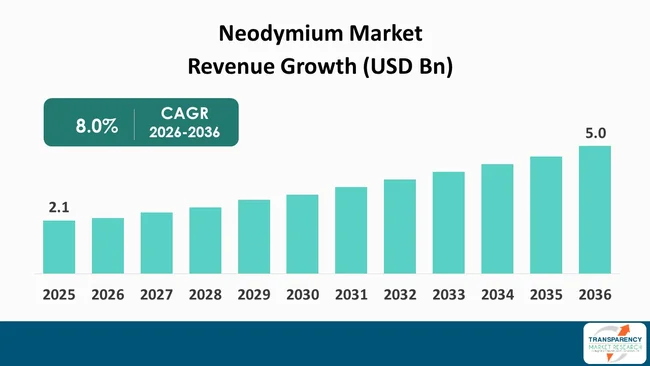
The neodymium market is undergoing transformation from a specialty products market to a strategic and more crucial part of the energy transition story. The demand drivers for neodymium have shifted and are now increasingly rooted in structural industries such as electric mobility, renewable energy, and industrialization, rather than in consumer electronics alone.
With permanent motors leading to permanently large demand for neodymium, even remotely conceivable expansion in EV or wind capacity leads to vastly higher levels of demand intensity for neodymium. The industry is highly consolidated and remains processing-intensive, leading to inherent susceptibility to geopolitical events and state intervention. Increasingly, investors and OEMs now concentrate on integrating upward and securing long-term offtake agreements and local downstream production chains. The fact is that a new trend, beginning with non-Chinese producers, is to secure all forms of NdPr oxides, metals, and alloys closer to demand. At the same time, the importance of recycling is continuously increasing with end-of-life conversion of initial EV and wind installations in sight, offering a carbon-neutral alternative to primary production. The industry is now witnessing an evolving security-of-supply-driven market, with access, origin-traceability, and processing potential becoming incomparably more important than cost alone.
Neodymium is a key strategic rare earth element that has high magnetic, optical, and metallurgical properties, rendering it essential for various high-tech sectors. It is mainly used as an alloy, especially neodymium iron boron compound, which exhibits high magnetic field strength, high temperature stability, and efficiency. Regarding its applications, neodymium is primarily used as a magnetic component, laser crystals, specialty glasses, and phosphors for its ability to enhance optical, coloration, and efficiency attributes.
As an alloying agent used in steel and non-ferrous metals, neodymium increases their strength, corrosion resistance, and high-temperature properties. In terms of material supply chain complexity, neodymium is often produced by a set of complex mining, separation, and processing techniques, which demand high technical knowledge and high capital investments. In view of its supply-life cycle, neodymium is thus primarily dependent not on its material supply but on the processing capacity of the overall rare earth group. The high technical complexity combined with the processing intensity of neodymium thus make it an essential material input for high-tech sectors.
| Attribute | Detail |
|---|---|
| Neodymium Market Drivers |
|
The burgeoning demand for electric vehicles and electrified powertrains is a major driving factor for the demand for neodymium, as it is a vital component in a neodymium iron boron (NdFeB) permanent magnet, a crucial component in a traction motor. Permanent magnet synchronous motors are preferred over induction motors by automakers because they can provide a high torque density with improved efficiency and a lighter design, ensuring direct advantages in favor of a longer driving range and a more compact powertrain design.
On an average, a battery-electric passenger car uses up to 1-2 Kg of magnet-grade neodymium, whereas electric buses and light-duty commercial vehicles can consume upwards of 3-5 Kg per unit due to their high power density. The worldwide EV sales base crossed 14 million units in 2024 alone. At a double-digit compound annual growth rate in 2025, this is a massive incremental demand for rare earth magnets. For instance, a massive demand for 5 million units a year can create an approximate demand for 5,000-10,000 tons of magnetic materials, a major portion of which comprises neodymium. Additionally, two-wheelers in Asia, electric trucks, and hybrid vehicles are pushing the demand base even further.
The neodymium market is experiencing growth due to the increase in demand for wind energy and the other renewable energy power systems, as neodymium is a key material in the production of neodymium iron boron (NdFeB) permanent magnets used in modern wind turbines.
The design of direct drive or hybrid-converter system wind turbines requires the use of NdFeB permanent magnets so that they can operate more efficiently than traditional designs. By using a permanent magnet generator instead of a traditional generator, the turbines have lower mechanical losses, are more efficient at generating electricity, and require less maintenance and servicing to be effective, especially in offshore environments where service costs are very high. Large onshore wind turbines can use 150 to 250 kg of NdFeB magnets per turbine; whereas offshore wind turbines greater than 10 MW can use between 400 to 600 kg of magnets per turbine; therefore, large quantities of neodymium will be used by each turbine.
If 50 GW of new wind capacity is added in a given year, this will require thousands of tons of rare earth elements (a significant portion of that is neodymium) to complete the construction of these new systems.
As all of the major global markets set targets for carbon neutrality (China, the U.S., and Europe), offshore wind generation will be developed more rapidly and rely on permanent magnets in more wind generation applications than in the past. This stationary and infrastructure-based deployment will create long-term neodymium supply stability within the entire global energy value chain.
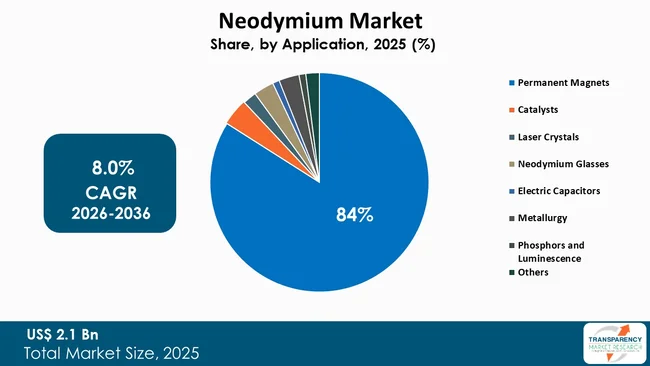
Permanent magnets are the dominated segment in the neodymium market in terms of application-wise demand, as neodymium is consumed in large volumes worldwide for the production of permanent magnets called neodymium-iron-boron (NdFeB) magnets, also referred to as super magnets.
NdFeB magnets possess the greatest magnetic force out of all permanent magnets that are commercially available in the market. This is followed by permanent magnets, as more than 80% of the total neodymium demand is from permanent magnets worldwide. A passenger vehicle requires around 1-2 kilograms of neodymium magnet material on an average for electric vehicles. On the other hand, electric buses, wind generators, and permanent motors require far more neodymium material.
A single offshore wind power generator consumes around 400-600 kilograms of NdFeB material, thus requiring large-scale neodymium material on a per installation basis. Apart from these applications, NdFeB material is used in consumer electronics, robotic devices, and industries requiring high precision as well as high power-density applications.
| Attribute | Detail |
|---|---|
| Key Opportunity |
|
The emergence of non-Chinese neodymium supply chains and recycling loops is a major strategic challenge in the neodymium industry, with increasing concerns over critical supply chain concentration and geopolitics.
Today, China holds more than 85% of worldwide neodymium separation and NdFeB magnet production, risking automotive, renewable, and defense sector supply chains in Western countries. As a result, Western governments in the U.S., European countries, and Australia are investing in emerging themes via financial grants, tax credits, and long-term off-take contracts. For instance, one medium-scale rare earth separation capacity outside China can currently produce 3,000 to 5,000 tons per year of high-grade NdPr oxide, capable of meeting magnets for over 2 million electric cars. The recycling sector is equally promising.
The dead EV motors and wind turbine stocks will contain net weight percentages ranging between 20% and 30% neodymium content in recycled magnetic components, with substantially low recycle energy costs relative to mining, processing, and converting primary ore. Starting 2030, recycling magnets can meet 10% to 15% of total worldwide neodymium demand, offsetting both volatility and ESG requirements.
| Attribute | Detail |
|---|---|
| Leading Region |
|
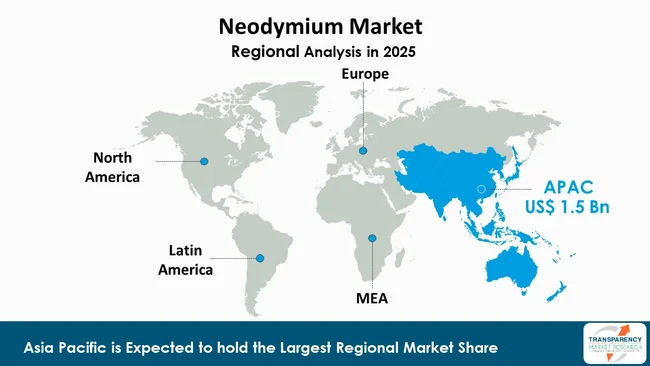
Asia-Pacific currently consumes more than 70% of the global neodymium, mainly due to China's strong rare earth element processing, Neodymium iron boron magnet manufacturing, and subsequent manufacturing. China alone currently produces more than 80% of the global NdFeB-type magnets, mainly for use in electric vehicles, wind-solar power, and subsequent electronic devices.
Asia-Pacific gets a boost with highly advanced magnet usage in transportation and electronic properties in countries like Japan and South Korea. The Europe’s market currently constitutes about 11% of the global demand in the neodymium segment, mainly driven by the rapid growth in the electrical vehicle and renewable sectors. For instance, Europe currently accumulates tens of gigawatts every year, largely in offshore projects, in which case, the use of permanent magnetic generators from Asia-Pacific is currently a major objective.
North America currently constitutes about 9% of the demand mainly due to electrical vehicles, military uses, and renewable power projects.
China Minmetals Rare Earth Company Ltd. is one of the most active participants in the worldwide neodymium industry, thanks to its integration into China's streamlined rare earth industry system. The company covers mining, separation, and smelting, allowing for massive production of neodymium and NdPr oxides, which can be applied in the production of permanent magnets. Its close ties with local permanent magnet manufacturers help to ensure a stable sales outlet in new energy, wind power, and industrial motors, so China's leading role in the worldwide neodymium industry chain is secured.
Lynas Rare Earth Ltd is the world's largest processor and producer of separated rare earth products outside of China and a major neodymium nd-pr supplier. The firm manufactures nd-pr oxide and concentrate that is vital in producing high-performance neodymium permanent magnets in EV and renewable energy applications. In this case, Lynas Rare Earth is also strategic in diversifying neodymium supplies to Western automotive and energy and industrial markets.
Arafura Resources, Metall Rare Earth Limited, HEFA Rare Earth Canada Co. Ltd., Alkane Resources Ltd, Neo Performance Materials Inc., Lenntech Water Treatment Solutions, Australian Strategic Materials Ltd., American Elements, and Noah Technologies Corporation are some other companies in the global neodymium chemicals market. Each of these players has been profiled in the neodymium chemicals market research report based on parameters such as company overview, financial overview, business strategies, product portfolio, business segments, and recent developments.
| Attribute | Detail |
|---|---|
| Market Size Value in 2025 | US$ 2.1 Bn |
| Market Forecast Value in 2036 | US$ 5.0 Bn |
| Growth Rate (CAGR) | 8.0% |
| Forecast Period | 2026-2036 |
| Historical Data Available for | 2021-2024 |
| Quantitative Units | US$ Bn and USD Billion for Value & Tons for Volume |
| Market Analysis | It includes cross-segment analysis at the global as well as regional level. Furthermore, the qualitative analysis includes drivers, restraints, neodymium market opportunities, key trends, Porter’s Five Forces analysis, value chain analysis, and key trend analysis. |
| Competition Landscape |
|
| Format | Electronic (PDF) + Excel |
| Market Segmentation | Application
|
| Regions Covered |
|
| Countries Covered |
|
| Companies Profiled |
|
| Customization Scope | Available upon request |
| Pricing | Available upon request |
The neodymium market was valued at US$ 2.1 Bn in 2025
The neodymium industry is expected to grow at a CAGR of 8.0% from 2026 to 2036
Rapid growth of electric vehicles and electrified powertrains and expansion of wind energy and renewable power infrastructure
Permanent magnets was the largest application segment in the neodymium market.
Asia Pacific was the most lucrative region in 2025
Lynas Rare Earth Ltd, Arafura Resources, Metall Rare Earth Limited, HEFA Rare Earth Canada Co. Ltd., Alkane Resources Ltd, Neo Performance Materials Inc., China Minmetals Rare Earth Co. Ltd., Lenntech Water Treatment Solutions, Australian Strategic Materials Ltd., American Elements, and Noah Technologies Corporation are the major companies in the global neodymium market.
List of Tables
Table 1 Global Neodymium Market Volume (Tons) Forecast, by Application, 2026 to 2036
Table 2 Global Neodymium Market Value (US$ Bn) Forecast, by Application, 2026 to 2036
Table 3 Global Neodymium Market Volume (Tons) Forecast, by Region, 2026 to 2036
Table 4 Global Neodymium Market Value (US$ Bn) Forecast, by Region, 2026 to 2036
Table 5 North America Neodymium Market Volume (Tons) Forecast, by Application, 2026 to 2036
Table 6 North America Neodymium Market Value (US$ Bn) Forecast, by Application, 2026 to 2036
Table 7 North America Neodymium Market Volume (Tons) Forecast, by Country, 2026 to 2036
Table 8 North America Neodymium Market Value (US$ Bn) Forecast, by Country, 2026 to 2036
Table 9 U.S. Neodymium Market Volume (Tons) Forecast, by Application, 2026 to 2036
Table 10 U.S. Neodymium Market Value (US$ Bn) Forecast, by Application, 2026 to 2036
Table 11 Canada Neodymium Market Volume (Tons) Forecast, by Application, 2026 to 2036
Table 12 Canada Neodymium Market Value (US$ Bn) Forecast, by Application, 2026 to 2036
Table 13 Europe Neodymium Market Volume (Tons) Forecast, by Application, 2026 to 2036
Table 14 Europe Neodymium Market Value (US$ Bn) Forecast, by Application, 2026 to 2036
Table 15 Europe Neodymium Market Volume (Tons) Forecast, by Country and Sub-region, 2026 to 2036
Table 16 Europe Neodymium Market Value (US$ Bn) Forecast, by Country and Sub-region, 2026 to 2036
Table 17 Germany Neodymium Market Volume (Tons) Forecast, by Application, 2026 to 2036
Table 18 Germany Neodymium Market Value (US$ Bn) Forecast, by Application, 2026 to 2036
Table 19 France Neodymium Market Volume (Tons) Forecast, by Application, 2026 to 2036
Table 20 France Neodymium Market Value (US$ Bn) Forecast, by Application, 2026 to 2036
Table 21 U.K. Neodymium Market Volume (Tons) Forecast, by Application, 2026 to 2036
Table 22 U.K. Neodymium Market Value (US$ Bn) Forecast, by Application, 2026 to 2036
Table 23 Italy Neodymium Market Volume (Tons) Forecast, by Application, 2026 to 2036
Table 24 Italy Neodymium Market Value (US$ Bn) Forecast, by Application, 2026 to 2036
Table 25 Spain Neodymium Market Volume (Tons) Forecast, by Application, 2026 to 2036
Table 26 Spain Neodymium Market Value (US$ Bn) Forecast, by Application, 2026 to 2036
Table 27 Russia & CIS Neodymium Market Volume (Tons) Forecast, by Application, 2026 to 2036
Table 28 Russia & CIS Neodymium Market Value (US$ Bn) Forecast, by Application, 2026 to 2036
Table 29 Rest of Europe Neodymium Market Volume (Tons) Forecast, by Application, 2026 to 2036
Table 30 Rest of Europe Neodymium Market Value (US$ Bn) Forecast, by Application, 2026 to 2036
Table 31 Asia Pacific Neodymium Market Volume (Tons) Forecast, by Application, 2026 to 2036
Table 32 Asia Pacific Neodymium Market Value (US$ Bn) Forecast, by Application, 2026 to 2036
Table 33 Asia Pacific Neodymium Market Volume (Tons) Forecast, by Country and Sub-region, 2026 to 2036
Table 34 Asia Pacific Neodymium Market Value (US$ Bn) Forecast, by Country and Sub-region, 2026 to 2036
Table 35 China Neodymium Market Volume (Tons) Forecast, by Application, 2026 to 2036
Table 36 China Neodymium Market Value (US$ Bn) Forecast, by Application, 2026 to 2036
Table 37 Japan Neodymium Market Volume (Tons) Forecast, by Application, 2026 to 2036
Table 38 Japan Neodymium Market Value (US$ Bn) Forecast, by Application, 2026 to 2036
Table 39 India Neodymium Market Volume (Tons) Forecast, by Application, 2026 to 2036
Table 40 India Neodymium Market Value (US$ Bn) Forecast, by Application, 2026 to 2036
Table 41 ASEAN Neodymium Market Volume (Tons) Forecast, by Application, 2026 to 2036
Table 42 ASEAN Neodymium Market Value (US$ Bn) Forecast, by Application, 2026 to 2036
Table 43 Rest of Asia Pacific Neodymium Market Volume (Tons) Forecast, by Application, 2026 to 2036
Table 44 Rest of Asia Pacific Neodymium Market Value (US$ Bn) Forecast, by Application, 2026 to 2036
Table 45 Latin America Neodymium Market Volume (Tons) Forecast, by Application, 2026 to 2036
Table 46 Latin America Neodymium Market Value (US$ Bn) Forecast, by Application, 2026 to 2036
Table 47 Latin America Neodymium Market Volume (Tons) Forecast, by Country and Sub-region, 2026 to 2036
Table 48 Latin America Neodymium Market Value (US$ Bn) Forecast, by Country and Sub-region, 2026 to 2036
Table 49 Brazil Neodymium Market Volume (Tons) Forecast, by Application, 2026 to 2036
Table 50 Brazil Neodymium Market Value (US$ Bn) Forecast, by Application, 2026 to 2036
Table 51 Mexico Neodymium Market Volume (Tons) Forecast, by Application, 2026 to 2036
Table 52 Mexico Neodymium Market Value (US$ Bn) Forecast, by Application, 2026 to 2036
Table 53 Rest of Latin America Neodymium Market Volume (Tons) Forecast, by Application, 2026 to 2036
Table 54 Rest of Latin America Neodymium Market Value (US$ Bn) Forecast, by Application, 2026 to 2036
Table 55 Middle East & Africa Neodymium Market Volume (Tons) Forecast, by Application, 2026 to 2036
Table 56 Middle East & Africa Neodymium Market Value (US$ Bn) Forecast, by Application, 2026 to 2036
Table 57 Middle East & Africa Neodymium Market Volume (Tons) Forecast, by Country and Sub-region, 2026 to 2036
Table 58 Middle East & Africa Neodymium Market Value (US$ Bn) Forecast, by Country and Sub-region, 2026 to 2036
Table 59 GCC Neodymium Market Volume (Tons) Forecast, by Application, 2026 to 2036
Table 60 GCC Neodymium Market Value (US$ Bn) Forecast, by Application, 2026 to 2036
Table 61 South Africa Neodymium Market Volume (Tons) Forecast, by Application, 2026 to 2036
Table 62 South Africa Neodymium Market Value (US$ Bn) Forecast, by Application, 2026 to 2036
Table 63 Rest of Middle East & Africa Neodymium Market Volume (Tons) Forecast, by Application, 2026 to 2036
Table 64 Rest of Middle East & Africa Neodymium Market Value (US$ Bn) Forecast, by Application, 2026 to 2036
Figure 1 Global Neodymium Market Value Share Analysis, by Application, 2025, 2029, and 2036
Figure 2 Global Neodymium Market Attractiveness, by Application,
Figure 3 Global Neodymium Market Value Share Analysis, by Region, 2025, 2029, and 2036
Figure 4 Global Neodymium Market Attractiveness, by Region
Figure 5 North America Neodymium Market Value Share Analysis, by Application, 2025, 2029, and 2036
Figure 6 North America Neodymium Market Attractiveness, by Application,
Figure 7 North America Neodymium Market Attractiveness, by Country and Sub-region
Figure 8 Europe Neodymium Market Value Share Analysis, by Application, 2025, 2029, and 2036
Figure 9 Europe Neodymium Market Attractiveness, by Application,
Figure 10 Europe Neodymium Market Value Share Analysis, by Country and Sub-region, 2025, 2029, and 2036
Figure 11 Europe Neodymium Market Attractiveness, by Country and Sub-region
Figure 12 Asia Pacific Neodymium Market Value Share Analysis, by Application, 2025, 2029, and 2036
Figure 13 Asia Pacific Neodymium Market Attractiveness, by Application,
Figure 14 Asia Pacific Neodymium Market Value Share Analysis, by Country and Sub-region, 2025, 2029, and 2036
Figure 15 Asia Pacific Neodymium Market Attractiveness, by Country and Sub-region
Figure 16 Latin America Neodymium Market Value Share Analysis, by Application, 2025, 2029, and 2036
Figure 17 Latin America Neodymium Market Attractiveness, by Application,
Figure 18 Latin America Neodymium Market Value Share Analysis, by Country and Sub-region, 2025, 2029, and 2036
Figure 19 Latin America Neodymium Market Attractiveness, by Country and Sub-region
Figure 20 Middle East & Africa Neodymium Market Value Share Analysis, by Application, 2025, 2029, and 2036
Figure 21 Middle East & Africa Neodymium Market Value Share Analysis, by Country and Sub-region, 2025, 2029, and 2036
Figure 22 Middle East & Africa Neodymium Market Attractiveness, by Country and Sub-region
Copyright © Transparency Market Research, Inc. All Rights reserved
Trust Online


Neodymium Market
