

Reports
Reports
The global Pozzolan market size was valued at USD 83.5 Billion in 2025 and is projected to reach USD 147.3 Billion by 2036, expanding at a CAGR of 5.3% from 2026 to 2036. The market growing by rising demand for sustainable and low-carbon construction material.
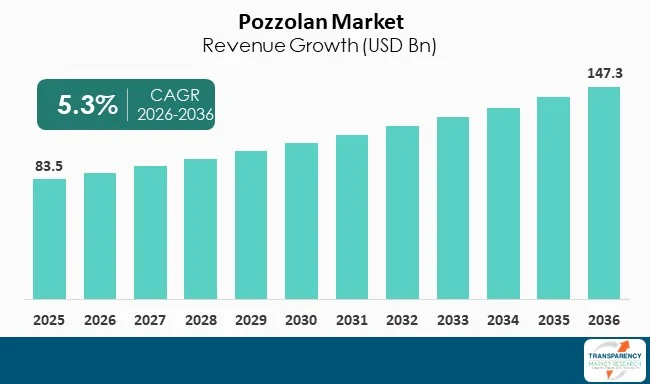
The global pozzolan market is undergoing a consistent rise. The main factors behind this are the worldwide inclination to use construction materials which are environment-friendly and the increasing necessity to minimize the carbon footprint of cement production. Pozzolans, comprising natural volcanic ash with industrial by-products like fly ash and silica fume, are the main components for making blended cement and concrete. They are preferred since they enhance properties and performance of the final product while at the same time reducing cement consumption. Infrastructure development is rising also in the emerging economies, the environmental regulations are becoming stricter about greenhouse emissions, and this has resulted in the increase of pozzolan usage in the construction of housing, businesses, and transportation facilities.
The material is being used more and more for sea structures dams bridges, and wastewater treatment plants since it brings the best performance over the years. Key players in Pozzolan Market concentrate on increasing production capacity, upgrading beneficiation and processing technologies, and inventing high-reactivity pozzolan varieties to comply with the changing construction codes. Many companies have involved themselves in making strategic partnerships with cement manufacturers and at the same time promote low-carbon cement solutions that are compatible with global sustainability initiatives. This not only strengthens their market penetration but also the long-term growth prospects.
The pozzolan market is essentially the global sector that deals with materials which act as additional cementing agents in cement and concrete manufacturing. Pozzolans are naturally occurring or manufactured materials that contain silica or alumina and, when combined with calcium hydroxide and water, they chemically react to produce compounds that have properties similar to cement. Such materials comprise not only natural volcanic ash but also industrial wastes like fly ash, silica fume, and calcined clay. Due to their role in enhancing the strength, durability, and chemical resistance of concrete, pozzolans find many uses in the construction of bridges dams marine structures, roads, and dwellings, among other projects.
| Attribute | Detail |
|---|---|
| Pozzolan Market Drivers |
|
The expanding demand for sustainable and environmentally friendly materials in construction has become the main reason behind the growth of the pozzolan market. It is because the worldwide construction industry is being pushed to minimize its environmental impacts and follow the new climate rules. Pozzolan materials are extensively discussed as they are used to partly substitute clinker in the production of cement which leads to a considerable decrease of carbon dioxide emissions that is one of the main by-products of the manufacture of cement. Production of Portland cement which is the traditional type famously is among the major industrial sources of greenhouse gases. Construction companies, infrastructure investors, and governments are looking for other additional cementitious materials that can provide a higher level of sustainability without lowering the quality of the construction. Pozzolanic materials like fly ash, silica fume, volcanic ash, and calcined clay are not only a very effective means to make concrete stronger and more durable but also to produce less heat during the setting process, and to resist chemical attacks better while at the same time reducing the use of clinker. An additional environmental compliance and technical capability is providing incentive towards the increased usage of these products in residential, commercial, and industrial construction.
Government policies aimed at promoting green buildings and carbon-neutral infrastructure are even more deepening demand in the Pozzolan market. Several areas have implemented regulatory structures compelling the use of mixed cement and environmentally friendly concrete materials in public infrastructure, transport systems, marine construction, and energy facilities. Sustainability certification schemes and environmental norms are giving the impetus to contractors and property developers to incorporate green construction materials in their projects. The growing focus on circular economy principles is equally benefiting consumer of pozzolans, mainly industrial by-products like fly ash and slag-derived materials, which not only reduce waste from industries but also produce valuable inputs for construction.
Key players in the industry are reacting to the market shifts by gearing up for major technological upgrades, targeting high productivity, and diversifying into new products. These steps are aimed at creating super-reactive pozzolanic materials that will meet the stringent standards of today's construction industry. Another move that companies are making is partnering with cement manufacturers and infrastructure companies to not only broaden their range of environmentally friendly cements but also to ensure their supply chains are very robust.
Growing infrastructure at a global scale and fast urbanization mainly fuel expansion of the pozzolan market. That is because governments and private sector developers increasingly pour funds into transportation networks, smart cities, industrial facilities, residential complexes, and public utility infrastructure. The upward trend of world population and people moving to cities lead to huge demand for construction materials that are durable and at the same time economical, which can also support structural performance for a long period of time. Due to their capability to not only increase concrete strength but also to reduce permeability, improve chemical resistance and extend the service life of infrastructure, pozzolans have become an indispensable element of contemporary building. Due to these features, pozzolan-based blended cement is very apt for large-scale infrastructure uses like bridges tunnels highways, dams ports airports, rail corridors, and wastewater treatment facilities where infrastructure durability over a long period and low maintenance costs are the most important factors.
Emerging economies across Asia Pacific, Middle East, Latin America, and Africa are undergoing rapid urban development and industrial growth, which in turn is generating strong consumption demand for cement and concrete products. Governments across these regions are increasingly investing in infrastructure upgrade programs to support economic growth, improve connectivity, and strengthen energy and transportation systems. Construction firms have begun to utilize supplementary cementitious materials like pozzolans not only to increase project productivity but also to help meet sustainability goals and regulatory compliance. Besides enhancing concrete properties, pozzolans can also make a difference in cost savings as they allow a reduction in clinker consumption - something important that has been gaining prominence due to the volatility of raw material and energy prices.
A renewed attention on resilient infrastructure that can withstand harsh climatic conditions is also a reason for increasing market penetration. Concrete containing pozzolans exhibit resistance even at a higher level against attack by sulfates, alkali-silica reaction and corrosion. It is quite beneficial in the construction of marine structures, coastal areas and industries exposed to aggressive environments. Leading players in the industry are increasing their production capacity, consolidating their regional distribution networks, and creating partnerships with construction and cement companies to make the most out of the rising infrastructure spending. Pozzolan processing and raw material optimization technological changes are helping producers to guarantee a high-quality standard of their products and offer customized solutions that are per the changing engineering and construction standards, which support the continuous growth of the Pozzolan market worldwide.
| Attribute | Detail |
|---|---|
| Pozzolan Market Opportunity |
|
The increased use of green cement technologies has led to a significant rise in the demand for pozzolan as governments, together with the construction industry, make concerted efforts to reduce carbon emissions derived from building materials. Pozzolans, as secondary cement materials, are gradually replacing clinker, which is the biggest reason of high energy use and carbon emissions in the production of conventional cement. By incorporating fly ash, silica fume, calcined clay, and natural volcanic ash, cement producers not only can make low carbon blended cement but also Quite a bit enhance concrete properties conferring higher durability, strength, and resistance to chemical corrosion. The growing realization of sustainable infrastructure and tougher environmental laws are acting as catalysts for the adoption of pozzolans even more in the processes of cement manufacturing.
Infrastructure developers, contractors, and real estate companies are not only taking up green cement technologies but also making it a part of their green building certification and sustainability targets. Advances in pozzolan processing and beneficiation are leading to better material quality and performance consistency that will encourage a wider commercial acceptance of pozzolans for residential, industrial, and transportation construction projects. On top of this, several leading players in the industry are making production expansions, ones of research partnerships, and launching new innovative low-carbon product portfolios as a way of increasing their market competitiveness.
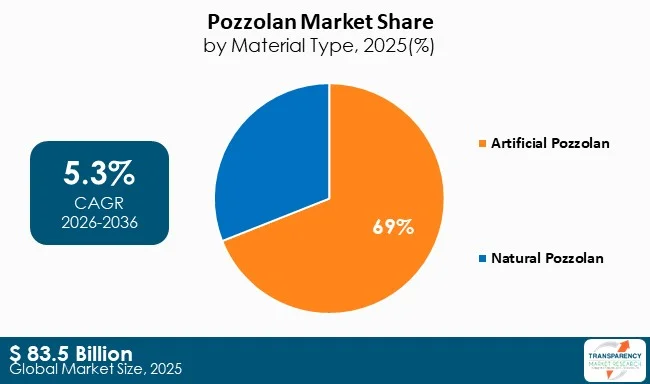
Artificial pozzolan makes up almost 69% of the pozzolan market mainly because it is widely available, inexpensive, and has a stable performance in cement and concrete applications. These include fly ash, silica fume, and slag which offer multiple benefits like improving durability, increasing strength, decreasing permeability, and reducing the amount of clinker used in blended cement production. Swift infrastructure development, the rising requirement for green building materials and the increasing use of industrial by-products for greener cement production are factors that are continuously helping the strong worldwide growth of artificial pozzolans.
| Attribute | Detail |
|---|---|
| Leading Region |
|
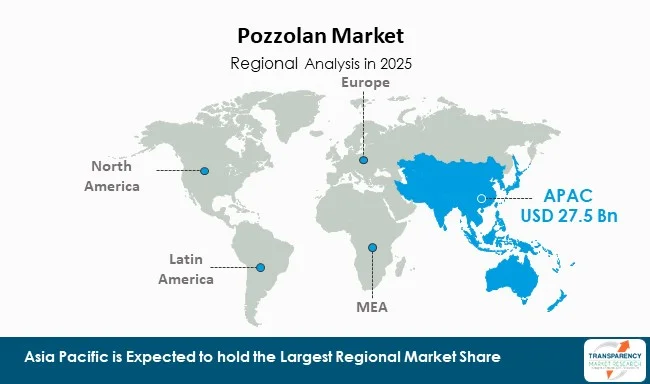
Asia Pacific dominates about 33% of the global pozzolan market owing to the rapid urbanization, huge infrastructure development, and consumption of cement in countries like China, India, and Japan. Governments across the region have been making significant investments in different sectors like transportation, smart cities, commercial buildings, and residential infrastructure that are majorly contributing to the increased demand of blended cement and sustainable construction materials. The region also benefits from the plentiful supply of fly ash and other industrial by-products and the introduction of stricter environmental regulations for low-carbon cement manufacturing which are together giving a considerable push to the market growth.
Imerys, 3M, WR Grace & Co-Conn. and Charah Solutions, Inc. are some of the companies that offer high-tech pozzolanic materials and cement-performance solutions aimed at sustainable construction. They provide different types of products like calcined clay, fly ash beneficiation technologies, silica-based additives, and cement enhancement products, which contribute to the production of more durable concrete, reduction of clinker usage, and support for the manufacture of low-carbon blended cement for building and industrial construction projects anywhere in the world.
Each of these players has been profiled in the Pozzolan market research report based on parameters such as company overview, financial overview, business strategies, product portfolio, business segments, and recent developments
| Attribute | Detail |
|---|---|
| Market Size Value in 2025 | USD 83.5 Billion |
| Market Forecast Value in 2036 | USD 147.3 Billion |
| Growth Rate (CAGR) | 5.3% |
| Forecast Period | 2026-2036 |
| Historical Data Available for | 2021-2024 |
| Quantitative Units | USD Billion for Value and Tons for Volume |
| Pozzolan Market Analysis | It includes cross-segment analysis at the global as well as regional level. The qualitative analysis includes drivers, restraints, Carbon Fiber market opportunities, key trends, Porter’s Five Forces analysis, value chain analysis, and key trend analysis. |
| Competition Landscape |
|
| Format | Electronic (PDF) + Excel |
| Market Segmentation | By Material Type
|
| Regions Covered |
|
| Countries Covered |
|
| Companies Profiled |
|
| Customization Scope | Available upon request |
| Pricing | Available upon request |
The Pozzolan market stood at USD 83.5 Billion in 2025.
The Pozzolan industry is expected to grow at a CAGR of 5.3% from 2026 to 2036.
Rising demand for sustainable and low-carbon construction materials and expansion of global infrastructure and urbanization projects.
Artificial Pozzolan held the largest share under the Material Type segment in 2025, accounting for 69% of the market.
Asia Pacific was the most lucrative region in the Pozzolan market in 2025, holding the largest revenue share of 33%.
Key players include, CARBO Ceramics Inc, CR Minerals Company, LLC., Hess Pumice Incorporated, The 3M Company, Imerys, Nevada Cement Company, Nanoshel LLC, I-Minerals Inc., Kirkland Mining Company, Sunrise Resources plc, W. R. Grace & Co.-Conn., Charah Solutions, Inc., Burgess Pigment Company, Pozzolanic Phils., Inc. (PPI), and Vitro Minerals.
Table 1 Global Pozzolan Market Volume (Tons) Forecast, by Material Type, 2026 to 2036
Table 2 Global Pozzolan Market Value (USD Billion) Forecast, by Material Type, 2026 to 2036
Table 3 Global Pozzolan Market Volume (Tons) Forecast, by End-use, 2026 to 2036
Table 4 Global Pozzolan Market Value (USD Billion) Forecast, by End-use, 2026 to 2036
Table 5 Global Pozzolan Market Volume (Tons) Forecast, by Region, 2026 to 2036
Table 6 Global Pozzolan Market Value (USD Billion) Forecast, by Region, 2026 to 2036
Table 7 North America Pozzolan Market Volume (Tons) Forecast, by Material Type, 2026 to 2036
Table 8 North America Pozzolan Market Value (USD Billion) Forecast, by Material Type, 2026 to 2036
Table 9 North America Pozzolan Market Volume (Tons) Forecast, by End-use, 2026 to 2036
Table 10 North America Pozzolan Market Value (USD Billion) Forecast, by End-use, 2026 to 2036
Table 11 North America Pozzolan Market Volume (Tons) Forecast, by Country, 2026 to 2036
Table 12 North America Pozzolan Market Value (USD Billion) Forecast, by Country, 2026 to 2036
Table 13 USA Pozzolan Market Volume (Tons) Forecast, by Material Type, 2026 to 2036
Table 14 USA Pozzolan Market Value (USD Billion) Forecast, by Material Type, 2026 to 2036
Table 15 USA Pozzolan Market Volume (Tons) Forecast, by End-use, 2026 to 2036
Table 16 USA Pozzolan Market Value (USD Billion) Forecast, by End-use, 2026 to 2036
Table 17 Canada Pozzolan Market Volume (Tons) Forecast, by Material Type, 2026 to 2036
Table 18 Canada Pozzolan Market Value (USD Billion) Forecast, by Material Type, 2026 to 2036
Table 19 Canada Pozzolan Market Volume (Tons) Forecast, by End-use, 2026 to 2036
Table 20 Canada Pozzolan Market Value (USD Billion) Forecast, by End-use 2026 to 2036
Table 21 Europe Pozzolan Market Volume (Tons) Forecast, by Material Type, 2026 to 2036
Table 22 Europe Pozzolan Market Value (USD Billion) Forecast, by Material Type, 2026 to 2036
Table 23 Europe Pozzolan Market Volume (Tons) Forecast, by End-use, 2026 to 2036
Table 24 Europe Pozzolan Market Value (USD Billion) Forecast, by End-use 2026 to 2036
Table 25 Europe Pozzolan Market Volume (Tons) Forecast, by Country and Sub-region, 2026 to 2036
Table 26 Europe Pozzolan Market Value (USD Billion) Forecast, by Country and Sub-region, 2026 to 2036
Table 27 Germany Pozzolan Market Volume (Tons) Forecast, by Material Type, 2026 to 2036
Table 28 Germany Pozzolan Market Value (USD Billion) Forecast, by Material Type, 2026 to 2036
Table 29 Germany Pozzolan Market Volume (Tons) Forecast, by End-use, 2026 to 2036
Table 30 Germany Pozzolan Market Value (USD Billion) Forecast, by End-use 2026 to 2036
Table 31 France Pozzolan Market Volume (Tons) Forecast, by Material Type, 2026 to 2036
Table 32 France Pozzolan Market Value (USD Billion) Forecast, by Material Type, 2026 to 2036
Table 33 France Pozzolan Market Volume (Tons) Forecast, by End-use, 2026 to 2036
Table 34 France Pozzolan Market Value (USD Billion) Forecast, by End-use 2026 to 2036
Table 35 UK Pozzolan Market Volume (Tons) Forecast, by Material Type, 2026 to 2036
Table 36 UK Pozzolan Market Value (USD Billion) Forecast, by Material Type, 2026 to 2036
Table 37 UK Pozzolan Market Volume (Tons) Forecast, by End-use, 2026 to 2036
Table 38 UK Pozzolan Market Value (USD Billion) Forecast, by End-use 2026 to 2036
Table 39 Italy Pozzolan Market Volume (Tons) Forecast, by Material Type, 2026 to 2036
Table 40 Italy Pozzolan Market Value (USD Billion) Forecast, by Material Type, 2026 to 2036
Table 41 Italy Pozzolan Market Volume (Tons) Forecast, by End-use, 2026 to 2036
Table 42 Italy Pozzolan Market Value (USD Billion) Forecast, by End-use 2026 to 2036
Table 43 Spain Pozzolan Market Volume (Tons) Forecast, by Material Type, 2026 to 2036
Table 44 Spain Pozzolan Market Value (USD Billion) Forecast, by Material Type, 2026 to 2036
Table 45 Spain Pozzolan Market Volume (Tons) Forecast, by End-use, 2026 to 2036
Table 46 Spain Pozzolan Market Value (USD Billion) Forecast, by End-use 2026 to 2036
Table 47 Russia & CIS Pozzolan Market Volume (Tons) Forecast, by Material Type, 2026 to 2036
Table 48 Russia & CIS Pozzolan Market Value (USD Billion) Forecast, by Material Type, 2026 to 2036
Table 49 Russia & CIS Pozzolan Market Volume (Tons) Forecast, by End-use, 2026 to 2036
Table 50 Russia & CIS Pozzolan Market Value (USD Billion) Forecast, by End-use 2026 to 2036
Table 51 Rest of Europe Pozzolan Market Volume (Tons) Forecast, by Material Type, 2026 to 2036
Table 52 Rest of Europe Pozzolan Market Value (USD Billion) Forecast, by Material Type, 2026 to 2036
Table 53 Rest of Europe Pozzolan Market Volume (Tons) Forecast, by End-use, 2026 to 2036
Table 54 Rest of Europe Pozzolan Market Value (USD Billion) Forecast, by End-use 2026 to 2036
Table 55 Asia Pacific Pozzolan Market Volume (Tons) Forecast, by Material Type, 2026 to 2036
Table 56 Asia Pacific Pozzolan Market Value (USD Billion) Forecast, by Material Type, 2026 to 2036
Table 57 Asia Pacific Pozzolan Market Volume (Tons) Forecast, by End-use, 2026 to 2036
Table 58 Asia Pacific Pozzolan Market Value (USD Billion) Forecast, by End-use 2026 to 2036
Table 59 Asia Pacific Pozzolan Market Volume (Tons) Forecast, by Country and Sub-region, 2026 to 2036
Table 60 Asia Pacific Pozzolan Market Value (USD Billion) Forecast, by Country and Sub-region, 2026 to 2036
Table 61 China Pozzolan Market Volume (Tons) Forecast, by Material Type, 2026 to 2036
Table 62 China Pozzolan Market Value (USD Billion) Forecast, by Material Type 2026 to 2036
Table 63 China Pozzolan Market Volume (Tons) Forecast, by End-use, 2026 to 2036
Table 64 China Pozzolan Market Value (USD Billion) Forecast, by End-use 2026 to 2036
Table 65 Japan Pozzolan Market Volume (Tons) Forecast, by Material Type, 2026 to 2036
Table 66 Japan Pozzolan Market Value (USD Billion) Forecast, by Material Type, 2026 to 2036
Table 67 Japan Pozzolan Market Volume (Tons) Forecast, by End-use, 2026 to 2036
Table 68 Japan Pozzolan Market Value (USD Billion) Forecast, by End-use 2026 to 2036
Table 69 India Pozzolan Market Volume (Tons) Forecast, by Material Type, 2026 to 2036
Table 70 India Pozzolan Market Value (USD Billion) Forecast, by Material Type, 2026 to 2036
Table 71 India Pozzolan Market Volume (Tons) Forecast, by End-use, 2026 to 2036
Table 72 India Pozzolan Market Value (USD Billion) Forecast, by End-use 2026 to 2036
Table 73 ASEAN Pozzolan Market Volume (Tons) Forecast, by Material Type, 2026 to 2036
Table 74 ASEAN Pozzolan Market Value (USD Billion) Forecast, by Material Type, 2026 to 2036
Table 75 ASEAN Pozzolan Market Volume (Tons) Forecast, by End-use, 2026 to 2036
Table 76 ASEAN Pozzolan Market Value (USD Billion) Forecast, by End-use 2026 to 2036
Table 77 Rest of Asia Pacific Pozzolan Market Volume (Tons) Forecast, by Material Type, 2026 to 2036
Table 78 Rest of Asia Pacific Pozzolan Market Value (USD Billion) Forecast, by Material Type, 2026 to 2036
Table 79 Rest of Asia Pacific Pozzolan Market Volume (Tons) Forecast, by End-use, 2026 to 2036
Table 80 Rest of Asia Pacific Pozzolan Market Value (USD Billion) Forecast, by End-use 2026 to 2036
Table 81 Latin America Pozzolan Market Volume (Tons) Forecast, by Material Type, 2026 to 2036
Table 82 Latin America Pozzolan Market Value (USD Billion) Forecast, by Material Type, 2026 to 2036
Table 83 Latin America Pozzolan Market Volume (Tons) Forecast, by End-use, 2026 to 2036
Table 84 Latin America Pozzolan Market Value (USD Billion) Forecast, by End-use 2026 to 2036
Table 85 Latin America Pozzolan Market Volume (Tons) Forecast, by Country and Sub-region, 2026 to 2036
Table 86 Latin America Pozzolan Market Value (USD Billion) Forecast, by Country and Sub-region, 2026 to 2036
Table 87 Brazil Pozzolan Market Volume (Tons) Forecast, by Material Type, 2026 to 2036
Table 88 Brazil Pozzolan Market Value (USD Billion) Forecast, by Material Type, 2026 to 2036
Table 89 Brazil Pozzolan Market Volume (Tons) Forecast, by End-use, 2026 to 2036
Table 90 Brazil Pozzolan Market Value (USD Billion) Forecast, by End-use 2026 to 2036
Table 91 Mexico Pozzolan Market Volume (Tons) Forecast, by Material Type, 2026 to 2036
Table 92 Mexico Pozzolan Market Value (USD Billion) Forecast, by Material Type, 2026 to 2036
Table 93 Mexico Pozzolan Market Volume (Tons) Forecast, by End-use, 2026 to 2036
Table 94 Mexico Pozzolan Market Value (USD Billion) Forecast, by End-use 2026 to 2036
Table 95 Rest of Latin America Pozzolan Market Volume (Tons) Forecast, by Material Type, 2026 to 2036
Table 96 Rest of Latin America Pozzolan Market Value (USD Billion) Forecast, by Material Type, 2026 to 2036
Table 97 Rest of Latin America Pozzolan Market Volume (Tons) Forecast, by End-use, 2026 to 2036
Table 98 Rest of Latin America Pozzolan Market Value (USD Billion) Forecast, by End-use 2026 to 2036
Table 99 Middle East & Africa Pozzolan Market Volume (Tons) Forecast, by Material Type, 2026 to 2036
Table 100 Middle East & Africa Pozzolan Market Value (USD Billion) Forecast, by Material Type, 2026 to 2036
Table 101 v Pozzolan Market Volume (Tons) Forecast, by End-use, 2026 to 2036
Table 102 Middle East & Africa Pozzolan Market Value (USD Billion) Forecast, by End-use 2026 to 2036
Table 103 Middle East & Africa Pozzolan Market Volume (Tons) Forecast, by Country and Sub-region, 2026 to 2036
Table 104 Middle East & Africa Pozzolan Market Value (USD Billion) Forecast, by Country and Sub-region, 2026 to 2036
Table 105 GCC Pozzolan Market Volume (Tons) Forecast, by Material Type, 2026 to 2036
Table 106 GCC Pozzolan Market Value (USD Billion) Forecast, by Material Type, 2026 to 2036
Table 107 GCC Pozzolan Market Volume (Tons) Forecast, by End-use, 2026 to 2036
Table 108 GCC Pozzolan Market Value (USD Billion) Forecast, by End-use 2026 to 2036
Table 109 South Africa Pozzolan Market Volume (Tons) Forecast, by Material Type, 2026 to 2036
Table 110 South Africa Pozzolan Market Value (USD Billion) Forecast, by Material Type, 2026 to 2036
Table 111 South Africa Pozzolan Market Volume (Tons) Forecast, by End-use, 2026 to 2036
Table 112 South Africa Pozzolan Market Value (USD Billion) Forecast, by End-use 2026 to 2036
Table 113 Rest of Middle East & Africa Pozzolan Market Volume (Tons) Forecast, by Material Type, 2026 to 2036
Table 114 Rest of Middle East & Africa Pozzolan Market Value (USD Billion) Forecast, by Material Type, 2026 to 2036
Table 115 Rest of Middle East & Africa Pozzolan Market Volume (Tons) Forecast, by End-use, 2026 to 2036
Table 116 Rest of Middle East & Africa Pozzolan Market Value (USD Billion) Forecast, by End-use 2026 to 2036
Figure 1 Global Pozzolan Market Volume Share Analysis, by Material Type, 2025, 2029, and 2036
Figure 2 Global Pozzolan Market Attractiveness, by Material Type
Figure 3 Global Pozzolan Market Volume Share Analysis, by End-use, 2025, 2029, and 2036
Figure 4 Global Pozzolan Market Attractiveness, by End-use
Figure 5 Global Pozzolan Market Volume Share Analysis, by Region, 2025, 2029, and 2036
Figure 6 Global Pozzolan Market Attractiveness, by Region
Figure 7 North America Pozzolan Market Volume Share Analysis, by Material Type, 2025, 2029, and 2036
Figure 8 North America Pozzolan Market Attractiveness, by Material Type
Figure 9 North America Pozzolan Market Attractiveness, by Material Type
Figure 10 North America Pozzolan Market Volume Share Analysis, by End-use, 2025, 2029, and 2036
Figure 11 North America Pozzolan Market Attractiveness, by End-use
Figure 12 North America Pozzolan Market Attractiveness, by Country and Sub-region
Figure 13 Europe Pozzolan Market Volume Share Analysis, by Material Type, 2025, 2029, and 2036
Figure 14 Europe Pozzolan Market Attractiveness, by Material Type
Figure 15 Europe Pozzolan Market Volume Share Analysis, by End-use, 2025, 2029, and 2036
Figure 16 Europe Pozzolan Market Attractiveness, by End-use
Figure 17 Europe Pozzolan Market Volume Share Analysis, by Country and Sub-region, 2025, 2029, and 2036
Figure 18 Europe Pozzolan Market Attractiveness, by Country and Sub-region
Figure 19 Asia Pacific Pozzolan Market Volume Share Analysis, by Material Type, 2025, 2029, and 2036
Figure 20 Asia Pacific Pozzolan Market Attractiveness, by Material Type
Figure 21 Asia Pacific Pozzolan Market Volume Share Analysis, by End-use, 2025, 2029, and 2036
Figure 22 Asia Pacific Pozzolan Market Attractiveness, by End-use
Figure 23 Asia Pacific Pozzolan Market Volume Share Analysis, by Country and Sub-region, 2025, 2029, and 2036
Figure 24 Asia Pacific Pozzolan Market Attractiveness, by Country and Sub-region
Figure 25 Latin America Pozzolan Market Volume Share Analysis, by Material Type, 2025, 2029, and 2036
Figure 26 Latin America Pozzolan Market Attractiveness, by Material Type
Figure 27 Latin America Pozzolan Market Volume Share Analysis, by End-use, 2025, 2029, and 2036
Figure 28 Latin America Pozzolan Market Attractiveness, by End-use
Figure 29 Latin America Pozzolan Market Volume Share Analysis, by Country and Sub-region, 2025, 2029, and 2036
Figure 30 Latin America Pozzolan Market Attractiveness, by Country and Sub-region
Figure 31 Middle East & Africa Pozzolan Market Volume Share Analysis, by Material Type, 2025, 2029, and 2036
Figure 32 Middle East & Africa Pozzolan Market Attractiveness, by Material Type
Figure 33 Middle East & Africa Pozzolan Market Volume Share Analysis, by End-use, 2025, 2029, and 2036
Figure 34 Middle East & Africa Pozzolan Market Attractiveness, by End-use
Figure 35 Middle East & Africa Pozzolan Market Volume Share Analysis, by Country and Sub-region, 2025, 2029, and 2036
Figure 36 Middle East & Africa Pozzolan Market Attractiveness, by Country and Sub-region
Copyright © Transparency Market Research, Inc. All Rights reserved
Trust Online


Pozzolan Market
