

Reports
Reports
The global iron and steel casting market size was valued at USD 169.5 Billion in 2025 and is projected to reach USD 269.4 Billion by 2036, expanding at a CAGR of 4.3% from 2026 to 2036. The market is driven by expanding infrastructure and industrial development accelerating demand for heavy-duty cast components.
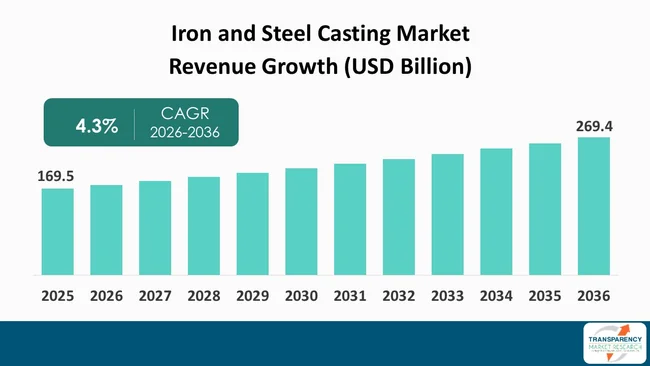
The global iron and steel casting market is expected to grow steadily, propelled by rising demand from various industry sectors including automotive, construction, industrial machinery, mining, railways, power generation, and heavy equipment segments. Infrastructure development programs, industrialization of developing nations, and the need for strong and tough components have been major factors behind the expansion of the market. Production of iron and steel casting is done by melting iron or steel in furnaces, casting the molten metal into molds and letting it cool down and performing heat treatments, machining and surface finishes to give the product desired mechanical and dimensional properties.
The companies operating in this market are trying to make their mark in this industry through technological advancements and improvement in processes. Major players in this market are using automated mold making and pouring equipment, casting simulations, robotics and advanced inspection techniques for improving productivity and reducing defects to maintain quality of products. Manufacturers have also started making investments in efficient energy-consuming furnaces and use of metal scrap for lowering emissions. Expansion of capacities, customization of components for various end-users, collaboration with OEMs and digital manufacturing have been helping producers to become more competitive.
Iron and steel castings are the manufacturing process wherein metallic components are fabricated by heating up metals, which are either iron or steel, and then pouring the resulting melted metal into certain molds to cool down and solidify. In order to meet various performance characteristics, depending on the intended use, various materials such as gray iron, ductile iron, malleable iron and cast steel are used. Some of the mechanical properties that are imparted include strength, wear-resistance, toughness and dimensional stability. Once cooled, the casting will be subjected to various processes like heat treatment, machining, cleaning and finishing in order to meet certain standards. Iron and steel castings find widespread application in auto parts, construction equipment, industrial machinery, mining equipment, railways, power generation systems, oil and gas industry equipment, agricultural machinery and marine application among others.
| Attribute | Detail |
|---|---|
| Iron and Steel Casting Market Drivers |
|
As a result of urbanization and development of industries in developed countries and emerging nations, there has been an increase in demand for iron and steel castings. Large-scale investments made in the construction of roads, smart cities, industrial zones, ports, airports, bridges, and buildings have created the need for machinery and equipment that uses castings because of their high strength and durability. The construction machinery such as excavators, loaders, cranes, concrete pumps, and tunneling machines make use of iron and steel castings in their construction. The demand for castings for machinery will continue because of the government's focus on improving infrastructure.
There has also been an increase in the demand for castings due to the growth of industries. Heavy industrial machinery operates under tough conditions with loads, vibrations, abrasions, and heat, requiring iron and steel castings for construction. With the growing production capacity, there is a need for greater quantities of customized and engineered castings to ensure longer life and lower maintenance cost. Increasing mechanization in developing nations would help in raising demand for castings in the long run.
To harness these opportunities, some of the major foundries have been working towards enhancing their manufacturing capacity through upgrades in their molding processes, along with automation in the process of pouring and machining to increase efficiency and consistency of their product output. Foundries are also utilizing simulation technology, robotics, and quality inspection processes to reduce any defects in their castings and to increase the yield from the process. Foundries are collaborating more with OEMs and creating application-based casting processes for improving their sustainability, along with recycling of metal and use of energy-efficient melting technologies to meet increasing industrial requirements.
The auto industry will continue to be the biggest customer for iron and steel castings, and thus car production will drive the growth of the industry. Passengers' vehicles, commercial trucks, heavy machinery, and electric cars use iron and steel castings in the engine block, transmission housing, brake systems, suspension systems, axles, steering systems, and chassis parts. Though more and more lightweight materials are used in passenger vehicles, iron and steel casting still provide a good combination of properties for such parts as durability, strength, thermal resistance, and low price. Increased number of automobiles on the roads, fleet renewal, and commercial transport demand will contribute to the growth of the industry.
The transition of the auto industry to EVs and hybrids opens some new opportunities for castings producers. The development of high-quality castings needed for EV chassis and platforms is a part of the challenge. Motor housings, battery housing, and drivetrain components need to be very precise, reliable, and durable. Thus, the manufacturers of auto parts tend to develop more advanced castings made of steel and iron with better performance, precision, and surface finish.
In response to this challenge, leading companies manufacturing castings are focusing on installing automated foundry operations, state-of-the-art molding equipment, process digitalization, and computer simulations in casting operations to boost the quality and efficiency of production processes. Machining capacities are being expanded, prediction-based maintenance operations are being implemented, and cooperation with automakers is being intensified to co-produce custom-made castings for the new generation of automobiles. Continuous research and development work, environmentally friendly melting furnaces, and the use of recycled materials are providing ways to increase sustainability without compromising performance.
| Attribute | Detail |
|---|---|
| Iron and Steel Casting Market Opportunity |
|
Global switch-over to renewable energy sources is generating huge opportunities for the iron and steel casting industry. The components for wind power generation, hydropower generation, biomass power plants, and concentrated solar power plants have to withstand high stresses and be resistant to the harsh environments. Iron and steel castings are often used for manufacturing the wind turbine hubs, bearing housings, gearbox casings, generator frame assemblies, hydro-turbine parts, and supporting structures due to the high strength and durability of these products. With the growth of capacities for producing renewable energy sources, there will be an increased demand for large and sophisticated castings. Foundry enterprises are making investments in order to modernize their production and provide high quality castings that would satisfy high requirements concerning reliability and longevity.
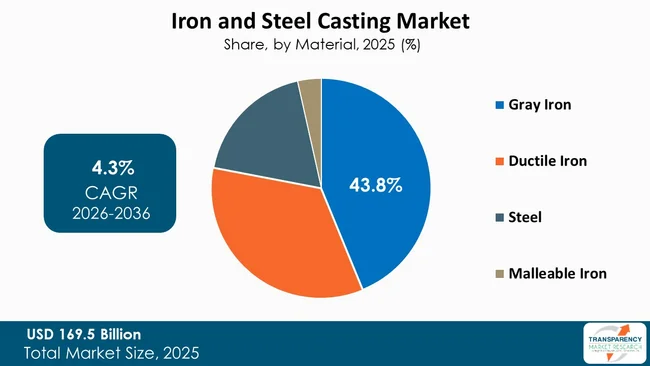
The Gray Iron segment holds the largest market share of approximately 43.8% in the Material segment in the Iron and Steel Casting market due to characteristics such as high castability, vibration damping properties, machinability and cost effectiveness of production. It has a graphite flake microstructure which renders it high thermal conductivity and wear resistance. Therefore, it is most suitable for manufacturing engine blocks, machine tool bases, pipes, pumps, valve bodies, brake discs and industrial machinery among others. Extensive use of gray iron in various applications especially automotive, construction and water infrastructure engineering along with availability of ample raw materials and efficient mass production has helped to maintain its dominance in the iron and steel casting industry.
Gray Iron constitutes the largest material segment in the iron and steel casting market and has graphite flakes as its constituents. It is known to provide high levels of castability, machinability, thermal conductivity, vibration damping and wear resistance. Gray iron castings are extensively used in engine blocks, brake discs, pipes, pumps, valve bodies, machine tool bases and other industrial machines.
| Attribute | Detail |
|---|---|
| Leading Region |
|
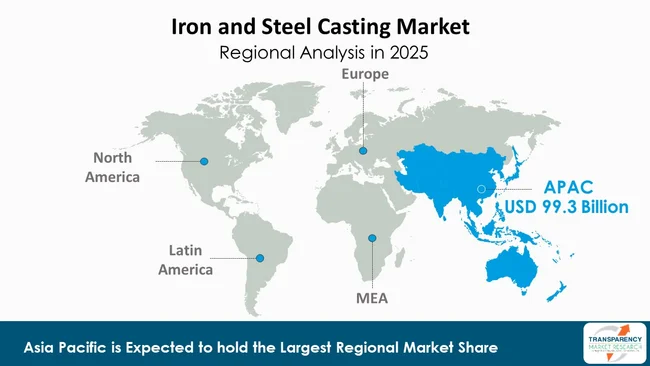
From the geographical perspective with regards to influence in the global market environment, the iron and steel casting market is experiencing influence from regional trends that are attributed to having the most dominant market share of 58.6% held by the Asia Pacific region. These factors can be attributed to its strong manufacturing base, high rate of industrialization, and development of infrastructure. Some of the countries include China, India, Japan, and South Korea that are known for the production and consumption of cast parts in the automotive, construction, industrial machinery, railways, and power generation industries.
Some major players contributing to the manufacturing of iron and steel castings include ArcelorMittal S.A., Amsted Rail Company Inc., Tata Steel Limited, Evraz PLC, Hitachi Metals, Ltd., Nucor Corporation. The list of products produced by these companies include railway castings, components for industrial machines, rolls, wear resistant castings, automobile castings, structural castings among others.
Apart from the above mentioned some other prominent players in the market are Kobe Steel Ltd., ESCO Corporation, Calmet, Inc., Hyundai Steel Company, Nelcast Limited, OSCO Industries, Inc.
Each of these players has been profiled in the iron and steel casting market research report based on parameters such as company overview, financial overview, business strategies, product portfolio, business segments, and recent development
| Attribute | Detail |
|---|---|
| Market Size Value in 2025 | USD 169.5 Billion |
| Market Forecast Value in 2036 | USD 269.4 Billion |
| Growth Rate (CAGR) | 4.3% |
| Forecast Period | 2026-2036 |
| Historical Data Available for | 2021-2025 |
| Quantitative Units | USD Billion for Value and Tons for Volume |
| Market Analysis | It includes cross-segment analysis at the global as well as regional level. The qualitative analysis includes drivers, restraints, iron and steel casting market opportunities, key trends, Porter’s Five Forces analysis, value chain analysis, and key trend analysis. |
| Competition Landscape |
|
| Format | Electronic (PDF) + Excel |
| Market Segmentation | Material
|
| Regions Covered |
|
| Countries Covered |
|
| Companies Profiled |
|
| Customization Scope | Available upon request |
| Pricing | Available upon request |
The iron and steel casting market was valued at USD 169.5 Billion in 2025
The iron and steel casting industry is expected to grow at a CAGR of 4.3% from 2026 to 2036
Expanding infrastructure and industrial development accelerating demand for heavy-duty cast components and growing automotive production and vehicle light weighting supporting advanced casting requirements.
Gray iron was the largest base metal segment and its value is anticipated to grow at a CAGR of 4.5% during the forecast period.
Asia Pacific was the most lucrative region in 2025
ArcelorMittal S.A., Amsted Rail Company Inc., Tata Steel Limited, Evraz PLC, Hitachi Metals, Ltd., Nucor Corporation, Kobe Steel Ltd., ESCO Corporation, Calmet, Inc., Hyundai Steel Company, Nelcast Limited, OSCO Industries, Inc. are the major players in the iron and steel casting market.
Table 1: Global Iron and Steel Casting Market Volume (Tons) Forecast, by Material, 2026 to 2036
Table 2: Global Iron and Steel Casting Market Value (USD Million) Forecast, by Material, 2026 to 2036
Table 3: Global Iron and Steel Casting Market Volume (Tons) Forecast, by Application, 2026 to 2036
Table 4: Global Iron and Steel Casting Market Value (USD Million) Forecast, by Application, 2026 to 2036
Table 5: Global Iron and Steel Casting Market Volume (Tons) Forecast, by Region, 2026 to 2036
Table 6: Global Iron and Steel Casting Market Value (USD Million) Forecast, by Region, 2026 to 2036
Table 7: North America Iron and Steel Casting Market Volume (Tons) Forecast, by Material, 2026 to 2036
Table 8: North America Iron and Steel Casting Market Value (USD Million) Forecast, by Material, 2026 to 2036
Table 9: North America Iron and Steel Casting Market Volume (Tons) Forecast, by Application, 2026 to 2036
Table 10: North America Iron and Steel Casting Market Value (USD Million) Forecast, by Application, 2026 to 2036
Table 11: North America Iron and Steel Casting Market Volume (Tons) Forecast, by Country, 2026 to 2036
Table 12: North America Iron and Steel Casting Market Value (USD Million) Forecast, by Country, 2026 to 2036
Table 13: U.S. Iron and Steel Casting Market Volume (Tons) Forecast, by Material, 2026 to 2036
Table 14: U.S. Iron and Steel Casting Market Value (USD Million) Forecast, by Material, 2026 to 2036
Table 15: U.S. Iron and Steel Casting Market Volume (Tons) Forecast, by Application, 2026 to 2036
Table 16: U.S. Iron and Steel Casting Market Value (USD Million) Forecast, by Application, 2026 to 2036
Table 17: Canada Iron and Steel Casting Market Volume (Tons) Forecast, by Material, 2026 to 2036
Table 18: Canada Iron and Steel Casting Market Value (USD Million) Forecast, by Material, 2026 to 2036
Table 19: Canada Iron and Steel Casting Market Volume (Tons) Forecast, by Application, 2026 to 2036
Table 20: Canada Iron and Steel Casting Market Value (USD Million) Forecast, by Application, 2026 to 2036
Table 21: Europe Iron and Steel Casting Market Volume (Tons) Forecast, by Material, 2026 to 2036
Table 22: Europe Iron and Steel Casting Market Value (USD Million) Forecast, by Material, 2026 to 2036
Table 23: Europe Iron and Steel Casting Market Volume (Tons) Forecast, by Application, 2026 to 2036
Table 24: Europe Iron and Steel Casting Market Value (USD Million) Forecast, by Application, 2026 to 2036
Table 25: Europe Iron and Steel Casting Market Volume (Tons) Forecast, by Country and Sub-region, 2026 to 2036
Table 26: Europe Iron and Steel Casting Market Value (USD Million) Forecast, by Country and Sub-region, 2026 to 2036
Table 27: Germany Iron and Steel Casting Market Volume (Tons) Forecast, by Material, 2026 to 2036
Table 28: Germany Iron and Steel Casting Market Value (USD Million) Forecast, by Material, 2026 to 2036
Table 29: Germany Iron and Steel Casting Market Volume (Tons) Forecast, by Application, 2026 to 2036
Table 30: Germany Iron and Steel Casting Market Value (USD Million) Forecast, by Application, 2026 to 2036
Table 31: U.K. Iron and Steel Casting Market Volume (Tons) Forecast, by Material, 2026 to 2036
Table 32: U.K. Iron and Steel Casting Market Value (USD Million) Forecast, by Material, 2026 to 2036
Table 33: U.K. Iron and Steel Casting Market Volume (Tons) Forecast, by Application, 2026 to 2036
Table 34: U.K. Iron and Steel Casting Market Value (USD Million) Forecast, by Application, 2026 to 2036
Table 35: France Iron and Steel Casting Market Volume (Tons) Forecast, by Material, 2026 to 2036
Table 36: France Iron and Steel Casting Market Value (USD Million) Forecast, by Material, 2026 to 2036
Table 37: France Iron and Steel Casting Market Volume (Tons) Forecast, by Application, 2026 to 2036
Table 38: France Iron and Steel Casting Market Value (USD Million) Forecast, by Application, 2026 to 2036
Table 39: Spain Iron and Steel Casting Market Volume (Tons) Forecast, by Material, 2026 to 2036
Table 40: Spain Iron and Steel Casting Market Value (USD Million) Forecast, by Material, 2026 to 2036
Table 41: Spain Iron and Steel Casting Market Volume (Tons) Forecast, by Application, 2026 to 2036
Table 42: Spain Iron and Steel Casting Market Value (USD Million) Forecast, by Application, 2026 to 2036
Table 43: Italy Iron and Steel Casting Market Volume (Tons) Forecast, by Material, 2026 to 2036
Table 44: Italy Iron and Steel Casting Market Value (USD Million) Forecast, by Material, 2026 to 2036
Table 45: Italy Iron and Steel Casting Market Volume (Tons) Forecast, by Application, 2026 to 2036
Table 46: Italy Iron and Steel Casting Market Value (USD Million) Forecast, by Application, 2026 to 2036
Table 47: Russia & CIS Iron and Steel Casting Market Volume (Tons) Forecast, by Material, 2026 to 2036
Table 48: Russia & CIS Iron and Steel Casting Market Value (USD Million) Forecast, by Material, 2026 to 2036
Table 49: Russia & CIS Iron and Steel Casting Market Volume (Tons) Forecast, by Application, 2026 to 2036
Table 50: Russia & CIS Iron and Steel Casting Market Value (USD Million) Forecast, by Application, 2026 to 2036
Table 51: Rest of Europe Iron and Steel Casting Market Volume (Tons) Forecast, by Material, 2026 to 2036
Table 52: Rest of Europe Iron and Steel Casting Market Value (USD Million) Forecast, by Material, 2026 to 2036
Table 53: Rest of Europe Iron and Steel Casting Market Volume (Tons) Forecast, by Application, 2026 to 2036
Table 54: Rest of Europe Iron and Steel Casting Market Value (USD Million) Forecast, by Application, 2026 to 2036
Table 55: Asia Pacific Iron and Steel Casting Market Volume (Tons) Forecast, by Material, 2026 to 2036
Table 56: Asia Pacific Iron and Steel Casting Market Value (USD Million) Forecast, by Material, 2026 to 2036
Table 57: Asia Pacific Iron and Steel Casting Market Volume (Tons) Forecast, by Application, 2026 to 2036
Table 58: Asia Pacific Iron and Steel Casting Market Value (USD Million) Forecast, by Application, 2026 to 2036
Table 59: Asia Pacific Iron and Steel Casting Market Volume (Tons) Forecast, by Country and Sub-region, 2026 to 2036
Table 60: Asia Pacific Iron and Steel Casting Market Value (USD Million) Forecast, by Country and Sub-region, 2026 to 2036
Table 61: China Iron and Steel Casting Market Volume (Tons) Forecast, by Material, 2026 to 2036
Table 62: China Iron and Steel Casting Market Value (USD Million) Forecast, by Material 2026 to 2036
Table 63: China Iron and Steel Casting Market Volume (Tons) Forecast, by Application, 2026 to 2036
Table 64: China Iron and Steel Casting Market Value (USD Million) Forecast, by Application, 2026 to 2036
Table 65: India Iron and Steel Casting Market Volume (Tons) Forecast, by Material, 2026 to 2036
Table 66: India Iron and Steel Casting Market Value (USD Million) Forecast, by Material, 2026 to 2036
Table 67: India Iron and Steel Casting Market Volume (Tons) Forecast, by Application, 2026 to 2036
Table 68: India Iron and Steel Casting Market Value (USD Million) Forecast, by Application, 2026 to 2036
Table 69: Japan Iron and Steel Casting Market Volume (Tons) Forecast, by Material, 2026 to 2036
Table 70: Japan Iron and Steel Casting Market Value (USD Million) Forecast, by Material, 2026 to 2036
Table 71: Japan Iron and Steel Casting Market Volume (Tons) Forecast, by Application, 2026 to 2036
Table 72: Japan Iron and Steel Casting Market Value (USD Million) Forecast, by Application, 2026 to 2036
Table 73: ASEAN Iron and Steel Casting Market Volume (Tons) Forecast, by Material, 2026 to 2036
Table 74: ASEAN Iron and Steel Casting Market Value (USD Million) Forecast, by Material, 2026 to 2036
Table 75: ASEAN Iron and Steel Casting Market Volume (Tons) Forecast, by Application, 2026 to 2036
Table 76: ASEAN Iron and Steel Casting Market Value (USD Million) Forecast, by Application, 2026 to 2036
Table 77: Rest of Asia Pacific Iron and Steel Casting Market Volume (Tons) Forecast, by Material, 2026 to 2036
Table 78: Rest of Asia Pacific Iron and Steel Casting Market Value (USD Million) Forecast, by Material, 2026 to 2036
Table 79: Rest of Asia Pacific Iron and Steel Casting Market Volume (Tons) Forecast, by Application, 2026 to 2036
Table 80: Rest of Asia Pacific Iron and Steel Casting Market Value (USD Million) Forecast, by Application, 2026 to 2036
Table 81: Latin America Iron and Steel Casting Market Volume (Tons) Forecast, by Material, 2026 to 2036
Table 82: Latin America Iron and Steel Casting Market Value (USD Million) Forecast, by Material, 2026 to 2036
Table 83: Latin America Iron and Steel Casting Market Volume (Tons) Forecast, by Application, 2026 to 2036
Table 84: Latin America Iron and Steel Casting Market Value (USD Million) Forecast, by Application, 2026 to 2036
Table 85: Latin America Iron and Steel Casting Market Volume (Tons) Forecast, by Country and Sub-region, 2026 to 2036
Table 86: Latin America Iron and Steel Casting Market Value (USD Million) Forecast, by Country and Sub-region, 2026 to 2036
Table 87: Brazil Iron and Steel Casting Market Volume (Tons) Forecast, by Material, 2026 to 2036
Table 88: Brazil Iron and Steel Casting Market Value (USD Million) Forecast, by Material, 2026 to 2036
Table 89: Brazil Iron and Steel Casting Market Volume (Tons) Forecast, by Application, 2026 to 2036
Table 90: Brazil Iron and Steel Casting Market Value (USD Million) Forecast, by Application, 2026 to 2036
Table 91: Mexico Iron and Steel Casting Market Volume (Tons) Forecast, by Material, 2026 to 2036
Table 92: Mexico Iron and Steel Casting Market Value (USD Million) Forecast, by Material, 2026 to 2036
Table 93: Mexico Iron and Steel Casting Market Volume (Tons) Forecast, by Application, 2026 to 2036
Table 94: Mexico Iron and Steel Casting Market Value (USD Million) Forecast, by Application, 2026 to 2036
Table 95: Rest of Latin America Iron and Steel Casting Market Volume (Tons) Forecast, by Material, 2026 to 2036
Table 96: Rest of Latin America Iron and Steel Casting Market Value (USD Million) Forecast, by Material, 2026 to 2036
Table 97: Rest of Latin America Iron and Steel Casting Market Volume (Tons) Forecast, by Application, 2026 to 2036
Table 98: Rest of Latin America Iron and Steel Casting Market Value (USD Million) Forecast, by Application, 2026 to 2036
Table 99: Middle East & Africa Iron and Steel Casting Market Volume (Tons) Forecast, by Material, 2026 to 2036
Table 100: Middle East & Africa Iron and Steel Casting Market Value (USD Million) Forecast, by Material, 2026 to 2036
Table 101: Middle East & Africa Iron and Steel Casting Market Volume (Tons) Forecast, by Application, 2026 to 2036
Table 102: Middle East & Africa Iron and Steel Casting Market Value (USD Million) Forecast, by Application, 2026 to 2036
Table 103: Middle East & Africa Iron and Steel Casting Market Volume (Tons) Forecast, by Country and Sub-region, 2026 to 2036
Table 104: Middle East & Africa Iron and Steel Casting Market Value (USD Million) Forecast, by Country and Sub-region, 2026 to 2036
Table 105: GCC Iron and Steel Casting Market Volume (Tons) Forecast, by Material, 2026 to 2036
Table 106: GCC Iron and Steel Casting Market Value (USD Million) Forecast, by Material, 2026 to 2036
Table 107: GCC Iron and Steel Casting Market Volume (Tons) Forecast, by Application, 2026 to 2036
Table 108: GCC Iron and Steel Casting Market Value (USD Million) Forecast, by Application, 2026 to 2036
Table 109: South Africa Iron and Steel Casting Market Volume (Tons) Forecast, by Material, 2026 to 2036
Table 110: South Africa Iron and Steel Casting Market Value (USD Million) Forecast, by Material, 2026 to 2036
Table 111: South Africa Iron and Steel Casting Market Volume (Tons) Forecast, by Application, 2026 to 2036
Table 112: South Africa Iron and Steel Casting Market Value (USD Million) Forecast, by Application, 2026 to 2036
Table 113: Rest of Middle East & Africa Iron and Steel Casting Market Volume (Tons) Forecast, by Material, 2026 to 2036
Table 114: Rest of Middle East & Africa Iron and Steel Casting Market Value (USD Million) Forecast, by Material, 2026 to 2036
Table 115: Rest of Middle East & Africa Iron and Steel Casting Market Volume (Tons) Forecast, by Application, 2026 to 2036
Table 116: Rest of Middle East & Africa Iron and Steel Casting Market Value (USD Million) Forecast, by Application, 2026 to 2036
Figure 1: Global Iron and Steel Casting Market Volume Share Analysis, by Material, 2025, 2029, and 2036
Figure 2: Global Iron and Steel Casting Market Attractiveness, by Material
Figure 3: Global Iron and Steel Casting Market Volume Share Analysis, by Application, 2025, 2029, and 2036
Figure 4: Global Iron and Steel Casting Market Attractiveness, by Application
Figure 5: Global Iron and Steel Casting Market Volume Share Analysis, by Region, 2025, 2029, and 2036
Figure 6: Global Iron and Steel Casting Market Attractiveness, by Region
Figure 7: North America Iron and Steel Casting Market Volume Share Analysis, by Material, 2025, 2029, and 2036
Figure 8: North America Iron and Steel Casting Market Attractiveness, by Material
Figure 9: North America Iron and Steel Casting Market Attractiveness, by Material
Figure 10: North America Iron and Steel Casting Market Volume Share Analysis, by Application, 2025, 2029, and 2036
Figure 11: North America Iron and Steel Casting Market Attractiveness, by Application
Figure 12: North America Iron and Steel Casting Market Attractiveness, by Country and Sub-region
Figure 13: Europe Iron and Steel Casting Market Volume Share Analysis, by Material, 2025, 2029, and 2036
Figure 14: Europe Iron and Steel Casting Market Attractiveness, by Material
Figure 15: Europe Iron and Steel Casting Market Volume Share Analysis, by Application, 2025, 2029, and 2036
Figure 16: Europe Iron and Steel Casting Market Attractiveness, by Application
Figure 17: Europe Iron and Steel Casting Market Volume Share Analysis, by Country and Sub-region, 2025, 2029, and 2036
Figure 18: Europe Iron and Steel Casting Market Attractiveness, by Country and Sub-region
Figure 19: Asia Pacific Iron and Steel Casting Market Volume Share Analysis, by Material, 2025, 2029, and 2036
Figure 20: Asia Pacific Iron and Steel Casting Market Attractiveness, by Material
Figure 21: Asia Pacific Iron and Steel Casting Market Volume Share Analysis, by Application, 2025, 2029, and 2036
Figure 22: Asia Pacific Iron and Steel Casting Market Attractiveness, by Application
Figure 23: Asia Pacific Iron and Steel Casting Market Volume Share Analysis, by Country and Sub-region, 2025, 2029, and 2036
Figure 24: Asia Pacific Iron and Steel Casting Market Attractiveness, by Country and Sub-region
Figure 25: Latin America Iron and Steel Casting Market Volume Share Analysis, by Material, 2025, 2029, and 2036
Figure 26: Latin America Iron and Steel Casting Market Attractiveness, by Material
Figure 27: Latin America Iron and Steel Casting Market Volume Share Analysis, by Application, 2025, 2029, and 2036
Figure 28: Latin America Iron and Steel Casting Market Attractiveness, by Application
Figure 29: Latin America Iron and Steel Casting Market Volume Share Analysis, by Country and Sub-region, 2025, 2029, and 2036
Figure 30: Latin America Iron and Steel Casting Market Attractiveness, by Country and Sub-region
Figure 31: Middle East & Africa Iron and Steel Casting Market Volume Share Analysis, by Material, 2025, 2029, and 2036
Figure 32: Middle East & Africa Iron and Steel Casting Market Attractiveness, by Material
Figure 33: Middle East & Africa Iron and Steel Casting Market Volume Share Analysis, by Application, 2025, 2029, and 2036
Figure 34: Middle East & Africa Iron and Steel Casting Market Attractiveness, by Application
Figure 35: Middle East & Africa Iron and Steel Casting Market Volume Share Analysis, by Country and Sub-region, 2025, 2029, and 2036
Figure 36: Middle East & Africa Iron and Steel Casting Market Attractiveness, by Country and Sub-region
Copyright © Transparency Market Research, Inc. All Rights reserved
Trust Online


Iron and Steel Casting Market
