

Reports
Reports
The global cement market size was valued at USD 387.7 Billion in 2025 and is projected to reach USD 642.6 Billion by 2036, expanding at a CAGR of 4.7% from 2026 to 2036. The market is primarily driven by accelerating urbanization, rising residential construction, and expanding infrastructure development.
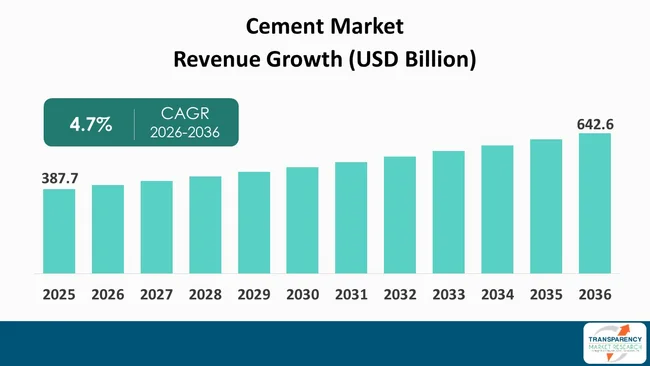
The global cement market is expected to witness sustained growth due to urbanization, residential construction, commercial development, infrastructure modernization, and large-scale development projects. Demand is particularly strong in developing economies experiencing expansion in housing, roads, industrial facilities, and infrastructure. Nonetheless, high energy costs, regional overcapacity, elevated interest rates, and stringent environmental regulations remain key challenges.
The cement manufacturing process involves limestone extraction and crushing, raw-material grinding, clinker production in rotary kilns, clinker cooling, and final grinding with gypsum and supplementary cementitious materials. The use of digital process control systems, energy-efficient technologies, waste heat recovery, alternative fuels, and blended cements in the cement production process has been increasing.
Leading players are undertaking initiatives related to clinker replacement, alternative/renewable fuels, carbon capture and storage (CCS), low-carbon cements, and digitized plants. These actions are being undertaken by the companies for lowering their carbon intensity and catering to increased construction needs. According to the IEA, the primary routes for decarbonization of the cement industry include SCMs, alternative fuels, material efficiency, and CCS.
Cement is a powdered binder composed primarily of limestone, clay, and other mineral materials. It is an important building material which is used for making concrete, mortar, grout, and many other construction materials. The process of cement production normally includes limestone mining, crushing, mixing of the raw material, grinding, clinker production in rotary kilns, clinker cooling, and the final grinding with the addition of gypsum and other supplementary cementitious materials. When mixed with water, cement undergoes hydration and forms a hardened mass that provides strength and durability. Cement is widely used in residential and commercial buildings, roads, bridges, dams, tunnels, airports, industrial facilities, and other civil infrastructure. Various types of cement are used based on the requirement of that particular application. These are Portland cement, blended cement, white cement, and low carbon cement.
| Attribute | Detail |
|---|---|
| Cement Market Drivers |
|
Population growth and rapid urbanization have been contributing to increased cement demand, especially in emerging nations. As populations shift toward urban areas, governments and private developers are increasing investment in housing, townships, and supporting urban infrastructure. The construction of houses will require cement usage in the form of foundations, structural parts, flooring, walls, concrete blocks, and other forms of construction work. Furthermore, increasing income levels and housing finance have been driving the residential construction sector.
Urbanization also provides opportunities that go beyond housing constructions in terms of cement and concrete usage. The building of roads, drainage systems, water supply systems, sewerage systems, metros, and other facilities require cement and concrete in large amounts. Governments are implementing housing and urban-development programs to address housing shortages and infrastructure requirements. This results in increased consumption of cement in the long run.
To meet this rising demand for cement, cement manufacturers are increasing their grinding and clinker capacity, building plants in different regions and refining their distribution channels. Cement companies are also introducing cement products tailored to specific residential construction requirements while reducing cost and environmental impact. As urban populations keep rising and cities continue to grow, construction work will continue to be an important source of demand for cement. This will help ensure that urban development, housing needs, and investments in city infrastructure will continue to support long-term growth of the cement market.
Large scale development of infrastructure is yet another major factor driving the growth of the cement market. Governments worldwide are increasing investment in highways, bridges, railways, airports, ports, dams, tunnels, water infrastructure, and transportation systems. Such infrastructure developments need huge amounts of cement and concrete due to the extensive structural needs. So, infrastructure investment generates substantial volume-based cement demand and supports large, long-term supply opportunities.
Developing economies make a significant contribution to this trend as governments invest in infrastructure to address existing development gaps. The projects related to public infrastructure such as highway expansions, rail modernizations, public transport facilities, and renewable energy infrastructure are highly cement intensive in nature. Developed economies generate demand through infrastructure rehabilitation, renovation, and modernization of aging assets.
Cement producers are changing their business models in response to infrastructure-driven demand through increased capacity, better logistics, creation of customized cement products for each project, and cement supply deals with big contractors. Firms are also upgrading their facilities and adopting greener manufacturing methods in order to comply with strict environmental regulations associated with large infrastructure projects. The combination of spending on infrastructure by the government, urban transportation networks, industrial infrastructure programs, and infrastructure replacement thus ensures the continuity of cement demand. As more nations focus on infrastructure as the basis of their economic growth, public and private infrastructure spending will continue to be an important underlying factor of the global cement market.
| Attribute | Detail |
|---|---|
| Cement Market Opportunity |
|
The increased environmental regulation and the trend of reduction of embodied carbon in the construction industry creates significant opportunities for the production of low-carbon cement products. Companies can develop their product range through the production of blended cement, reduced-clinker cement, supplementary cementitious materials (SCMs), and alternative binders. These products can help manufacturers capture higher-value opportunities as infrastructure developers and environmentally conscious customers increasingly prioritize lower-carbon construction materials. They will be able to improve their competitive position by using energy-efficient kilns, renewable energy production, carbon capture, and clinker substitute technologies. Furthermore, sustainable procurement practices and considerations during construction of large buildings will lead to customers increasingly considering low-carbon cement products in procurement decisions.
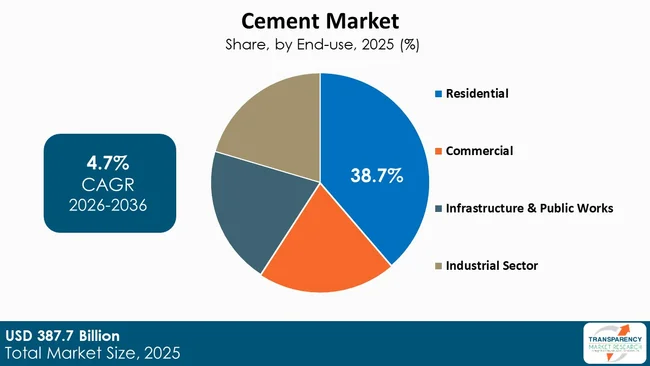
The residential segment dominated the global cement market in 2025, accounting for approximately 38.7% of total market revenue due to urbanization, population growth, housing shortages, and an increase in demand for residential buildings like houses and apartments. Government programs for affordable housing, along with increased income levels of households, further aid in residential construction. Cement is widely used in foundations, structural framing, walls, flooring, and other construction applications. Moreover, renovation, repair, and replacement of aging residential structures also contribute to cement consumption.
The residential segment includes cement used in the construction, renovation, expansion, and maintenance of houses, apartments, condominiums, villas, townhouses, and other residential structures.
| Attribute | Detail |
|---|---|
| Leading Region |
|
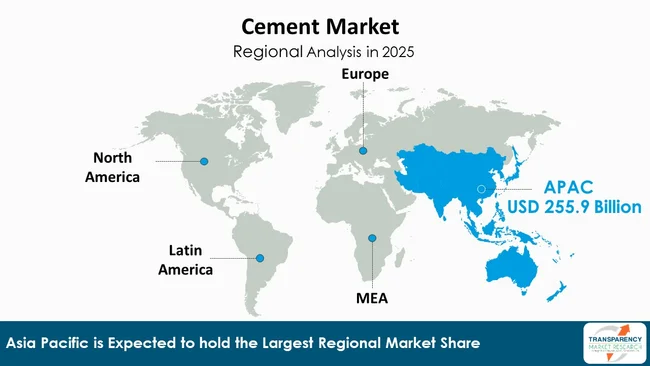
Asia Pacific dominated the global cement market in 2025, accounting for approximately 66.0% of total market revenue due to rapid urbanization, population growth, housing developments, and large infrastructure spending. Countries such as China, India, Indonesia, and Vietnam support regional demand through residential, commercial, transportation, and industrial infrastructure development.
Prominent companies operating in the cement market include Mitsubishi Cement Corporation, ACC Limited, Alamo Cement Company, Heidelberg Cement, National Cement Company, and Deccan Cement Limited. Their portfolios include Portland cement, blended cement, specialty and high-performance cement, ready-mix concrete, and other value-added cementitious materials. These companies also offer ready-mix concrete and value-added cementitious products for various construction applications.
In addition to the above-mentioned companies, there are certain other significant players in the market, including HOLCIM, Cemex, Sidhee Cement, UltraTech Cement, Scio Packaging Co., Vicat S.A., Buzzi Unicem, and Asia Cement Corporation.
Each of these players has been profiled in the Cement market research report based on parameters such as company overview, financial overview, business strategies, product portfolio, business segments, and recent developments.
| Attribute | Detail |
|---|---|
| Market Size Value in 2025 | USD 387.7 Billion |
| Market Forecast Value in 2036 | USD 642.6 Billion |
| Growth Rate (CAGR) | 4.7% |
| Forecast Period | 2026-2036 |
| Historical Data Available for | 2021-2025 |
| Quantitative Units | USD Billion for Value and Billion Tons for Volume |
| Market Analysis | It includes cross-segment analysis at the global as well as regional level. The qualitative analysis includes drivers, restraints, Cement market opportunities, key trends, Porter’s Five Forces analysis, value chain analysis, and key trend analysis. |
| Competition Landscape |
|
| Format | Electronic (PDF) + Excel |
| Market Segmentation | Type
|
| Regions Covered |
|
| Countries Covered |
|
| Companies Profiled |
|
| Customization Scope | Available upon request |
| Pricing | Available upon request |
The cement market was valued at USD 387.7 Billion in 2025.
The cement industry is expected to expand at a CAGR of 4.7% from 2026 to 2036.
Key drivers include accelerating urbanization and residential construction, along with the expansion of infrastructure and public development projects.
The residential segment accounted for the largest share of the market, representing 38.7% in 2025.
Asia Pacific was the most lucrative region in 2025.
Mitsubishi Cement Corporation, ACC Limited, Alamo Cement Company, Heidelberg Cement, National Cement Company, Deccan Cement Limited, HOLCIM, Cemex, Sidhee Cement, UltraTech Cement, Scio Packaging Co., Vicat S.A., Buzzi Unicem, and Asia Cement Corporation are among the prominent players operating in the global cement market.
Table 1: Global Cement Market Volume (Billion Tons) Forecast, by Type, 2026 to 2036
Table 2: Global Cement Market Value (USD Billion) Forecast, by Type, 2026 to 2036
Table 3: Global Cement Market Volume (Billion Tons) Forecast, by Manufacturing Process, 2026 to 2036
Table 4: Global Cement Market Value (USD Billion) Forecast, by Manufacturing Process, 2026 to 2036
Table 5: Global Cement Market Volume (Billion Tons) Forecast, by End-use, 2026 to 2036
Table 6: Global Cement Market Value (USD Billion) Forecast, by End-use, 2026 to 2036
Table 7: Global Cement Market Volume (Billion Tons) Forecast, by Region, 2026 to 2036
Table 8: Global Cement Market Value (USD Billion) Forecast, by Region, 2026 to 2036
Table 9: North America Cement Market Volume (Billion Tons) Forecast, by Type, 2026 to 2036
Table 10: North America Cement Market Value (USD Billion) Forecast, by Type, 2026 to 2036
Table 11: North America Cement Market Volume (Billion Tons) Forecast, by Manufacturing Process, 2026 to 2036
Table 12: North America Cement Market Value (USD Billion) Forecast, by Manufacturing Process, 2026 to 2036
Table 13: North America Cement Market Volume (Billion Tons) Forecast, by End-use, 2026 to 2036
Table 14: North America Cement Market Value (USD Billion) Forecast, by End-use, 2026 to 2036
Table 15: North America Cement Market Volume (Billion Tons) Forecast, by Country, 2026 to 2036
Table 16: North America Cement Market Value (USD Billion) Forecast, by Country, 2026 to 2036
Table 17: U.S. Cement Market Volume (Billion Tons) Forecast, by Type, 2026 to 2036
Table 18: U.S. Cement Market Value (USD Billion) Forecast, by Type, 2026 to 2036
Table 19: U.S. Cement Market Volume (Billion Tons) Forecast, by Manufacturing Process, 2026 to 2036
Table 20: U.S. Cement Market Value (USD Billion) Forecast, by Manufacturing Process, 2026 to 2036
Table 21: U.S. Cement Market Volume (Billion Tons) Forecast, by End-use, 2026 to 2036
Table 22: U.S. Cement Market Value (USD Billion) Forecast, by End-use, 2026 to 2036
Table 23: Canada Cement Market Volume (Billion Tons) Forecast, by Type, 2026 to 2036
Table 24: Canada Cement Market Value (USD Billion) Forecast, by Type, 2026 to 2036
Table 25: Canada Cement Market Volume (Billion Tons) Forecast, by Manufacturing Process, 2026 to 2036
Table 26: Canada Cement Market Value (USD Billion) Forecast, by Manufacturing Process, 2026 to 2036
Table 27: Canada Cement Market Volume (Billion Tons) Forecast, by End-use, 2026 to 2036
Table 28: Canada Cement Market Value (USD Billion) Forecast, by End-use, 2026 to 2036
Table 29: Europe Cement Market Volume (Billion Tons) Forecast, by Type, 2026 to 2036
Table 30: Europe Cement Market Value (USD Billion) Forecast, by Type, 2026 to 2036
Table 31: Europe Cement Market Volume (Billion Tons) Forecast, by Manufacturing Process, 2026 to 2036
Table 32: Europe Cement Market Value (USD Billion) Forecast, by Manufacturing Process, 2026 to 2036
Table 33: Europe Cement Market Volume (Billion Tons) Forecast, by End-use, 2026 to 2036
Table 34: Europe Cement Market Value (USD Billion) Forecast, by End-use, 2026 to 2036
Table 35: Europe Cement Market Volume (Billion Tons) Forecast, by Country and Sub-region, 2026 to 2036
Table 36: Europe Cement Market Value (USD Billion) Forecast, by Country and Sub-region, 2026 to 2036
Table 37: Germany Cement Market Volume (Billion Tons) Forecast, by Type, 2026 to 2036
Table 38: Germany Cement Market Value (USD Billion) Forecast, by Type, 2026 to 2036
Table 39: Germany Cement Market Volume (Billion Tons) Forecast, by Manufacturing Process, 2026 to 2036
Table 40: Germany Cement Market Value (USD Billion) Forecast, by Manufacturing Process, 2026 to 2036
Table 41: Germany Cement Market Volume (Billion Tons) Forecast, by End-use, 2026 to 2036
Table 42: Germany Cement Market Value (USD Billion) Forecast, by End-use, 2026 to 2036
Table 43: France Cement Market Volume (Billion Tons) Forecast, by Type, 2026 to 2036
Table 44: France Cement Market Value (USD Billion) Forecast, by Type, 2026 to 2036
Table 45: France Cement Market Volume (Billion Tons) Forecast, by Manufacturing Process, 2026 to 2036
Table 46: France Cement Market Value (USD Billion) Forecast, by Manufacturing Process, 2026 to 2036
Table 47: France Cement Market Volume (Billion Tons) Forecast, by End-use, 2026 to 2036
Table 48: France Cement Market Value (USD Billion) Forecast, by End-use, 2026 to 2036
Table 49: U.K. Cement Market Volume (Billion Tons) Forecast, by Type, 2026 to 2036
Table 50: U.K. Cement Market Value (USD Billion) Forecast, by Type, 2026 to 2036
Table 51: U.K. Cement Market Volume (Billion Tons) Forecast, by Manufacturing Process, 2026 to 2036
Table 52: U.K. Cement Market Value (USD Billion) Forecast, by Manufacturing Process, 2026 to 2036
Table 53: U.K. Cement Market Volume (Billion Tons) Forecast, by End-use, 2026 to 2036
Table 54: U.K. Cement Market Value (USD Billion) Forecast, by End-use, 2026 to 2036
Table 55: Italy Cement Market Volume (Billion Tons) Forecast, by Type, 2026 to 2036
Table 56: Italy Cement Market Value (USD Billion) Forecast, by Type, 2026 to 2036
Table 57: Italy Cement Market Volume (Billion Tons) Forecast, by Manufacturing Process, 2026 to 2036
Table 58: Italy Cement Market Value (USD Billion) Forecast, by Manufacturing Process, 2026 to 2036
Table 59: Italy Cement Market Volume (Billion Tons) Forecast, by End-use, 2026 to 2036
Table 60: Italy Cement Market Value (USD Billion) Forecast, by End-use, 2026 to 2036
Table 61: Spain Cement Market Volume (Billion Tons) Forecast, by Type, 2026 to 2036
Table 62: Spain Cement Market Value (USD Billion) Forecast, by Type, 2026 to 2036
Table 63: Spain Cement Market Volume (Billion Tons) Forecast, by Manufacturing Process, 2026 to 2036
Table 64: Spain Cement Market Value (USD Billion) Forecast, by Manufacturing Process, 2026 to 2036
Table 65: Spain Cement Market Volume (Billion Tons) Forecast, by End-use, 2026 to 2036
Table 66: Spain Cement Market Value (USD Billion) Forecast, by End-use, 2026 to 2036
Table 67: Russia & CIS Cement Market Volume (Billion Tons) Forecast, by Type, 2026 to 2036
Table 68: Russia & CIS Cement Market Value (USD Billion) Forecast, by Type, 2026 to 2036
Table 69: Russia & CIS Cement Market Volume (Billion Tons) Forecast, by Manufacturing Process, 2026 to 2036
Table 70: Russia & CIS Cement Market Value (USD Billion) Forecast, by Manufacturing Process, 2026 to 2036
Table 71: Russia & CIS Cement Market Volume (Billion Tons) Forecast, by End-use, 2026 to 2036
Table 72: Russia & CIS Cement Market Value (USD Billion) Forecast, by End-use, 2026 to 2036
Table 73: Rest of Europe Cement Market Volume (Billion Tons) Forecast, by Type, 2026 to 2036
Table 74: Rest of Europe Cement Market Value (USD Billion) Forecast, by Type, 2026 to 2036
Table 75: Rest of Europe Cement Market Volume (Billion Tons) Forecast, by Manufacturing Process, 2026 to 2036
Table 76: Rest of Europe Cement Market Value (USD Billion) Forecast, by Manufacturing Process, 2026 to 2036
Table 77: Rest of Europe Cement Market Volume (Billion Tons) Forecast, by End-use, 2026 to 2036
Table 78: Rest of Europe Cement Market Value (USD Billion) Forecast, by End-use, 2026 to 2036
Table 79: Asia Pacific Cement Market Volume (Billion Tons) Forecast, by Type, 2026 to 2036
Table 80: Asia Pacific Cement Market Value (USD Billion) Forecast, by Type, 2026 to 2036
Table 81: Asia Pacific Cement Market Volume (Billion Tons) Forecast, by Manufacturing Process, 2026 to 2036
Table 82: Asia Pacific Cement Market Value (USD Billion) Forecast, by Manufacturing Process, 2026 to 2036
Table 83: Asia Pacific Cement Market Volume (Billion Tons) Forecast, by End-use, 2026 to 2036
Table 84: Asia Pacific Cement Market Value (USD Billion) Forecast, by End-use, 2026 to 2036
Table 85: Asia Pacific Cement Market Volume (Billion Tons) Forecast, by Country and Sub-region, 2026 to 2036
Table 86: Asia Pacific Cement Market Value (USD Billion) Forecast, by Country and Sub-region, 2026 to 2036
Table 87: China Cement Market Volume (Billion Tons) Forecast, by Type, 2026 to 2036
Table 88: China Cement Market Value (USD Billion) Forecast, by Type 2026 to 2036
Table 89: China Cement Market Volume (Billion Tons) Forecast, by Manufacturing Process, 2026 to 2036
Table 90: China Cement Market Value (USD Billion) Forecast, by Manufacturing Process, 2026 to 2036
Table 91: China Cement Market Volume (Billion Tons) Forecast, by End-use, 2026 to 2036
Table 92: China Cement Market Value (USD Billion) Forecast, by End-use, 2026 to 2036
Table 93: Japan Cement Market Volume (Billion Tons) Forecast, by Type, 2026 to 2036
Table 94: Japan Cement Market Value (USD Billion) Forecast, by Type, 2026 to 2036
Table 95: Japan Cement Market Volume (Billion Tons) Forecast, by Manufacturing Process, 2026 to 2036
Table 96: Japan Cement Market Value (USD Billion) Forecast, by Manufacturing Process, 2026 to 2036
Table 97: Japan Cement Market Volume (Billion Tons) Forecast, by End-use, 2026 to 2036
Table 98: Japan Cement Market Value (USD Billion) Forecast, by End-use, 2026 to 2036
Table 99: India Cement Market Volume (Billion Tons) Forecast, by Type, 2026 to 2036
Table 100: India Cement Market Value (USD Billion) Forecast, by Type, 2026 to 2036
Table 101: India Cement Market Volume (Billion Tons) Forecast, by Manufacturing Process, 2026 to 2036
Table 102: India Cement Market Value (USD Billion) Forecast, by Manufacturing Process, 2026 to 2036
Table 103: India Cement Market Volume (Billion Tons) Forecast, by End-use, 2026 to 2036
Table 104: India Cement Market Value (USD Billion) Forecast, by End-use, 2026 to 2036
Table 105: India Cement Market Volume (Billion Tons) Forecast, by End-use, 2026 to 2036
Table 106: India Cement Market Value (USD Billion) Forecast, by End-use 2026 to 2036
Table 107: ASEAN Cement Market Volume (Billion Tons) Forecast, by Type, 2026 to 2036
Table 108: ASEAN Cement Market Value (USD Billion) Forecast, by Type, 2026 to 2036
Table 109: ASEAN Cement Market Volume (Billion Tons) Forecast, by Manufacturing Process, 2026 to 2036
Table 110: ASEAN Cement Market Value (USD Billion) Forecast, by Manufacturing Process, 2026 to 2036
Table 111: ASEAN Cement Market Volume (Billion Tons) Forecast, by End-use, 2026 to 2036
Table 112: ASEAN Cement Market Value (USD Billion) Forecast, by End-use, 2026 to 2036
Table 113: Rest of Asia Pacific Cement Market Volume (Billion Tons) Forecast, by Type, 2026 to 2036
Table 114: Rest of Asia Pacific Cement Market Value (USD Billion) Forecast, by Type, 2026 to 2036
Table 115: Rest of Asia Pacific Cement Market Volume (Billion Tons) Forecast, by Manufacturing Process, 2026 to 2036
Table 116: Rest of Asia Pacific Cement Market Value (USD Billion) Forecast, by Manufacturing Process, 2026 to 2036
Table 117: Rest of Asia Pacific Cement Market Volume (Billion Tons) Forecast, by End-use, 2026 to 2036
Table 118: Rest of Asia Pacific Cement Market Value (USD Billion) Forecast, by End-use, 2026 to 2036
Table 119: Latin America Cement Market Volume (Billion Tons) Forecast, by Type, 2026 to 2036
Table 120: Latin America Cement Market Value (USD Billion) Forecast, by Type, 2026 to 2036
Table 121: Latin America Cement Market Volume (Billion Tons) Forecast, by Manufacturing Process, 2026 to 2036
Table 122: Latin America Cement Market Value (USD Billion) Forecast, by Manufacturing Process, 2026 to 2036
Table 123: Latin America Cement Market Volume (Billion Tons) Forecast, by End-use, 2026 to 2036
Table 124: Latin America Cement Market Value (USD Billion) Forecast, by End-use, 2026 to 2036
Table 125: Latin America Cement Market Volume (Billion Tons) Forecast, by Country and Sub-region, 2026 to 2036
Table 126: Latin America Cement Market Value (USD Billion) Forecast, by Country and Sub-region, 2026 to 2036
Table 127: Brazil Cement Market Volume (Billion Tons) Forecast, by Type, 2026 to 2036
Table 128: Brazil Cement Market Value (USD Billion) Forecast, by Type, 2026 to 2036
Table 129: Brazil Cement Market Volume (Billion Tons) Forecast, by Manufacturing Process, 2026 to 2036
Table 130: Brazil Cement Market Value (USD Billion) Forecast, by Manufacturing Process, 2026 to 2036
Table 131: Brazil Cement Market Volume (Billion Tons) Forecast, by End-use, 2026 to 2036
Table 132: Brazil Cement Market Value (USD Billion) Forecast, by End-use, 2026 to 2036
Table 133: Mexico Cement Market Volume (Billion Tons) Forecast, by Type, 2026 to 2036
Table 134: Mexico Cement Market Value (USD Billion) Forecast, by Type, 2026 to 2036
Table 135: Mexico Cement Market Volume (Billion Tons) Forecast, by Manufacturing Process, 2026 to 2036
Table 136: Mexico Cement Market Value (USD Billion) Forecast, by Manufacturing Process, 2026 to 2036
Table 137: Mexico Cement Market Volume (Billion Tons) Forecast, by End-use, 2026 to 2036
Table 138: Mexico Cement Market Value (USD Billion) Forecast, by End-use, 2026 to 2036
Table 139: Rest of Latin America Cement Market Volume (Billion Tons) Forecast, by Type, 2026 to 2036
Table 140: Rest of Latin America Cement Market Value (USD Billion) Forecast, by Type, 2026 to 2036
Table 141: Rest of Latin America Cement Market Volume (Billion Tons) Forecast, by Manufacturing Process, 2026 to 2036
Table 142: Rest of Latin America Cement Market Value (USD Billion) Forecast, by Manufacturing Process, 2026 to 2036
Table 143: Rest of Latin America Cement Market Volume (Billion Tons) Forecast, by End-use, 2026 to 2036
Table 144: Rest of Latin America Cement Market Value (USD Billion) Forecast, by End-use, 2026 to 2036
Table 145: Middle East & Africa Cement Market Volume (Billion Tons) Forecast, by Type, 2026 to 2036
Table 146: Middle East & Africa Cement Market Value (USD Billion) Forecast, by Type, 2026 to 2036
Table 147: Middle East & Africa Cement Market Volume (Billion Tons) Forecast, by Manufacturing Process, 2026 to 2036
Table 148: Middle East & Africa Cement Market Value (USD Billion) Forecast, by Manufacturing Process, 2026 to 2036
Table 149: Middle East & Africa Cement Market Volume (Billion Tons) Forecast, by End-use, 2026 to 2036
Table 150: Middle East & Africa Cement Market Value (USD Billion) Forecast, by End-use, 2026 to 2036
Table 151: Middle East & Africa Cement Market Volume (Billion Tons) Forecast, by Country and Sub-region, 2026 to 2036
Table 152: Middle East & Africa Cement Market Value (USD Billion) Forecast, by Country and Sub-region, 2026 to 2036
Table 153: GCC Cement Market Volume (Billion Tons) Forecast, by Type, 2026 to 2036
Table 154: GCC Cement Market Value (USD Billion) Forecast, by Type, 2026 to 2036
Table 155: GCC Cement Market Volume (Billion Tons) Forecast, by Manufacturing Process, 2026 to 2036
Table 156: GCC Cement Market Value (USD Billion) Forecast, by Manufacturing Process, 2026 to 2036
Table 157: GCC Cement Market Volume (Billion Tons) Forecast, by End-use, 2026 to 2036
Table 158: GCC Cement Market Value (USD Billion) Forecast, by End-use, 2026 to 2036
Table 159: South Africa Cement Market Volume (Billion Tons) Forecast, by Type, 2026 to 2036
Table 160: South Africa Cement Market Value (USD Billion) Forecast, by Type, 2026 to 2036
Table 161: South Africa Cement Market Volume (Billion Tons) Forecast, by Manufacturing Process, 2026 to 2036
Table 162: South Africa Cement Market Value (USD Billion) Forecast, by Manufacturing Process, 2026 to 2036
Table 163: South Africa Cement Market Volume (Billion Tons) Forecast, by End-use, 2026 to 2036
Table 164: South Africa Cement Market Value (USD Billion) Forecast, by End-use, 2026 to 2036
Table 165: Rest of Middle East & Africa Cement Market Volume (Billion Tons) Forecast, by Type, 2026 to 2036
Table 166: Rest of Middle East & Africa Cement Market Value (USD Billion) Forecast, by Type, 2026 to 2036
Table 167: Rest of Middle East & Africa Cement Market Volume (Billion Tons) Forecast, by Manufacturing Process, 2026 to 2036
Table 168: Rest of Middle East & Africa Cement Market Value (USD Billion) Forecast, by Manufacturing Process, 2026 to 2036
Table 169: Rest of Middle East & Africa Cement Market Volume (Billion Tons) Forecast, by End-use, 2026 to 2036
Table 170: Rest of Middle East & Africa Cement Market Value (USD Billion) Forecast, by End-use, 2026 to 2036
Figure 1: Global Cement Market Volume Share Analysis, by Type, 2025, 2029, and 2036
Figure 2: Global Cement Market Attractiveness, by Type
Figure 3: Global Cement Market Volume Share Analysis, by Manufacturing Process, 2025, 2029, and 2036
Figure 4: Global Cement Market Attractiveness, by Manufacturing Process
Figure 5: Global Cement Market Volume Share Analysis, by End-use, 2025, 2029, and 2036
Figure 6: Global Cement Market Attractiveness, by End-use
Figure 7: Global Cement Market Volume Share Analysis, by Region, 2025, 2029, and 2036
Figure 8: Global Cement Market Attractiveness, by Region
Figure 9: North America Cement Market Volume Share Analysis, by Type, 2025, 2029, and 2036
Figure 10: North America Cement Market Attractiveness, by Type
Figure 11: North America Cement Market Attractiveness, by Type
Figure 12: North America Cement Market Volume Share Analysis, by Manufacturing Process, 2025, 2029, and 2036
Figure 13: North America Cement Market Attractiveness, by Manufacturing Process
Figure 14: North America Cement Market Volume Share Analysis, by End-use, 2025, 2029, and 2036
Figure 15: North America Cement Market Attractiveness, by End-use
Figure 16: North America Cement Market Attractiveness, by Country and Sub-region
Figure 17: Europe Cement Market Volume Share Analysis, by Type, 2025, 2029, and 2036
Figure 18: Europe Cement Market Attractiveness, by Type
Figure 19: Europe Cement Market Volume Share Analysis, by Manufacturing Process, 2025, 2029, and 2036
Figure 20: Europe Cement Market Attractiveness, by Manufacturing Process
Figure 21: Europe Cement Market Volume Share Analysis, by End-use, 2025, 2029, and 2036
Figure 22: Europe Cement Market Attractiveness, by End-use
Figure 23: Europe Cement Market Volume Share Analysis, by Country and Sub-region, 2025, 2029, and 2036
Figure 24: Europe Cement Market Attractiveness, by Country and Sub-region
Figure 25: Asia Pacific Cement Market Volume Share Analysis, by Type, 2025, 2029, and 2036
Figure 26: Asia Pacific Cement Market Attractiveness, by Type
Figure 27: Asia Pacific Cement Market Volume Share Analysis, by Manufacturing Process, 2025, 2029, and 2036
Figure 28: Asia Pacific Cement Market Attractiveness, by Manufacturing Process
Figure 29: Asia Pacific Cement Market Volume Share Analysis, by End-use, 2025, 2029, and 2036
Figure 30: Asia Pacific Cement Market Attractiveness, by End-use
Figure 31: Asia Pacific Cement Market Volume Share Analysis, by Country and Sub-region, 2025, 2029, and 2036
Figure 32: Asia Pacific Cement Market Attractiveness, by Country and Sub-region
Figure 33: Latin America Cement Market Volume Share Analysis, by Type, 2025, 2029, and 2036
Figure 34: Latin America Cement Market Attractiveness, by Type
Figure 35: Latin America Cement Market Volume Share Analysis, by Manufacturing Process, 2025, 2029, and 2036
Figure 36: Latin America Cement Market Attractiveness, by Manufacturing Process
Figure 37: Latin America Cement Market Volume Share Analysis, by End-use, 2025, 2029, and 2036
Figure 38: Latin America Cement Market Attractiveness, by End-use
Figure 39: Latin America Cement Market Volume Share Analysis, by Country and Sub-region, 2025, 2029, and 2036
Figure 40: Latin America Cement Market Attractiveness, by Country and Sub-region
Figure 41: Middle East & Africa Cement Market Volume Share Analysis, by Type, 2025, 2029, and 2036
Figure 42: Middle East & Africa Cement Market Attractiveness, by Type
Figure 43: Middle East & Africa Cement Market Volume Share Analysis, by Manufacturing Process, 2025, 2029, and 2036
Figure 44: Middle East & Africa Cement Market Attractiveness, by Manufacturing Process
Figure 45: Middle East & Africa Cement Market Volume Share Analysis, by End-use, 2025, 2029, and 2036
Figure 46: Middle East & Africa Cement Market Attractiveness, by End-use
Figure 47: Middle East & Africa Cement Market Volume Share Analysis, by Country and Sub-region, 2025, 2029, and 2036
Figure 48: Middle East & Africa Cement Market Attractiveness, by Country and Sub-region
v
Copyright © Transparency Market Research, Inc. All Rights reserved
Trust Online


Cement Market
