

Reports
Reports
The global Ancillary Services for Power market size was valued at USD 10.6 Billion in 2025 and is projected to reach USD 24.2 Billion by 2036, expanding at a CAGR of 7.8% from 2026 to 2036. The market is driven by the growing integration of renewable energy sources, increasing demand for grid stability, expanding energy storage deployment, and ongoing grid modernization initiatives that require advanced ancillary services for reliable power system operations.
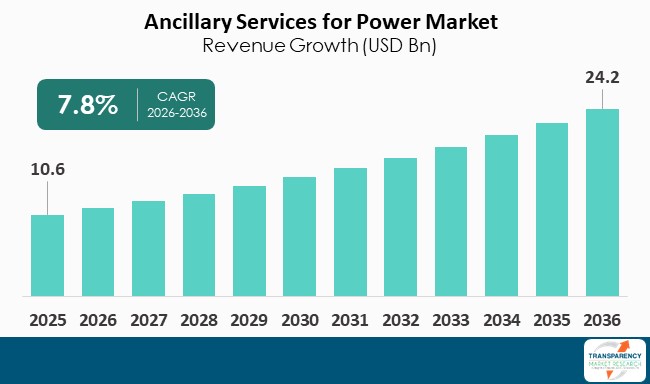
The Ancillary Services for Power Market is continuously attaining growth as power systems are getting more complicated and the share of renewable energy is increasing. Ancillary services are the additional functions necessary to ensure the reliable operation of the grid, stability, and power quality by balancing supply and demand, frequency regulation, voltage management, and provision of reserve capacity for contingencies. These services are key in present-day electricity systems in which the presence of wind and solar power, whose generation varies, causes power supply changes.
The Ancillary Services for Power Market expansion is mainly fueled by efforts to modernize the grid, a greater share of renewable energy installations, increased electricity demand, and the drive towards resilient power infrastructures. Transmission system operators, utilities, and independent power producers are focusing their investments on advanced grid management technologies, battery energy storage systems, and digital monitoring platforms to not only enhance response times but also optimize the overall operational efficiency. Leading market players are also employing artificial intelligence, real-time analytics, and automated control systems to maximize the performance of ancillary services. The establishment of regulatory structures that nourish a supportive environment and the use of competitive procurement mechanisms for ancillary services are not only attracting a larger number of participants but also enhancing the flexibility of the grid and opening up new revenue streams in the power sector.
Ancillary services for power market refer to a set of specific services that support the efficient and secure operation of electricity grids. These services go far beyond simply generating and supplying electricity as they matter a lot in the stability of the system by, among other things, balancing the electricity supply and demand, frequency regulation, voltage control, and even providing the reserve capacity for unforeseen power outages or changes in demand. The grid operators, utilities, and power producers rely mainly on ancillary services to maintain a steady power supply and avert any possible disruptions in the system. The ancillary services market is composed of several types of services like frequency regulation, spinning reserves, non-spinning reserves, reactive power support, and black-start capabilities, etc. The continuous integration of renewable energy sources, the complexities of the grid, and the demand for power reliability are the main reasons why the need for ancillary services is increasing. What is more, the use of advanced energy storage systems, digital grid technologies, and automated control solutions is Quite a bit enhancing the efficiency and responsiveness of the ancillary service role in present-day electricity networks.
| Attribute | Detail |
|---|---|
| Ancillary Services for Power Market Drivers |
|
The continuous upgrade of power grids is one of the key reasons fueling the development of the Ancillary Services for Power Industry. Utilities, grid operators, and governments worldwide have been urged to invest heavily in advanced grid technologies as aging transmission and distribution infrastructure, rising electricity consumption, and increasing complexity of power networks have been their main challenges. Traditional power systems focused mainly on centralized generation and stable demand. The fast expansion of distributed energy resources - mainly in form of clean energy, electric vehicles, and smart energy systems - has really changed what the grid needs to operate. Because of this, upgraded grids are in need of much more advanced ancillary services for the grid to remain stable, reliable, and efficient.
Grid modernization is a complex initiative of integrating smart grid technologies, advanced metering infrastructure, digital monitoring systems, automated substations, and real-time communication networks. These technologies provide the operators with the capability to not only closely monitor the grid conditions but also to act in real-time to the variations in electricity generation and consumption. Advanced ancillary services including frequency regulation, voltage control, spinning reserves, reactive power support, and black-start capabilities are key elements that enable these digitally reinforced power systems. Ancillary services play a pivotal function by constantly balancing the supply of electricity with the demand, thereby they avert power failures, ease congestion, and upgrade the performance of the overall grid.
As the use of renewable energy sources is increasing exponentially, their role in the rise of more complex ancillary services in the modernized power grids cannot be overlooked. Due to Really solar and wind energy harnessing depends on the elements and can bring about sudden changes in the power production, the presence of a swiftly reacting mechanism for balancing is indispensable for system stability. For this reason, apart from energy storage systems, demand response programs, and flexible generation units which are capable of participating in the ancillary service markets, these are the focal points of investment by the grid operators. Since these sources are capable of very swift alterations to the power supply and demand, they Quite a bit lead to the enhancement of the grid's flexibility and its capability to address issues.
Government agencies and regulators are contributing to the effort of modernizing the power grid by rolling out new policies, providing financial support for infrastructure, and reforming markets to give a larger role to Ancillary Services for Power Market. Quite a few power markets are launching competitive bidding and rewarding schemes based on performance to lure new suppliers and make operations more efficient. Tech firms and power companies are turning more and more to AI, predictive data analysis, and automation platforms for getting the most out of ancillary services.
The Ancillary Services for Power Market is largely influenced by the growing concern of the community for having a dependable and consistent supply of electricity. With the widespread use of electricity by industries, commercial establishments, digital societies, healthcare centers and homes, it is inevitable that the power system operators are put into a difficult position to keep up with their grid requirements at all times of the day. A power outage by even a fraction of a second can cause a lot of issues such as loss of business, lower productivity, and interruptions of services among others, Because of this, grid reliability has become the main concern of both the utilities and the regulatory authorities. In line with this, the need for ancillary services has also risen since it is through them the power systems can be operated safely and efficiently.
The purpose of ancillary services is to help stabilize electricity generation and consumption on a second-by-second basis, alongside keeping main grid factors like frequency, voltage, and reserve capacity at healthy levels. With power systems turning into networks and becoming complicated, operators would have to rely more on these support services in all kinds of ways if in case they need to respond to an unexpected breakdown of equipment, the example of a transmission being obstructed, demand suddenly going up, and a shortfall of generation. A frequency regulating service keeps supply and demand balanced while voltage support delivers the power quality that is needed for both the transmission and distribution networks. Operating reserves are made up of spinning and non-spinning reserves that provide backup which can be used in emergencies in a very short time to lower the possibility of large-scale failures.
The expanding use of renewable energy sources has greatly increased the demand for reliability-focused services, driving growth in the Ancillary Services for Power Market. Fluctuations caused by solar and wind facilities are among the unbalances that are challenging the control of the traditional power system. Faced with these difficulties, the control centers of electric systems are turning their attention to flexible resources like battery energy storage systems, demand response measures, as well as power plants that can ramp up quickly and provide ancillary services of rapid response. These resources are a great support to the electricity system because they allow operators to react promptly to unforeseen generation or consumption variations, thereby strengthening the system's ability to withstand stress.
As the electrification of sectors such as transportation, manufacturing, and residential is increasing, power networks are getting more stressed by the changing demand patterns and the added complexity of their operation. To address this, utilities and grid operators are reinforcing their facilities with sophisticated grid management platforms, monitoring technologies in real-time, and automated control systems to a raise level of reliability. The regulatory agencies are setting higher reliability standards and encouraging the provision of ancillary services using market-based procurement. These ongoing efforts not only demonstrate the increasing role of ancillary services in the stability of the power system but also create significant opportunities for market players and at the same time promote the long-term development of the Ancillary Services for Power Market.
| Attribute | Detail |
|---|---|
| Ancillary Services for Power Market Opportunity |
|
The integration of digital grid technologies and the optimization powered by artificial intelligence (AI) is opening up enormous potentials in the Ancillary Services for Power Market. The transformation of power systems into more decentralized and complicated ones is leading the utilities and grid operators to use more advanced digital tools to raise the level of visibility, control, and efficiency in the operation of electricity networks. Smart sensors, advanced metering infrastructure, Internet of Things (IoT) devices, cloud-based platforms, and real-time monitoring systems are technologies that produce a vast amount of operational data which can be used for better grid management and enhancement of the performance of ancillary services.
With AI and machine learning algorithms, grid operators can analyze the current state of the grid, predict electricity demand, forecast changes in renewable energy generation, and even anticipate disruptions in the system. Such forecasting ability gives the providers of ancillary services a chance to better allocate their resources, speed up their responses, and lower costs of operations. Energy storage systems, flexible generation assets, and demand response resources resident on constant time-intervals can be dispatch through digital platforms automatically and accurately, Because of this a lot shortening the delivery time of grid services. AI-based forecasting and decision-support systems represent a very powerful means of maximizing ancillary service contributions and simultaneously increasing the reliability and resilience of the grid. As utility companies accelerate their digital transformation processes and invest more in smart grid infrastructure, the Ancillary Services for Power Market is expected to grow, thereby creating substantial opportunities for market players and technology vendors.
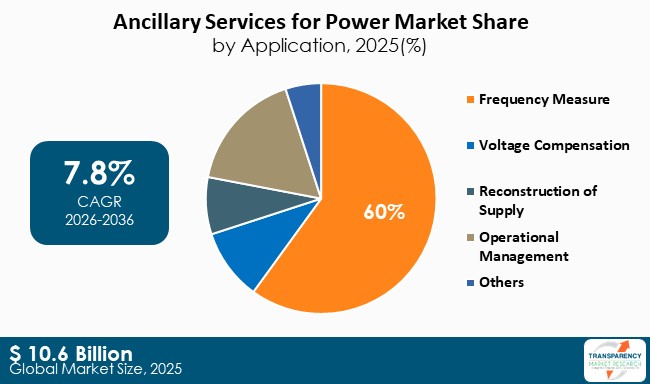
Frequency Measure accounts for the largest share of the Ancillary Services for Power Market at around 60% mainly because it is key in keeping the constant balance between electricity production and consumption which makes sure that the grid frequency stays within allowable limits. The rising penetration of renewable energy sources, unpredictable power demand, and grid complexities have greatly lead to a growing demand for frequency control services capable of fast response. Utilities and grid operators mainly focus on frequency regulation as a means to prevent system instability, avert power outages, and uphold a reliable operation of the power system that is why it has been continuously gaining the market.
| Attribute | Detail |
|---|---|
| Leading Region |
|
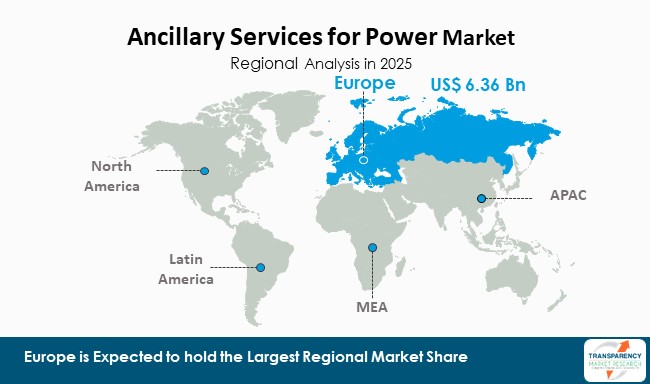
Europe holds the largest part of the Ancillary Services for Power Market it’s around 36% due to significant share of renewable energy, well-developed grid infrastructure, and effective regulatory systems raising the bar. Germany, UK, and France are competitive in the ancillary service market and are also spending a lot on grid upgrading, energy storage systems, and electricity interconnections across borders. Variable wind and solar power generation integration are on a roll, leading to more frequency regulation, reserve capacity, and voltage support needs. On top of that, solid decarbonization goals, more battery storages, and digital grid management are among the huge factors for ancillary services demand.
Siemens AG, ABB Ltd. Schneider Electric SE, and General Electric Company provide, among other things, grid automation systems at an advanced level, energy management platforms, digital substations, solutions for power quality, technologies for frequency regulation, and grid monitoring software that support ancillary services. Their suites of products and services assist utilities and grid operators in a number of ways like helping them keep frequency and voltage stable, incorporating renewable energy sources more efficiently, managing reserve capacity in an optimized manner, and improving together the reliability of the grid. These companies' innovations empower the operation of modern electricity networks efficiently and also back the increased need for flexible grid services.
Each of these players has been profiled in the Ancillary Services for Power market research report based on parameters such as company overview, financial overview, business strategies, product portfolio, business segments, and recent developments
| Attribute | Detail |
|---|---|
| Market Size Value in 2025 | USD 10.6 Billion |
| Market Forecast Value in 2036 | USD 24.2 Billion |
| Growth Rate (CAGR) | 7.8% |
| Forecast Period | 2026-2036 |
| Historical Data Available for | 2021-2025 |
| Quantitative Units | USD Billion |
| Ancillary Services for Power Market Analysis | It includes cross-segment analysis at the global as well as regional level. The qualitative analysis includes drivers, restraints, Carbon Fiber market opportunities, key trends, Porter’s Five Forces analysis, value chain analysis, and key trend analysis. |
| Competition Landscape |
|
| Format | Electronic (PDF) + Excel |
| Market Segmentation | By Service Type
|
| Regions Covered |
|
| Countries Covered |
|
| Companies Profiled |
|
| Customization Scope | Available upon request |
| Pricing | Available upon request |
The Ancillary Services for Power market stood at USD 10.6 Billion in 2025.
The Ancillary Services for Power market is expected to grow at a CAGR of 7.8% from 2026 to 2036.
Grid modernization initiatives accelerate adoption of advanced ancillary services and growing need for power system reliability and stability fuels market expansion.
Frequency Measure held the largest share under the Application segment in 2025, accounting for 60% of the market.
Europe was the most lucrative region in the Ancillary Services for Power market in 2025, holding the largest revenue share of 36%.
Siemens AG, NextEra Energy, Inc., General Electric Company, New York Independent System Operato, ABB Ltd., General Electric Company, Mitsubishi Electric Corporation, Eaton Corporation plc, National Grid plc, Snowy Hydro, PJM Interconnection, Independent Electricity System Operator, California Independent System Operator (CAISO), Elia Group, Southwest Power Pool (SPP), Transelectrica SA, Alberta Electric System Operator, Midcontinent Independent System Operator, Duke Energy Corporation and Schnei
Table 1 Global Ancillary Services for Power Market Value (USD Billion) Forecast, by Service Type, 2026 to 2036
Table 2 Global Ancillary Services for Power Market Value (USD Billion) Forecast, by Application, 2026 to 2036
Table 3 Global Ancillary Services for Power Market Value (USD Billion) Forecast, by Region, 2026 to 2036
Table 4 North America Ancillary Services for Power Market Value (USD Billion) Forecast, by Service Type, 2026 to 2036
Table 5 North America Ancillary Services for Power Market Value (USD Billion) Forecast, by Application, 2026 to 2036
Table 6 North America Ancillary Services for Power Market Value (USD Billion) Forecast, by Country, 2026 to 2036
Table 7 USA Ancillary Services for Power Market Value (USD Billion) Forecast, by Service Type, 2026 to 2036
Table 8 USA Ancillary Services for Power Market Value (USD Billion) Forecast, by Application, 2026 to 2036
Table 9 Canada Ancillary Services for Power Market Value (USD Billion) Forecast, by Service Type, 2026 to 2036
Table 10 Canada Ancillary Services for Power Market Value (USD Billion) Forecast, by Application 2026 to 2036
Table 11 Europe Ancillary Services for Power Market Value (USD Billion) Forecast, by Service Type, 2026 to 2036
Table 12 Europe Ancillary Services for Power Market Value (USD Billion) Forecast, by Application 2026 to 2036
Table 13 Europe Ancillary Services for Power Market Value (USD Billion) Forecast, by Country and Sub-region, 2026 to 2036
Table 14 Germany Ancillary Services for Power Market Value (USD Billion) Forecast, by Service Type, 2026 to 2036
Table 15 Germany Ancillary Services for Power Market Value (USD Billion) Forecast, by Application 2026 to 2036
Table 16 France Ancillary Services for Power Market Value (USD Billion) Forecast, by Service Type, 2026 to 2036
Table 17 France Ancillary Services for Power Market Value (USD Billion) Forecast, by Application 2026 to 2036
Table 18 UK Ancillary Services for Power Market Value (USD Billion) Forecast, by Service Type, 2026 to 2036
Table 19 UK Ancillary Services for Power Market Value (USD Billion) Forecast, by Application 2026 to 2036
Table 20 Italy Ancillary Services for Power Market Value (USD Billion) Forecast, by Service Type, 2026 to 2036
Table 21 Italy Ancillary Services for Power Market Value (USD Billion) Forecast, by Application 2026 to 2036
Table 22 Spain Ancillary Services for Power Market Value (USD Billion) Forecast, by Service Type, 2026 to 2036
Table 23 Spain Ancillary Services for Power Market Value (USD Billion) Forecast, by Application 2026 to 2036
Table 24 Russia & CIS Ancillary Services for Power Market Value (USD Billion) Forecast, by Service Type, 2026 to 2036
Table 25 Russia & CIS Ancillary Services for Power Market Value (USD Billion) Forecast, by Application 2026 to 2036
Table 26 Rest of Europe Ancillary Services for Power Market Value (USD Billion) Forecast, by Service Type, 2026 to 2036
Table 27 Rest of Europe Ancillary Services for Power Market Value (USD Billion) Forecast, by Application 2026 to 2036
Table 28 Asia Pacific Ancillary Services for Power Market Value (USD Billion) Forecast, by Service Type, 2026 to 2036
Table 29 Asia Pacific Ancillary Services for Power Market Value (USD Billion) Forecast, by Application 2026 to 2036
Table 30 Asia Pacific Ancillary Services for Power Market Value (USD Billion) Forecast, by Country and Sub-region, 2026 to 2036
Table 31 China Ancillary Services for Power Market Value (USD Billion) Forecast, by Service Type 2026 to 2036
Table 32 China Ancillary Services for Power Market Value (USD Billion) Forecast, by Application 2026 to 2036
Table 33 Japan Ancillary Services for Power Market Value (USD Billion) Forecast, by Service Type, 2026 to 2036
Table 34 Japan Ancillary Services for Power Market Value (USD Billion) Forecast, by Application 2026 to 2036
Table 35 India Ancillary Services for Power Market Value (USD Billion) Forecast, by Service Type, 2026 to 2036
Table 36 India Ancillary Services for Power Market Value (USD Billion) Forecast, by Application 2026 to 2036
Table 37 ASEAN Ancillary Services for Power Market Value (USD Billion) Forecast, by Service Type, 2026 to 2036
Table 38 ASEAN Ancillary Services for Power Market Value (USD Billion) Forecast, by Application 2026 to 2036
Table 39 Rest of Asia Pacific Ancillary Services for Power Market Value (USD Billion) Forecast, by Service Type, 2026 to 2036
Table 40 Rest of Asia Pacific Ancillary Services for Power Market Value (USD Billion) Forecast, by Application 2026 to 2036
Table 41 Latin America Ancillary Services for Power Market Value (USD Billion) Forecast, by Service Type, 2026 to 2036
Table 42 Latin America Ancillary Services for Power Market Value (USD Billion) Forecast, by Application 2026 to 2036
Table 43 Latin America Ancillary Services for Power Market Value (USD Billion) Forecast, by Country and Sub-region, 2026 to 2036
Table 44 Brazil Ancillary Services for Power Market Value (USD Billion) Forecast, by Service Type, 2026 to 2036
Table 45 Brazil Ancillary Services for Power Market Value (USD Billion) Forecast, by Application 2026 to 2036
Table 46 Mexico Ancillary Services for Power Market Value (USD Billion) Forecast, by Service Type, 2026 to 2036
Table 47 Mexico Ancillary Services for Power Market Value (USD Billion) Forecast, by Application 2026 to 2036
Table 48 Rest of Latin America Ancillary Services for Power Market Value (USD Billion) Forecast, by Service Type, 2026 to 2036
Table 49 Rest of Latin America Ancillary Services for Power Market Value (USD Billion) Forecast, by Application 2026 to 2036
Table 50 Middle East & Africa Ancillary Services for Power Market Value (USD Billion) Forecast, by Service Type, 2026 to 2036
Table 51 Middle East & Africa Ancillary Services for Power Market Value (USD Billion) Forecast, by Application 2026 to 2036
Table 52 Middle East & Africa Ancillary Services for Power Market Value (USD Billion) Forecast, by Country and Sub-region, 2026 to 2036
Table 53 GCC Ancillary Services for Power Market Value (USD Billion) Forecast, by Service Type, 2026 to 2036
Table 54 GCC Ancillary Services for Power Market Value (USD Billion) Forecast, by Application 2026 to 2036
Table 55 South Africa Ancillary Services for Power Market Value (USD Billion) Forecast, by Service Type, 2026 to 2036
Table 56 South Africa Ancillary Services for Power Market Value (USD Billion) Forecast, by Application 2026 to 2036
Table 57 Rest of Middle East & Africa Ancillary Services for Power Market Value (USD Billion) Forecast, by Service Type, 2026 to 2036
Table 58 Rest of Middle East & Africa Ancillary Services for Power Market Value (USD Billion) Forecast, by Application 2026 to 2036
Figure 1 Global Ancillary Services for Power Market Value Share Analysis, by Service Type, 2025, 2029, and 2036
Figure 2 Global Ancillary Services for Power Market Attractiveness, by Service Type
Figure 3 Global Ancillary Services for Power Market Value Share Analysis, by Application, 2025, 2029, and 2036
Figure 4 Global Ancillary Services for Power Market Attractiveness, by Application
Figure 5 Global Ancillary Services for Power Market Value Share Analysis, by Region, 2025, 2029, and 2036
Figure 6 Global Ancillary Services for Power Market Attractiveness, by Region
Figure 7 North America Ancillary Services for Power Market Value Share Analysis, by Service Type, 2025, 2029, and 2036
Figure 8 North America Ancillary Services for Power Market Attractiveness, by Service Type
Figure 9 North America Ancillary Services for Power Market Attractiveness, by Service Type
Figure 10 North America Ancillary Services for Power Market Value Share Analysis, by Application, 2025, 2029, and 2036
Figure 11 North America Ancillary Services for Power Market Attractiveness, by Application
Figure 12 North America Ancillary Services for Power Market Attractiveness, by Country and Sub-region
Figure 13 Europe Ancillary Services for Power Market Value Share Analysis, by Service Type, 2025, 2029, and 2036
Figure 14 Europe Ancillary Services for Power Market Attractiveness, by Service Type
Figure 15 Europe Ancillary Services for Power Market Value Share Analysis, by Application, 2025, 2029, and 2036
Figure 16 Europe Ancillary Services for Power Market Attractiveness, by Application
Figure 17 Europe Ancillary Services for Power Market Value Share Analysis, by Country and Sub-region, 2025, 2029, and 2036
Figure 18 Europe Ancillary Services for Power Market Attractiveness, by Country and Sub-region
Figure 19 Asia Pacific Ancillary Services for Power Market Value Share Analysis, by Service Type, 2025, 2029, and 2036
Figure 20 Asia Pacific Ancillary Services for Power Market Attractiveness, by Service Type
Figure 21 Asia Pacific Ancillary Services for Power Market Value Share Analysis, by Application, 2025, 2029, and 2036
Figure 22 Asia Pacific Ancillary Services for Power Market Attractiveness, by Application
Figure 23 Asia Pacific Ancillary Services for Power Market Value Share Analysis, by Country and Sub-region, 2025, 2029, and 2036
Figure 24 Asia Pacific Ancillary Services for Power Market Attractiveness, by Country and Sub-region
Figure 25 Latin America Ancillary Services for Power Market Value Share Analysis, by Service Type, 2025, 2029, and 2036
Figure 26 Latin America Ancillary Services for Power Market Attractiveness, by Service Type
Figure 27 Latin America Ancillary Services for Power Market Value Share Analysis, by Application, 2025, 2029, and 2036
Figure 28 Latin America Ancillary Services for Power Market Attractiveness, by Application
Figure 29 Latin America Ancillary Services for Power Market Value Share Analysis, by Country and Sub-region, 2025, 2029, and 2036
Figure 30 Latin America Ancillary Services for Power Market Attractiveness, by Country and Sub-region
Figure 31 Middle East & Africa Ancillary Services for Power Market Value Share Analysis, by Service Type, 2025, 2029, and 2036
Figure 32 Middle East & Africa Ancillary Services for Power Market Attractiveness, by Service Type
Figure 33 Middle East & Africa Ancillary Services for Power Market Value Share Analysis, by Application, 2025, 2029, and 2036
Figure 34 Middle East & Africa Ancillary Services for Power Market Attractiveness, by Application
Figure 35 Middle East & Africa Ancillary Services for Power Market Value Share Analysis, by Country and Sub-region, 2025, 2029, and 2036
Figure 36 Middle East & Africa Ancillary Services for Power Market Attractiveness, by Country and Sub-region
Copyright © Transparency Market Research, Inc. All Rights reserved
Trust Online


Ancillary Services for Power Market
