

Reports
Reports
Analysts’ Viewpoint on Magnetometer Market Scenario
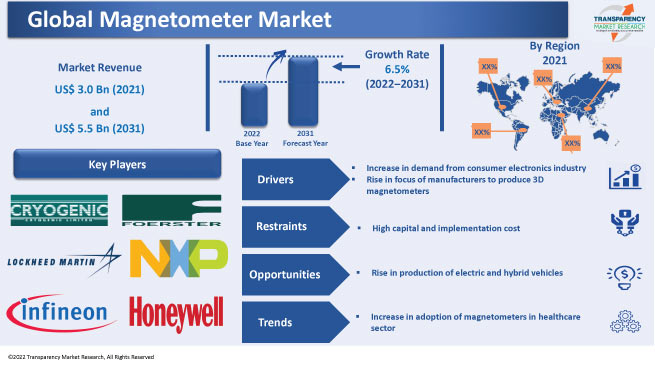
The global magnetometer market is estimated to grow at a decent pace during the forecast period, due to the rise in demand for magnetometers in various end-use industries such as aerospace & defense, consumer electronics, automotive, and healthcare. COVID-19 had disrupted the supply chain of magnetometers. However, companies operating in the global magnetometer market are focusing on high-growth applications such as cameras, camcorders, and MP3 players to keep their business growing post the peak of the COVID-19 pandemic. The magnetometer market in Asia Pacific is anticipated to grow at a significant pace in the next few years, owing to increase in adoption of electric vehicles in the region. Magnetometer offers various advantages such as low power consumption and low noise. Manufacturers should tap into incremental opportunities by focusing on development of 3D magnetometers to broaden their revenue streams.
Magnetometer is a device used to measure magnetic field direction and strength at a particular location. Based on axis, there are two types of magnetometers: single axis magnetometer and three axis magnetometer. Magnetometers are used in mission-critical applications in automobiles such as electronic compass, GPS navigation, and magnetic field detection. Magnetometers can also be utilized in consumer electronics applications such as computer tablets, smartphones, gaming and audio/video devices, desktop PCs, and personal electronics due to advancements in microelectromechanical system (MEMS) technology. Rise in adoption of stationary magnetometers or fixed magnetometers, portable magnetometers, SQUID magnetometers, and mobile magnetometers in various end-use industries is projected to create incremental opportunities for manufacturers during the forecast period. The global magnetometer market size is expected to increase due to rise in applications in joystick and gimbals, robotics position sensing, etc., during the forecast period.
Increase in usage of magnetometer in consumer electronics products such as household appliances, digital cameras, smartphones, toys, electronic instruments, and other electronic equipment is likely to propel the global magnetometer market during the forecast period. Magnetometers are used to determine speed and direction, position, alignment, proximity, and rotational position without making direct contact with the target. Magnetometer can be employed in rugged protected enclosures for use in harsh environments, or in small circuit board mount packages to save space. Furthermore, development of flexible magnetic sensors has grabbed the attention of various end-users to explore new opportunities. Mobile navigation is one of the rapidly growing applications of magnetometers. The electronic compass is a must-have feature in mobile devices such as smartphones and tablets. Therefore, increase in usage of magnetometers in consumer electronics industry is expected to drive the magnetometer market demand during the forecast period.
Increase in demand for magnetic sensors in industrial, medical, and automotive industries is anticipated to drive the global magnetometer market in the next few years. Major market players, such as Infineon Technologies AG, have developed products based on 3D magnetometers. The TLI493D-W2BW XENSIV 3D magnetic sensor combines high-accuracy magnetic field measurements with an extremely small footprint and low power consumption (minimum 7 nA). This sensor enables plenty of novel applications, such as human-machine interfaces in industrial and consumer joysticks, ergonomic pushbuttons on household appliances, and highly precise position control in robotics. These sensors are Hall-effect based and detect the strength of a magnetic field in all three dimensions; namely linear, angular, and rotational movements and transmit the data via an output interface. Furthermore, these sensors can provide accurate measurements and require a small amount of power to operate.
Magnetometers provide high accuracy for several measuring parameters such as pressure, proximity, position, fluid flow, etc. This sensor possesses several advantageous properties, including high sensitivity, high linearity, large field range, and low power consumption. Therefore, manufacturers are focusing on the development of compact low-voltage 3D magnetometers.
In terms of product, the global magnetometer market has been segmented into single axis and three axis. The three axis segment held major share of 84.3% of the global magnetometer market in 2021. It is likely to maintain its share and grow at a growth rate of 6.9% during the forecast period. Rise in demand for these magnetometers from the aerospace & defense industry is a major factor boosting the segment. In aerospace & defense, the three axis magnetometer is an integral component used in spacecraft telemetry for developing spacecraft’s magnetic cleanliness design. Preference for three axis magnetometers in the aerospace industry is due to their unique variable permeability characteristics along with excellent noise performance, high sensitivity, and good linearity. Furthermore, ongoing advancements in technology are enabling manufacturers to improve the performance characteristics of magnetometers to suit specific requirements of aerospace & defense applications.
In terms of end-use industry, the global magnetometer market has been classified into aerospace & defense, automotive, consumer electronics, healthcare, industrial, and others. The automotive segment held 33.1% share of the global magnetometer market in 2021, and is expected to dominate the global market with a CAGR of 7.8% during the forecast period. Magnetometers have been gaining popularity in the automotive industry for the last few years. Magnetometers are used in the automotive industry for gear stick position, control element in the top module, multi-function steering vehicle/Knob, and pedal/ valve position sensing, among others. For instance, in June 2020, Melexis introduced the MLX90395 Triaxis magnetometer node, an automotive-grade (AEC-Q100) monolithic sensor that uses the Hall Effect technology to provide contactless sensing in three dimensions. MLX90395 Triaxis provides redundancy for demanding scenarios such as gear lever position sensing in automotive applications. Moreover, magnetometers also help detect the presence of a vehicle while parking on docks, which triggers an alarm to notify the dock attendant that the vehicle is in the position for loading and unloading. All these factors are likely to drive the automotive segment during the forecast period.
The Asia Pacific region held 34.1% share of the global magnetometer market in 2021, and it is expected to dominate the global market during the forecast period. This can be ascribed to the lucrative presence of leading automobile manufacturers in major economies across Asia Pacific such as Japan, India, and China. Moreover, factors such as industrialization, rapid urbanization, and growth in demand for smartphones, computers, etc., have created prominent opportunities for manufacturers of magnetometers. Advancement in MEMS technology is also likely to drive the magnetometer market in the region during the forecast period. Furthermore, one of the latest consumer applications of magnetometers is the integration of mobile phones with e-compasses that help measure magnetic fields greater than 1 nT. In Asia Pacific, the automotive sector is continuously expanding and hence, the implementation of magnetometer-based vehicle detection systems for smart parking applications is on the rise, which in turn is boosting the magnetometer market growth in Asia Pacific.
North America held prominent share of 29.8% of the global magnetometer market in 2021. Rise in demand for magnetometers from aerospace & defense industry is projected to drive the market in the region in the next few years. Increase in usage of military-grade fluxgate magnetometers in unmanned aircraft (UAV) and drones is likely to boost the demand for magnetometers in the region. Moreover, digital fluxgate magnetometers make ideal standalone sensors for airborne measurements in the sensor package in UAVs, which is expected to further propel the magnetometer market in North America during the forecast period.
The global magnetometer market is fragmented, with a small number of large-scale vendors that control majority of the share. Expansion of product portfolios and mergers and acquisitions are major strategies adopted by leading manufacturers operating in the global magnetometer market. Bartington Instruments Ltd, Cryogenic Limited, FOERSTER Holding GmbH, Gem Systems Advanced Magnetometers, Geometrics, Honeywell International Inc, Infineon Technology, Lake Shore Cryotronics, Inc, Lockheed Martin Corporation, Marine Magnetics Corp, NXP Semiconductors N.V, Scintrex Limited, Tristan Technologies, Inc, and VectorNav Technologies are key players operating in the global magnetometer market.
Key players have been profiled in the magnetometer market report based on parameters such as company overview, financial overview, business strategies, product portfolio, business segments, and recent developments.
|
Attribute |
Detail |
|
Market Size Value in 2021 |
US$ 3.0 Bn |
|
Market Forecast Value in 2031 |
US$ 5.5 Bn |
|
Growth Rate (CAGR) |
6.5% |
|
Forecast Period |
2022–2031 |
|
Historical Data Available for |
2017–2020 |
|
Quantitative Units |
US$ Bn for Value & Million Units for Volume |
|
Market Analysis |
It includes cross segment analysis at global as well as regional level. Furthermore, qualitative analysis includes drivers, restraints, opportunities, key trends, Porter’s Five Forces analysis, value chain analysis, and key trend analysis. |
|
Competition Landscape |
|
|
Format |
Electronic (PDF) + Excel |
|
Market Segmentation |
|
|
Regions Covered |
|
|
Countries Covered |
|
|
Companies Profiled |
|
|
Customization Scope |
Available upon request |
|
Pricing |
Available upon request |
The global magnetometer market stood at US$ 3.0 Bn in 2021
The global magnetometer market is expected to grow at a CAGR of 6.5% during the forecast period
Increase in demand from consumer electronics industry and rise in focus of manufacturers to produce 3D magnetometers
The automotive segment accounted for major share of 33.1% of the global magnetometer market in 2021
Asia Pacific is more attractive region for vendors and held 7.1% share of the global magnetometer market in 2021
The U.S. accounted 21.4% of share of the global magnetometer market in 2021
Bartington Instruments Ltd, Cryogenic Limited, FOERSTER Holding GmbH, Gem Systems Advanced Magnetometers, Geometrics, Honeywell International Inc, Infineon Technology, Lake Shore Cryotronics, Inc., Lockheed Martin Corporation, Marine Magnetics Corp, NXP Semiconductors N.V, Scintrex Limited, Tristan Technologies, Inc., VectorNav Technologies
1. Preface
1.1. Market Introduction
1.2. Market and Segments Definition
1.3. Market Taxonomy
1.4. Research Methodology
1.5. Assumption and Acronyms
2. Executive Summary
2.1. Magnetometer Market Overview
2.2. Regional Outline
2.3. Industry Outline
2.4. Market Dynamics Snapshot
2.5. Competition Blueprint
3. Market Dynamics
3.1. Macro-economic Factors
3.2. Drivers
3.3. Restraints
3.4. Opportunities
3.5. Key Trends
3.6. Regulatory Framework
4. Associated Industry and Key Indicator Assessment
4.1. Parent Industry Overview – Global Analytical Instrument Industry Overview
4.2. Supply Chain Analysis
4.3. Pricing Analysis
4.4. Technology Roadmap Analysis
4.5. Industry SWOT Analysis
4.6. Porter Five Forces Analysis
4.7. Covid-19 Impact and Recovery Analysis
5. Magnetometer Market Analysis By Type
5.1. Magnetometer Market Value (US$ Mn) and Volume (Million Units) Analysis & Forecast, by Type, 2017–2031
5.1.1. Scalar Magnetometer
5.1.1.1. Proton Precession
5.1.1.2. Overhauser Effect
5.1.1.3. Ionized Gas
5.1.2. Vector Magnetometer
5.1.2.1. Fluxgate
5.1.2.2. SQUID
5.1.2.3. Magneto Resistive
5.1.2.4. Others
5.2. Market Attractiveness Analysis, By Type
6. Magnetometer Market Analysis By Product
6.1. Magnetometer Market Value (US$ Mn) Analysis & Forecast, by Product, 2017–2031
6.1.1. Single Axis
6.1.2. Three Axis
6.2. Market Attractiveness Analysis, By Product
7. Magnetometer Market Analysis By Form Factor
7.1. Magnetometer Market Value (US$ Mn) Analysis & Forecast, by Form Factor, 2017–2031
7.1.1. Fixed
7.1.2. Portable
7.2. Market Attractiveness Analysis, by Form Factor
8. Magnetometer Market Analysis By Application
8.1. Magnetometer Market Value (US$ Mn) Analysis & Forecast, by Application, 2017–2031
8.1.1. Space Exploration
8.1.2. Pedal/Valve Position Sensing
8.1.3. Healthcare Monitoring
8.1.4. Archeological Surveys
8.1.5. Robotics Position Sensing
8.1.6. Hearable
8.1.7. Others
8.2. Market Attractiveness Analysis, by Application
9. Magnetometer Market Analysis By End-use Industry
9.1. Magnetometer Market Value (US$ Mn) Analysis & Forecast, By End-use Industry, 2017–2031
9.1.1. Aerospace & Defense
9.1.2. Automotive
9.1.3. Consumer Electronics
9.1.4. Healthcare
9.1.5. Industrial
9.1.6. Others
9.2. Market Attractiveness Analysis, By End-use Industry
10. Magnetometer Market Analysis and Forecast, By Region
10.1. Magnetometer Market Value (US$ Mn) and Volume (Million Units) Analysis & Forecast, By Region, 2017–2031
10.1.1. North America
10.1.2. Europe
10.1.3. Asia Pacific
10.1.4. Middle East & Africa
10.1.5. South America
10.2. Market Attractiveness Analysis, By Region
11. North America Magnetometer Market Analysis and Forecast
11.1. Market Snapshot
11.2. Drivers and Restraints: Impact Analysis
11.3. Magnetometer Market Value (US$ Mn) and Volume (Million Units) Analysis & Forecast, By Type, 2017–2031
11.3.1. Scalar Magnetometer
11.3.1.1. Proton Precession
11.3.1.2. Overhauser Effect
11.3.1.3. Ionized Gas
11.3.2. Vector Magnetometer
11.3.2.1. Fluxgate
11.3.2.2. SQUID
11.3.2.3. Magneto Resistive
11.3.2.4. Others
11.4. Magnetometer Market Value (US$ Mn) Analysis & Forecast, By Product, 2017–2031
11.4.1. Single Axis
11.4.2. Three Axis
11.5. Magnetometer Market Value (US$ Mn) Analysis & Forecast, By Form Factor, 2017–2031
11.5.1. Fixed
11.5.2. Portable
11.6. Magnetometer Market Value (US$ Mn) Analysis & Forecast, By Application, 2017–2031
11.6.1. Space Exploration
11.6.2. Pedal/Valve Position Sensing
11.6.3. Healthcare Monitoring
11.6.4. Archeological Surveys
11.6.5. Robotics Position Sensing
11.6.6. Hearable
11.6.7. Others
11.7. Magnetometer Market Value (US$ Mn) Analysis & Forecast, By End-use Industry, 2017–2031
11.7.1. Aerospace & Defense
11.7.2. Automotive
11.7.3. Consumer Electronics
11.7.4. Healthcare
11.7.5. Industrial
11.7.6. Others
11.8. Magnetometer Value (US$ Mn) and Volume (Million Units) Analysis & Forecast, By Country and Sub-region, 2017–2031
11.8.1. The U.S.
11.8.2. Canada
11.8.3. Rest of North America
11.9. Market Attractiveness Analysis
11.9.1. By Type
11.9.2. By Product
11.9.3. By Form Factor
11.9.4. By Application
11.9.5. By End-use Industry
11.9.6. By Country/Sub-region
12. Europe Magnetometer Market Analysis and Forecast
12.1. Market Snapshot
12.2. Drivers and Restraints: Impact Analysis
12.3. Magnetometer Market Value (US$ Mn) and Volume (Million Units) Analysis & Forecast, By Type, 2017–2031
12.3.1. Scalar Magnetometer
12.3.1.1. Proton Precession
12.3.1.2. Overhauser Effect
12.3.1.3. Ionized Gas
12.3.2. Vector Magnetometer
12.3.2.1. Fluxgate
12.3.2.2. SQUID
12.3.2.3. Magneto Resistive
12.3.2.4. Others
12.4. Magnetometer Market Value (US$ Mn) Analysis & Forecast, By Product, 2017–2031
12.4.1. Single Axis
12.4.2. Three Axis
12.5. Magnetometer Market Value (US$ Mn) Analysis & Forecast, By Form Factor, 2017–2031
12.5.1. Fixed
12.5.2. Portable
12.6. Magnetometer Market Value (US$ Mn) Analysis & Forecast, By Application, 2017–2031
12.6.1. Space Exploration
12.6.2. Pedal/Valve Position Sensing
12.6.3. Healthcare Monitoring
12.6.4. Archeological Surveys
12.6.5. Robotics Position Sensing
12.6.6. Hearable
12.6.7. Others
12.7. Magnetometer Market Value (US$ Mn) Analysis & Forecast, By End-use Industry, 2017–2031
12.7.1. Aerospace & Defense
12.7.2. Automotive
12.7.3. Consumer Electronics
12.7.4. Healthcare
12.7.5. Industrial
12.7.6. Others
12.8. Magnetometer Value (US$ Mn) and Volume (Million Units) Analysis & Forecast, By Country and Sub-region, 2017–2031
12.8.1. The U.K.
12.8.2. Germany
12.8.3. France
12.8.4. Rest of Europe
12.9. Market Attractiveness Analysis
12.9.1. By Type
12.9.2. By Product
12.9.3. By Form Factor
12.9.4. By Application
12.9.5. By End-use Industry
12.9.6. By Country/Sub-region
13. Asia Pacific Magnetometer Market Analysis and Forecast
13.1. Market Snapshot
13.2. Drivers and Restraints: Impact Analysis
13.3. Magnetometer Market Value (US$ Mn) and Volume (Million Units) Analysis & Forecast, By Type, 2017–2031
13.3.1. Scalar Magnetometer
13.3.1.1. Proton Precession
13.3.1.2. Overhauser Effect
13.3.1.3. Ionized Gas
13.3.2. Vector Magnetometer
13.3.2.1. Fluxgate
13.3.2.2. SQUID
13.3.2.3. Magneto Resistive
13.3.2.4. Others
13.4. Magnetometer Market Value (US$ Mn) Analysis & Forecast, By Product, 2017–2031
13.4.1. Single Axis
13.4.2. Three Axis
13.5. Magnetometer Market Value (US$ Mn) Analysis & Forecast, By Form Factor, 2017–2031
13.5.1. Fixed
13.5.2. Portable
13.6. Magnetometer Market Value (US$ Mn) Analysis & Forecast, By Application, 2017–2031
13.6.1. Space Exploration
13.6.2. Pedal/Valve Position Sensing
13.6.3. Healthcare Monitoring
13.6.4. Archeological Surveys
13.6.5. Robotics Position Sensing
13.6.6. Hearable
13.6.7. Others
13.7. Magnetometer Market Value (US$ Mn) Analysis & Forecast, By End-use Industry, 2017–2031
13.7.1. Aerospace & Defense
13.7.2. Automotive
13.7.3. Consumer Electronics
13.7.4. Healthcare
13.7.5. Industrial
13.7.6. Others
13.8. Magnetometer Value (US$ Mn) and Volume (Million Units) Analysis & Forecast, By Country and Sub-region, 2017–2031
13.8.1. China
13.8.2. India
13.8.3. Japan
13.8.4. South Korea
13.8.5. ASEAN
13.8.6. Rest of Asia Pacific
13.9. Market Attractiveness Analysis
13.9.1. By Type
13.9.2. By Product
13.9.3. By Form Factor
13.9.4. By Application
13.9.5. By End-use Industry
13.9.6. By Country/Sub-region
14. Middle East and Africa Magnetometer Market Analysis and Forecast
14.1. Market Snapshot
14.2. Drivers and Restraints: Impact Analysis
14.3. Magnetometer Market Value (US$ Mn) and Volume (Million Units) Analysis & Forecast, By Type, 2017–2031
14.3.1. Scalar Magnetometer
14.3.1.1. Proton Precession
14.3.1.2. Overhauser Effect
14.3.1.3. Ionized Gas
14.3.2. Vector Magnetometer
14.3.2.1. Fluxgate
14.3.2.2. SQUID
14.3.2.3. Magneto Resistive
14.3.2.4. Others
14.4. Magnetometer Market Value (US$ Mn) Analysis & Forecast, By Product, 2017–2031
14.4.1. Single Axis
14.4.2. Three Axis
14.5. Magnetometer Market Value (US$ Mn) Analysis & Forecast, By Form Factor, 2017–2031
14.5.1. Fixed
14.5.2. Portable
14.6. Magnetometer Market Value (US$ Mn) Analysis & Forecast, By Application, 2017–2031
14.6.1. Space Exploration
14.6.2. Pedal/Valve Position Sensing
14.6.3. Healthcare Monitoring
14.6.4. Archeological Surveys
14.6.5. Robotics Position Sensing
14.6.6. Hearable
14.6.7. Others
14.7. Magnetometer Market Value (US$ Mn) Analysis & Forecast, By End-use Industry, 2017–2031
14.7.1. Aerospace & Defense
14.7.2. Automotive
14.7.3. Consumer Electronics
14.7.4. Healthcare
14.7.5. Industrial
14.7.6. Others
14.8. Magnetometer Value (US$ Mn) and Volume (Million Units) Analysis & Forecast, By Country and Sub-region, 2017–2031
14.8.1. GCC
14.8.2. South Africa
14.8.3. Rest of the Middle East and Africa
14.9. Market Attractiveness Analysis
14.9.1. By Type
14.9.2. By Product
14.9.3. By Form Factor
14.9.4. By Application
14.9.5. By End-use Industry
14.9.6. By Country/Sub-region
15. South America Magnetometer Market Analysis and Forecast
15.1. Market Snapshot
15.2. Drivers and Restraints: Impact Analysis
15.3. Magnetometer Market Value (US$ Mn) and Volume (Million Units) Analysis & Forecast, By Type, 2017–2031
15.3.1. Scalar Magnetometer
15.3.1.1. Proton Precession
15.3.1.2. Overhauser Effect
15.3.1.3. Ionized Gas
15.3.2. Vector Magnetometer
15.3.2.1. Fluxgate
15.3.2.2. SQUID
15.3.2.3. Magneto Resistive
15.3.2.4. Others
15.4. Magnetometer Market Value (US$ Mn) Analysis & Forecast, By Product, 2017–2031
15.4.1. Single Axis
15.4.2. Three Axis
15.5. Magnetometer Market Value (US$ Mn) Analysis & Forecast, By Form Factor, 2017–2031
15.5.1. Fixed
15.5.2. Portable
15.6. Magnetometer Market Value (US$ Mn) Analysis & Forecast, By Application, 2017–2031
15.6.1. Space Exploration
15.6.2. Pedal/Valve Position Sensing
15.6.3. Healthcare Monitoring
15.6.4. Archeological Surveys
15.6.5. Robotics Position Sensing
15.6.6. Hearable
15.6.7. Others
15.7. Magnetometer Market Value (US$ Mn) Analysis & Forecast, By End-use Industry, 2017–2031
15.7.1. Aerospace & Defense
15.7.2. Automotive
15.7.3. Consumer Electronics
15.7.4. Healthcare
15.7.5. Industrial
15.7.6. Others
15.8. Magnetometer Value (US$ Mn) and Volume (Million Units) Analysis & Forecast, By Country and Sub-region, 2017–2031
15.8.1. Brazil
15.8.2. Rest of South America
15.9. Market Attractiveness Analysis
15.9.1. By Type
15.9.2. By Product
15.9.3. By Form Factor
15.9.4. By Application
15.9.5. By End-use Industry
15.9.6. By Country/Sub-region
16. Competition Assessment
16.1. Global Magnetometer Market Competition Matrix - a Dashboard View
16.1.1. Global Magnetometer Market Company Share Analysis, by Value (2021)
16.1.2. Technological Differentiator
17. Company Profiles (Global Manufacturers/Suppliers)
17.1. Bartington Instruments Ltd
17.1.1. Overview
17.1.2. Product Portfolio
17.1.3. Sales Footprint
17.1.4. Key Subsidiaries or Distributors
17.1.5. Strategy and Recent Developments
17.1.6. Key Financials
17.2. Cryogenic Limited
17.2.1. Overview
17.2.2. Product Portfolio
17.2.3. Sales Footprint
17.2.4. Key Subsidiaries or Distributors
17.2.5. Strategy and Recent Developments
17.2.6. Key Financials
17.3. FOERSTER Holding GmbH
17.3.1. Overview
17.3.2. Product Portfolio
17.3.3. Sales Footprint
17.3.4. Key Subsidiaries or Distributors
17.3.5. Strategy and Recent Developments
17.3.6. Key Financials
17.4. Gem Systems Advanced Magnetometers
17.4.1. Overview
17.4.2. Product Portfolio
17.4.3. Sales Footprint
17.4.4. Key Subsidiaries or Distributors
17.4.5. Strategy and Recent Developments
17.4.6. Key Financials
17.5. Geometrics
17.5.1. Overview
17.5.2. Product Portfolio
17.5.3. Sales Footprint
17.5.4. Key Subsidiaries or Distributors
17.5.5. Strategy and Recent Developments
17.5.6. Key Financials
17.6. Honeywell International Inc
17.6.1. Overview
17.6.2. Product Portfolio
17.6.3. Sales Footprint
17.6.4. Key Subsidiaries or Distributors
17.6.5. Strategy and Recent Developments
17.6.6. Key Financials
17.7. Infineon Technology
17.7.1. Overview
17.7.2. Product Portfolio
17.7.3. Sales Footprint
17.7.4. Key Subsidiaries or Distributors
17.7.5. Strategy and Recent Developments
17.7.6. Key Financials
17.8. Lake Shore Cryotronics, Inc.
17.8.1. Overview
17.8.2. Product Portfolio
17.8.3. Sales Footprint
17.8.4. Key Subsidiaries or Distributors
17.8.5. Strategy and Recent Developments
17.8.6. Key Financials
17.9. Lockheed Martin Corporation
17.9.1. Overview
17.9.2. Product Portfolio
17.9.3. Sales Footprint
17.9.4. Key Subsidiaries or Distributors
17.9.5. Strategy and Recent Developments
17.9.6. Key Financials
17.10. Marine Magnetics Corp
17.10.1. Overview
17.10.2. Product Portfolio
17.10.3. Sales Footprint
17.10.4. Key Subsidiaries or Distributors
17.10.5. Strategy and Recent Developments
17.10.6. Key Financials
17.11. NXP Semiconductors N.V
17.11.1. Overview
17.11.2. Product Portfolio
17.11.3. Sales Footprint
17.11.4. Key Subsidiaries or Distributors
17.11.5. Strategy and Recent Developments
17.11.6. Key Financials
17.12. Scintrex Limited
17.12.1. Overview
17.12.2. Product Portfolio
17.12.3. Sales Footprint
17.12.4. Key Subsidiaries or Distributors
17.12.5. Strategy and Recent Developments
17.12.6. Key Financials
17.13. Tristan Technologies, Inc.
17.13.1. Overview
17.13.2. Product Portfolio
17.13.3. Sales Footprint
17.13.4. Key Subsidiaries or Distributors
17.13.5. Strategy and Recent Developments
17.13.6. Key Financials
17.14. VectorNav Technologies
17.14.1. Overview
17.14.2. Product Portfolio
17.14.3. Sales Footprint
17.14.4. Key Subsidiaries or Distributors
17.14.5. Strategy and Recent Developments
17.14.6. Key Financials
18. Recommendation
18.1. Opportunity Assessment
18.1.1. By Type
18.1.2. By Product
18.1.3. By Form Factor
18.1.4. By Application
18.1.5. By End-use Industry
18.1.6. By Region
List of Tables
Table 1: Global Magnetometer Market Value (US$ Mn) & Forecast, by Type, 2017‒2031
Table 2: Global Magnetometer Market Volume (Million Units) & Forecast, by Type, 2017‒2031
Table 3: Global Magnetometer Market Value (US$ Mn) & Forecast, by Product, 2017‒2031
Table 4: Global Magnetometer Market Value (US$ Mn) & Forecast, by Form Factor, 2017‒2031
Table 5: Global Magnetometer Market Value (US$ Mn) & Forecast, by Application, 2017‒2031
Table 6: Global Magnetometer Market Value (US$ Mn) & Forecast, by End-use Industry, 2017‒2031
Table 7: Global Magnetometer Market Value (US$ Mn) & Forecast, by Region, 2017‒2031
Table 8: North America Magnetometer Market Value (US$ Mn) & Forecast, by Type, 2017‒2031
Table 9: North America Magnetometer Market Volume (Million Units) & Forecast, by Type, 2017‒2031
Table 10: North America Magnetometer Market Value (US$ Mn) & Forecast, by Product, 2017‒2031
Table 11: North America Magnetometer Market Value (US$ Mn) & Forecast, by Form Factor, 2017‒2031
Table 12: North America Magnetometer Market Value (US$ Mn) & Forecast, by Application, 2017‒2031
Table 13: North America Magnetometer Market Value (US$ Mn) & Forecast, by End-use industry, 2017‒2031
Table 14: North America Magnetometer Market Value (US$ Mn) & Forecast, by Country and Sub-region, 2017‒2031
Table 15: Europe Magnetometer Market Value (US$ Mn) & Forecast, by Type, 2017‒2031
Table 16: Europe Magnetometer Market Volume (Million Units) & Forecast, by Type, 2017‒2031
Table 17: Europe Magnetometer Market Value (US$ Mn) & Forecast, by Product, 2017‒2031
Table 18: Europe Magnetometer Market Value (US$ Mn) & Forecast, by Form Factor, 2017‒2031
Table 19: Europe Magnetometer Market Value (US$ Mn) & Forecast, by Application, 2017‒2031
Table 20: Europe Magnetometer Market Value (US$ Mn) & Forecast, by End-use Industry, 2017‒2031
Table 21: Europe Magnetometer Market Value (US$ Mn) & Forecast, by Country and Sub-region, 2017‒2031
Table 22: Asia Pacific Magnetometer Market Value (US$ Mn) & Forecast, by Type, 2017‒2031
Table 23: Asia Pacific Magnetometer Market Volume (Million Units) & Forecast, by Type, 2017‒2031
Table 24: Asia Pacific Magnetometer Market Value (US$ Mn) & Forecast, by Product, 2017‒2031
Table 25: Asia Pacific Magnetometer Market Value (US$ Mn) & Forecast, by Form Factor, 2017‒2031
Table 26: Asia Pacific Magnetometer Market Value (US$ Mn) & Forecast, by Application, 2017‒2031
Table 27: Asia Pacific Magnetometer Market Value (US$ Mn) & Forecast, by End-use Industry, 2017‒2031
Table 28: Asia Pacific Magnetometer Market Value (US$ Mn) & Forecast, by Country and Sub-region, 2017‒2031
Table 29: Middle East & Africa Magnetometer Market Value (US$ Mn) & Forecast, by Type, 2017‒2031
Table 30: Middle East & Africa Magnetometer Market Volume (Million Units) & Forecast, by Type, 2017‒2031
Table 31: Middle East & Africa Magnetometer Market Value (US$ Mn) & Forecast, by Product, 2017‒2031
Table 32: Middle East & Africa Magnetometer Market Value (US$ Mn) & Forecast, by Form Factor, 2017‒2031
Table 33: Middle East & Africa Magnetometer Market Value (US$ Mn) & Forecast, by Application, 2017‒2031
Table 34: Middle East & Africa Magnetometer Market Value (US$ Mn) & Forecast, by End-use Industry, 2017‒2031
Table 35: Middle East & Africa Magnetometer Market Value (US$ Mn) & Forecast, by Country and Sub-region, 2017‒2031
Table 36: South America Magnetometer Market Value (US$ Mn) & Forecast, by Type, 2017‒2031
Table 37: South America Magnetometer Market Volume (Million Units) & Forecast, by Type, 2017‒2031
Table 38: South America Magnetometer Market Value (US$ Mn) & Forecast, by Product, 2017‒2031
Table 39: South America Magnetometer Market Value (US$ Mn) & Forecast, by Form Factor, 2017‒2031
Table 40: South America Magnetometer Market Value (US$ Mn) & Forecast, by Application, 2017‒2031
Table 41: South America Magnetometer Market Value (US$ Mn) & Forecast, by End-use Industry, 2017‒2031
Table 42: South America Magnetometer Market Value (US$ Mn) & Forecast, by Country and Sub-region, 2017‒2031
List of Figures
Figure 01: Supply Chain Analysis - Global Magnetometer
Figure 02: Global Magnetometer Price Trend Analysis (Average Price, US$)
Figure 03: Porter Five Forces Analysis - Global Magnetometer
Figure 04: Technology Road Map - Global Magnetometer
Figure 05: Global Magnetometers Market, Value (US$ Mn), 2017-2031
Figure 06: Global Magnetometer Market Size & Forecast, Y-O-Y, Value (US$ Mn), 2017‒2031
Figure 07: Global Magnetometers Market, Volume (Million Units), 2017-2031
Figure 08: Global Magnetometer Market Size & Forecast, Y-O-Y, Volume (Million Units), 2017‒2031
Figure 09: Global Magnetometer Market Projections by Type, Value (US$ Mn), 2017‒2031
Figure 10: Global Magnetometer Market, Incremental Opportunity, by Type, 2021‒2031
Figure 11: Global Magnetometer Market Share Analysis, by Type, 2021 and 2031
Figure 12: Global Magnetometer Market Projections by Product, Value (US$ Mn), 2017‒2031
Figure 13: Global Magnetometer Market, Incremental Opportunity, by Product, 2021‒2031
Figure 14: Global Magnetometer Market Share Analysis, by Product, 2021 and 2031
Figure 15: Global Magnetometer Market Projections by Form Factor, Value (US$ Mn), 2017‒2031
Figure 16: Global Magnetometer Market, Incremental Opportunity, by Form Factor, 2021‒2031
Figure 17: Global Magnetometer Market Share Analysis, by Form Factor, 2021 and 2031
Figure 18: Global Magnetometer Market Projections by End-use Industry, Value (US$ Mn), 2017‒2031
Figure 19: Global Magnetometer Market, Incremental Opportunity, by Application, 2021‒2031
Figure 20: Global Magnetometer Market Share Analysis, by Application, 2021 and 2031
Figure 21: Global Magnetometer Market Projections by End-use Industry, Value (US$ Mn), 2017‒2031
Figure 22: Global Magnetometer Market, Incremental Opportunity, by End-use Industry, 2021‒2031
Figure 23: Global Magnetometer Market Share Analysis, by End-use Industry, 2021 and 2031
Figure 24: Global Magnetometer Market Projections by Region, Value (US$ Mn), 2017‒2031
Figure 25: Global Magnetometer Market, Incremental Opportunity, by Region, 2021‒2031
Figure 26: Global Magnetometer Market Share Analysis, by Region, 2021 and 2031
Figure 27: North America Magnetometer Market Size & Forecast, Value (US$ Mn), 2017‒2031
Figure 28: North America Magnetometer Market Size & Forecast, Y-O-Y, Value (US$ Mn), 2017‒2031
Figure 29: North America Magnetometers Market, Volume (Million Units), 2017-2031
Figure 30: North America Magnetometer Market Size & Forecast, Y-O-Y, Volume (Million Units), 2017‒2031
Figure 31: North America Magnetometer Market Projections by Type Value (US$ Mn), 2017‒2031
Figure 32: North America Magnetometer Market, Incremental Opportunity, by Type, 2021‒2031
Figure 33: North America Magnetometer Market Share Analysis, by Type, 2021 and 2031
Figure 34: North America Magnetometer Market Projections by Product, Value (US$ Mn), 2017‒2031
Figure 35: North America Magnetometer Market, Incremental Opportunity, by Product, 2021‒2031
Figure 36: North America Magnetometer Market Share Analysis, by Product, 2021 and 2031
Figure 37: North America Magnetometer Market Projections by Form Factor, Value (US$ Mn), 2017‒2031
Figure 38: North America Magnetometer Market, Incremental Opportunity, by Form Factor, 2021‒2031
Figure 39: North America Magnetometer Market Share Analysis, by Form Factor, 2021 and 2031
Figure 40: North America Magnetometer Market Projections by Application, Value (US$ Mn), 2017‒2031
Figure 41: North America Magnetometer Market, Incremental Opportunity, by Application, 2021‒2031
Figure 42: North America Magnetometer Market Share Analysis, by Application, 2021 and 2031
Figure 43: North America Magnetometer Market Projections by End-use Industry, Value (US$ Mn), 2017‒2031
Figure 44: North America Magnetometer Market, Incremental Opportunity, by End-use Industry, 2021‒2031
Figure 45: North America Magnetometer Market Share Analysis, by End-use Industry, 2021 and 2031
Figure 46: North America Magnetometer Market Projections by Country and sub-region, Value (US$ Mn), 2017‒2031
Figure 47: North America Magnetometer Market, Incremental Opportunity, by Country and sub-region, 2021‒2031
Figure 48: North America Magnetometer Market Share Analysis, by Country and sub-region 2021 and 2031
Figure 49: Europe Magnetometer Market Size & Forecast, Value (US$ Mn), 2017‒2031
Figure 50: Europe Magnetometer Market Size & Forecast, Y-O-Y, Value (US$ Mn), 2017‒2031
Figure 51: Europe Magnetometers Market, Volume (Million Units), 2017-2031
Figure 52: Europe Magnetometer Market Size & Forecast, Y-O-Y, Volume (Million Units), 2017‒2031
Figure 53: Europe Magnetometer Market Projections by Type Value (US$ Mn), 2017‒2031
Figure 54: Europe Magnetometer Market, Incremental Opportunity, by Type, 2021‒2031
Figure 55: Europe Magnetometer Market Share Analysis, by Type, 2021 and 2031
Figure 56: Europe Magnetometer Market Projections by Product, Value (US$ Mn), 2017‒2031
Figure 57: Europe Magnetometer Market, Incremental Opportunity, by Product, 2021‒2031
Figure 58: Europe Magnetometer Market Share Analysis, by Product, 2021 and 2031
Figure 59: Europe Magnetometer Market Projections by Form Factor, Value (US$ Mn), 2017‒2031
Figure 60: Europe Magnetometer Market, Incremental Opportunity, by Form Factor, 2021‒2031
Figure 61: Europe Magnetometer Market Share Analysis, by Form Factor, 2021 and 2031
Figure 62: Europe Magnetometer Market Projections by Application, Value (US$ Mn), 2017‒2031
Figure 63: Europe Magnetometer Market, Incremental Opportunity, by Application, 2021‒2031
Figure 64: Europe Magnetometer Market Share Analysis, by Application, 2021 and 2031
Figure 65: Europe Magnetometer Market Projections by End-use Industry, Value (US$ Mn), 2017‒2031
Figure 66: Europe Magnetometer Market, Incremental Opportunity, by End-use Industry, 2021‒2031
Figure 67: Europe Magnetometer Market Share Analysis, by End-use Industry, 2021 and 2031
Figure 68: Europe Magnetometer Market Projections by Country and sub-region, Value (US$ Mn), 2017‒2031
Figure 69: Europe Magnetometer Market, Incremental Opportunity, by Country and sub-region, 2021‒2031
Figure 70: Europe Magnetometer Market Share Analysis, by Country and sub-region 2021 and 2031
Figure 71: Asia Pacific Magnetometer Market Size & Forecast, Value (US$ Mn), 2017‒2031
Figure 72: Asia Pacific Magnetometer Market Size & Forecast, Y-O-Y, Value (US$ Mn), 2017‒2031
Figure 73: Asia Pacific Magnetometers Market, Volume (Million Units), 2017-2031
Figure 74: Asia Pacific Magnetometer Market Size & Forecast, Y-O-Y, Volume (Million Units), 2017‒2031
Figure 75: Asia Pacific Magnetometer Market Projections by Type Value (US$ Mn), 2017‒2031
Figure 76: Asia Pacific Magnetometer Market, Incremental Opportunity, by Type, 2021‒2031
Figure 77: Asia Pacific Magnetometer Market Share Analysis, by Type, 2021 and 2031
Figure 78: Asia Pacific Magnetometer Market Projections by Product, Value (US$ Mn), 2017‒2031
Figure 79: Asia Pacific Magnetometer Market, Incremental Opportunity, by Product, 2021‒2031
Figure 80: Asia Pacific Magnetometer Market Share Analysis, by Product, 2021 and 2031
Figure 81: Asia Pacific Magnetometer Market Projections by Form Factor, Value (US$ Mn), 2017‒2031
Figure 82: Asia Pacific Magnetometer Market, Incremental Opportunity, by Form Factor, 2021‒2031
Figure 83: Asia Pacific Magnetometer Market Share Analysis, by Form Factor, 2021 and 2031
Figure 84: Asia Pacific Magnetometer Market Projections by Application, Value (US$ Mn), 2017‒2031
Figure 85: Asia Pacific Magnetometer Market, Incremental Opportunity, by Application, 2021‒2031
Figure 86: Asia Pacific Magnetometer Market Share Analysis, by Application, 2021 and 2031
Figure 87: Asia Pacific Magnetometer Market Projections by End-use Industry, Value (US$ Mn), 2017‒2031
Figure 88: Asia Pacific Magnetometer Market, Incremental Opportunity, by End-use Industry, 2021‒2031
Figure 89: Asia Pacific Magnetometer Market Share Analysis, by End-use Industry, 2021 and 2031
Figure 90: Asia Pacific Magnetometer Market Projections by Country and sub-region, Value (US$ Mn), 2017‒2031
Figure 91: Asia Pacific Magnetometer Market, Incremental Opportunity, by Country and sub-region, 2021‒2031
Figure 92: Asia Pacific Magnetometer Market Share Analysis, by Country and sub-region 2021 and 2031
Figure 93: MEA Magnetometer Market Size & Forecast, Value (US$ Mn), 2017‒2031
Figure 94: MEA Magnetometer Market Size & Forecast, Y-O-Y, Value (US$ Mn), 2017‒2031
Figure 95: MEA Magnetometers Market, Volume (Million Units), 2017-2031
Figure 96: MEA Magnetometer Market Size & Forecast, Y-O-Y, Volume (Million Units), 2017‒2031
Figure 97: MEA Magnetometer Market Projections by Type Value (US$ Mn), 2017‒2031
Figure 98: MEA Magnetometer Market, Incremental Opportunity, by Type, 2021‒2031
Figure 99: MEA Magnetometer Market Share Analysis, by Type, 2021 and 2031
Figure 100: MEA Magnetometer Market Projections by Product, Value (US$ Mn), 2017‒2031
Figure 101: MEA Magnetometer Market, Incremental Opportunity, by Product, 2021‒2031
Figure 102: MEA Magnetometer Market Share Analysis, by Product, 2021 and 2031
Figure 103: MEA Magnetometer Market Projections by Form Factor, Value (US$ Mn), 2017‒2031
Figure 104: MEA Magnetometer Market, Incremental Opportunity, by Form Factor, 2021‒2031
Figure 105: MEA Magnetometer Market Share Analysis, by Form Factor, 2021 and 2031
Figure 106: MEA Magnetometer Market Projections by Application, Value (US$ Mn), 2017‒2031
Figure 107: MEA Magnetometer Market, Incremental Opportunity, by Application, 2021‒2031
Figure 108: MEA Magnetometer Market Share Analysis, by Application, 2021 and 2031
Figure 109: MEA Magnetometer Market Projections by End-use Industry, Value (US$ Mn), 2017‒2031
Figure 110: MEA Magnetometer Market, Incremental Opportunity, by End-use Industry, 2021‒2031
Figure 111: MEA Magnetometer Market Share Analysis, by End-use Industry, 2021 and 2031
Figure 112: MEA Magnetometer Market Projections by Country and sub-region, Value (US$ Mn), 2017‒2031
Figure 113: MEA Magnetometer Market, Incremental Opportunity, by Country and sub-region, 2021‒2031
Figure 114: MEA Magnetometer Market Share Analysis, by Country and sub-region 2021 and 2031
Figure 115: South America Magnetometer Market Size & Forecast, Value (US$ Mn), 2017‒2031
Figure 116: South America Magnetometer Market Size & Forecast, Y-O-Y, Value (US$ Mn), 2017‒2031
Figure 117: South America Magnetometers Market, Volume (Million Units), 2017-2031
Figure 118: South America Magnetometer Market Size & Forecast, Y-O-Y, Volume (Million Units), 2017‒2031
Figure 119: South America Magnetometer Market Projections by Type Value (US$ Mn), 2017‒2031
Figure 120: South America Magnetometer Market, Incremental Opportunity, by Type, 2021‒2031
Figure 121: South America Magnetometer Market Share Analysis, by Type, 2021 and 2031
Figure 123: South America Magnetometer Market Projections by Product, Value (US$ Mn), 2017‒2031
Figure 124: South America Magnetometer Market, Incremental Opportunity, by Product, 2021‒2031
Figure 125: South America Magnetometer Market Share Analysis, by Product, 2021 and 2031
Figure 126: South America Magnetometer Market Projections by Form Factor, Value (US$ Mn), 2017‒2031
Figure 127: South America Magnetometer Market, Incremental Opportunity, by Form Factor, 2021‒2031
Figure 128: South America Magnetometer Market Share Analysis, by Form Factor, 2021 and 2031
Figure 129: South America Magnetometer Market Projections by Application, Value (US$ Mn), 2017‒2031
Figure 130: South America Magnetometer Market, Incremental Opportunity, by Application, 2021‒2031
Figure 131: South America Magnetometer Market Share Analysis, by Application, 2021 and 2031
Figure 132: South America Magnetometer Market Projections by End-use Industry, Value (US$ Mn), 2017‒2031
Figure 133: South America Magnetometer Market, Incremental Opportunity, by End-use Industry, 2021‒2031
Figure 134: South America Magnetometer Market Share Analysis, by End-use Industry, 2021 and 2031
Figure 135: South America Magnetometer Market Projections by Country and sub-region, Value (US$ Mn), 2017‒2031
Figure 136: South America Magnetometer Market, Incremental Opportunity, by Country and sub-region, 2021‒2031
Figure 137: South America Magnetometer Market Share Analysis, by Country and sub-region 2021 and 2031
Figure 138: Global Magnetometers Market Competition
Figure 139: Global Magnetometer Market Company Share Analysis
Copyright © Transparency Market Research, Inc. All Rights reserved
Trust Online


Magnetometer Market
