

Reports
Reports
The global vertical farming market was valued at USD 8.5 Billion in 2025 and is projected to reach USD 118.9 Billion by 2036, expanding at a CAGR of 26.8% from 2026 to 2036. Market growth is driven by increasing demand for locally grown and pesticide-free produce, rising urbanization, limited availability of arable land, growing adoption of controlled-environment agriculture, and continued investment in automation, LED lighting, climate control, and crop-monitoring technologies.
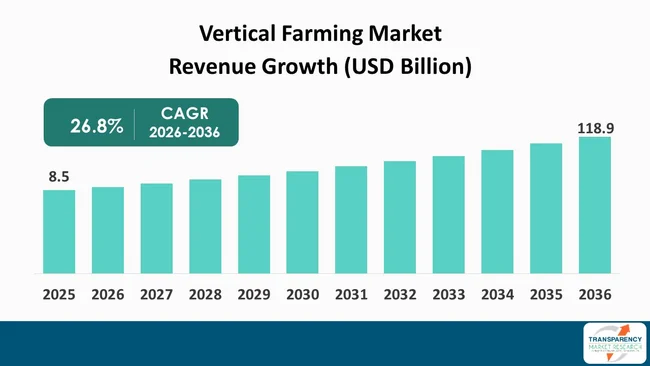
The market is transitioning from speculative projects to more disciplined commercial deployments of controlled-environment agriculture. Vertical farms offer predictable growing environments, enable localized production, and mitigate the impact of many weather-related events. Such benefits enhance the value proposition for growers operating in markets where freshness, consistency, and reliable supply are important. The USDA has shown that controlled environment agriculture operations grew by more than 100.0% between comparable census periods. This expansion indicates growing commercial interest in controlled-environment agriculture and specialized indoor-farming infrastructure.
The electricity consumption is still a key operating concern for facilities relying on artificial lighting and advanced climate control. Many projects also face high upfront capital costs, which can hinder development if equipment utilization is low, crop selection is unsuitable, or reliable market access is not established. Labor availability is another factor, as advanced farms require a skilled workforce spanning horticulture, engineering, and digital operations. As a result, leading operators are increasingly focusing on automation, data-driven monitoring, and standardized production processes. There is an opportunity for technology providers to create additional value through integrated systems and lifecycle support, rather than simply selling individual pieces of equipment.
Software can automate the coordination of environmental controls, crop schedules, irrigation, lighting, and production data across multiple facilities. Services can further enhance the value proposition by assisting with feasibility assessment, installation, commissioning, maintenance, and operational optimization. Commercial models are also evolving, with more customers looking for turnkey systems and recurring technology support. The strongest market opportunities are expected to emerge where production economics are a natural fit with local demand and infrastructure. In conclusion, competitive advantage will be driven by measurable productivity, resource efficiency, reliability, and scalable deployment.
Vertical farming is a type of controlled-environment agriculture (CEA) where crops are grown in vertically stacked layers. It integrates artificial lighting, delivery of nutrients, environmental control, monitoring, and digital control in sealed environments. Hydroponics, aeroponics, and aquaponics are several ways to supply water and nutrients to plants grown intensively. Vertical farms can be deployed in purpose-built facilities, existing buildings, containers, and other specialized formats. Production spaces in building-based farms can also be combined with commercial or industrial facilities.
Containerized farms offer tightly packed, small-scale farm units that can be sited close to appropriate centers of demand. Modular pods enable incremental deployment where smaller production units are preferred. The market also includes racks, towers, irrigation systems, lighting, monitoring, climate control systems, and integrated farm solutions. Tracking devices enable visibility into crop, growing, and environmental parameters. Environmental control is increasingly integrated by software platforms with crop planning, analytics, optimization, and operational decision-making.
The services include designing, engineering, production, installation, commissioning, maintenance, consulting, and feasibility analysis. Leafy greens are well suited to controlled environments because their growth cycles favor management. Herbs and selected fruits and vegetables can also be cultivated where technical and economic conditions are favorable. Commercial products range from equipment supply to complete turnkey systems and repeatable services. Together, these technologies and services support controlled production, efficient resource management, reliable supply, and scalable fresh-food production.
| Attribute | Detail |
|---|---|
| Market Drivers |
|
Water scarcity is increasing interest in production systems that can precisely control irrigation in highly controlled environments. Vertical farms can enable direct delivery of nutrients to plant roots, eliminating reliance on potentially inconsistent soil conditions. Closed irrigation loops can enable water recovery while carefully controlling crop conditions throughout production cycles. FAO considers hydroponics to be an input-efficient and water-saving production approach for challenging production environments. With agriculture accounting for approximately 70.0% of global freshwater withdrawals, pressure to improve agricultural water-use efficiency remains substantial.
FAO emphasizes the potential of hydroponics to increase production where soil quality or available arable land limits traditional agriculture. This improves the relevance of vertical farming in water-stressed agricultural areas. Traditional agriculture relies on rainfall patterns that can become more erratic as a result of climate change. Conversely, controlled systems allow growers to provide irrigation as needed, based on crop requirements and facility conditions. Precision delivery can also reduce unnecessary nutrient losses and improve consistency across various commercial production cycles.
Improved resource control can lead to more dependable output for growers producing fresh, high-quality produce for market. Water efficiency is especially critical when agricultural water demand competes with household, industrial, and ecological water needs. Vertical farms can bring production closer to where water infrastructure and monitoring systems are more manageable and transparent. However, water savings are contingent on proper system design, maintenance, and operational discipline. Inadequate nutrient management or equipment failures can jeopardize both productivity and resource efficiency.
FAO recommends technical knowledge and a thorough evaluation before implementing hydroponic production systems. This has created a demand for suppliers that can provide integrated irrigation, filtration, monitoring, nutrient management, and resource recovery solutions. Digital controls can enhance visibility of water usage and help to detect anomalies before they cause a significant reduction in crop performance. Service providers can assist with commissioning, maintenance, training, and optimization throughout the lifecycle of the facility. Innovative, resource-efficient growing technologies are expected to gain more commercial traction globally as water stress increases across agricultural systems.
Urbanization is driving demand for food production models that can be located closer to dense consumer markets and distribution networks. Vertical farms can operate in unused buildings and compact spaces, eliminating the need for vast swaths of traditional farmland. Proximity of production to consumers can decrease reliance on long supply chains and enhance harvest responsiveness for fresh produce. According to UN DESA, approximately 45.0% of the global population resides in cities. This concentration of population strengthens the economic argument for localized fresh-food production.
Urban populations are increasingly seeking freshness, availability, consistency, and transparent production practices. Vertical farms can operate year-round, as the environmental conditions inside the protected facilities are carefully controlled. This allows production planning to more accurately follow demand from retailers, foodservice, and distribution, ensuring reliable local availability. Shorter supply chains can also simplify handling and improve coordination between harvesting and delivery. Compact facilities can be developed in areas where high land prices or limited availability of conventional agricultural land constrain traditional production.
Building-based farms can incorporate growing systems into existing commercial, industrial, or mixed-use buildings. Containerized systems offer another alternative for sites that require flexible or relocatable production capacity. Modular pod systems can allow for incremental investment and expansion as demand matures. Urban deployment also opens up possibilities for partnerships between retailers, property owners, foodservice companies, distributors, and technology providers. But successful facilities need to consider electricity availability, building suitability, labor needs, and operating costs.
Local markets must also provide crop prices high enough to cover controlled-environment production costs and required technical investments. Digital monitoring can be used to align production with demand and reduce operational misfits. The value proposition may be further enhanced through integrated logistics linking harvest scheduling to distribution scheduling. As cities continue to concentrate consumption, the need for resilient local food infrastructure should continue to be structurally relevant across major markets. For this reason, vertical farming is seen as an complementary production model within wider urban food systems.
Automation, energy management, analytics, and efficient growing technologies represent a significant market opportunity when integrated into scalable commercial farming platforms globally. Digital controls can automate lighting, irrigation, climate control, nutrient delivery, and crop timing, reducing manual labor. Automation also reduces variability and improves consistency by identifying deviations and triggering timely operational adjustments. The World Bank expects the global population to reach 10 billion by 2050, increasing the demand for sustainable food production. Vertical farming can contribute to meeting future food demand by enabling localized production and more controlled use of resources.
Modular systems can enable operators to increase capacity without having to redesign entire facilities. Turnkey deployment can add further value to customers who do not have specialized engineering, horticultural, and operational capabilities. Software integration opens new possibilities for recurring revenue through monitoring, optimization, analytics, and remote operational support. Equipment suppliers can create differentiation by integrating hardware performance with data-driven service capabilities for growers. Energy management is another area of opportunity, as lighting and climate control are key drivers of facility operating economics.
Suppliers capable of improving energy and resource efficiency can help operators reduce production intensity without compromising crop quality. Services can include feasibility studies, system design, installation, commissioning, maintenance, and continuous optimization throughout the lifecycle of a facility. Partnerships between technology providers, growers, retailers, and infrastructure owners can speed up commercial deployment. This opportunity is particularly compelling where customers are driven by the need for reliable supply, localized production, and consistent crop quality. In summary, scalable integrated solutions should command higher value as vertical farming transitions to a more disciplined, resilient, and commercialized industry.
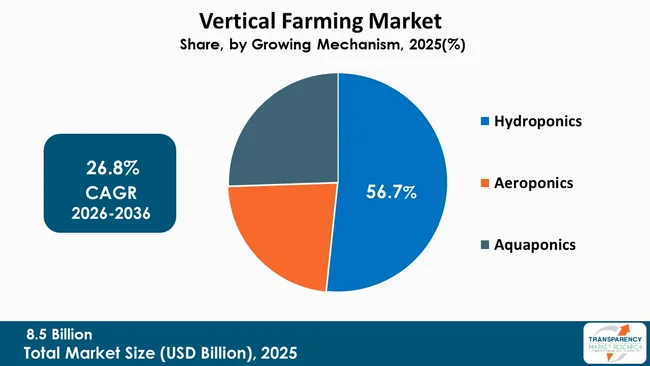
The hydroponics segment dominated the global vertical farming market in 2025, accounting for approximately 56.7% of total market revenue. Its nutrient-solution system enables cultivators to have an exceptionally high level of control over water, nutrients, and the root-zone environment. FAO considers hydroponics one of the soilless culture techniques that can be applied in controlled environment agriculture. Hydroponic systems are compatible with stacked racks, channels, trays, towers, and other vertical growing structures. The technology is particularly suitable for leafy greens and herbs requiring consistent growing conditions.
Hydroponic systems are typically able to support automated irrigation and nutrient delivery, which help to increase the repeatability of production between crops in a system. By integrating with sensors and software, growers are able to see the status of nutrient concentration, irrigation, and condition of the crops. These features make hydroponics appealing to commercial operations desiring to achieve a homogeneous production process. Hydroponics also benefits from an established ecosystem of pumps, reservoirs, channels, irrigation equipment, lighting systems, and environmental controls. This type of compatibility can ease system design, as well as facilitate modularization.
The system performance is influenced by water quality, nutrient management, maintenance, and technical expertise. Equipment reliability, water quality, and proper nutrient management are critical to crop health and financial performance. The system’s next stage of advancement is anticipated to focus on automation, resource recovery, monitoring, and connectivity to digital farm management platforms. Hydroponics is expected to remain a leading growing mechanism for scalable vertical farming systems.
| Attribute | Detail |
|---|---|
| Leading Region |
|
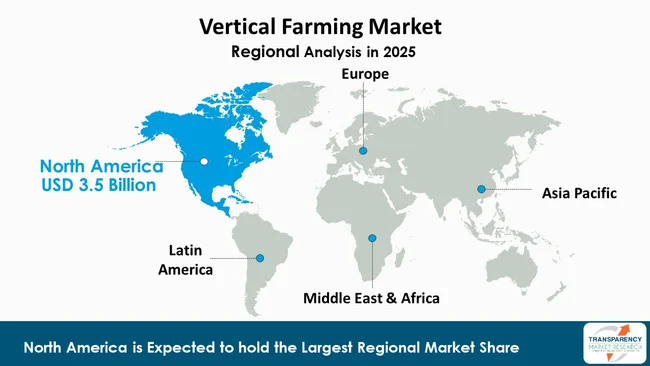
North America dominated the global vertical farming market in 2025, accounting for approximately 41.4% of total market revenue. The region's leading position is supported by established controlled-environment agriculture capabilities, advanced technology ecosystems, and strong adoption of automation, lighting, climate-control, irrigation, and farm-management systems. Commercial growers have increasingly pursued indoor production to enhance supply reliability and to access regional consumer markets. USDA research places vertical agriculture under the controlled-environment agriculture umbrella and acknowledges its promise. North American growers have well-established logistics with retailers, foodservice, and distributors to support their needs.
Technology integration is a strength in the region, especially at those farms that integrate environmental controls and digital monitoring. Farmers can leverage data and information to optimize crop conditions, to schedule production activities, and to spot inefficiencies. Indoor facilities can enable production close to major consumption centers, helping shorten supply chains and improve access to locally grown produce. Container and module formats offer flexibility for companies testing locations or incrementally scaling production, or both. However, energy prices and infrastructure needs still play a large part in considering farm viability.
The ability to run advanced operations effectively can be dependent on the availability of labor and technical know-how. Competing players have also witnessed a growing focus on automation, system integration, and life-cycle technical support. Future regional expansion should concentrate on energy efficiency, crop economics, and capacity utilization. In general, North America will continue to lead as operators trend toward dependable production, integration, and scalable indoor farming.
Acuity Inc., Agrowtek Inc., American Hydroponics (AmHydro), Controlled Environments Limited (CEL Group), CropKing Inc., CubicFarm Systems Corp., FarmBox Foods, Fork Farms, Growcer Inc., Heliospectra AB, Hydrofarm Holdings Group, Inc., Intelligent Growth Solutions Ltd., Just Vertical, Modular Farms Co., Montel Inc., Pipp Mobile Storage Systems, Inc., Priva B.V., Signify Holding N.V., Sollum Technologies Inc., and Urban Crop Solutions are among the prominent companies operating in the global vertical farming market.
Each of these companies has been profiled in the global vertical farming industry report based on parameters such as company overview, business strategies, financial overview, business segments, product portfolio, and recent developments.
| Attribute | Detail |
|---|---|
|
Market Size Value in 2025 (Base Year) |
USD 8.5 Billion |
|
Market Forecast Value in 2036 |
USD 118.9 Million |
|
Growth Rate (CAGR 2026 to 2036) |
26.8% |
|
Forecast Period |
2026-2036 |
|
Historical data Available for |
2021-2025 |
|
Quantitative Units |
Value and Volume |
|
Market Analysis |
Global qualitative analysis includes drivers, restraints, opportunities, key trends, key market indicators, Porter’s Five Forces analysis, value chain analysis, SWOT analysis, etc. Furthermore, at the regional level, qualitative analysis includes key trends, price trends, and key supplier analysis. |
|
Competition Landscape |
|
|
Format |
Electronic (PDF) + Excel |
|
Market Segmentations |
Component
Growing Mechanism
Farm Deployment Format
Application
Commercial / Delivery Model
|
|
Regions Covered |
|
|
Countries Covered |
|
|
Companies Profiled |
|
|
Customization Scope |
Available upon request |
|
Pricing |
Available upon request |
The global vertical farming market was valued at USD 8.5 Billion in 2025.
The global vertical farming industry is projected to reach USD 118.9 Billion by 2036.
Key drivers include increasing water scarcity and the need for greater resource efficiency, along with urbanization and rising demand for localized food production.
The global vertical farming market is anticipated to expand at a CAGR of 26.8% from 2026 to 2036.
The hydroponics segment accounted for the largest share of the global vertical farming market in 2025, representing approximately 56.7% of total market revenue.
North America dominated the global vertical farming market in 2025, accounting for approximately 41.4% of total market revenue.
Acuity Inc., Agrowtek Inc., American Hydroponics (AmHydro), Controlled Environments Limited (CEL Group), CropKing Inc., CubicFarm Systems Corp., FarmBox Foods, Fork Farms, Growcer Inc., Heliospectra AB, Hydrofarm Holdings Group, Inc., Intelligent Growth Solutions Ltd., Just Vertical, Modular Farms Co., Montel Inc., Pipp Mobile Storage Systems, Inc., Priva B.V., Signify Holding N.V., Sollum Technologies Inc., and Urban Crop Solutions are among the prominent players operating in the global vertica
Table 01: Global Vertical Farming Market Value (Value) Projection, By Component 2021 to 2036
Table 02: Global Vertical Farming Market Volume (Volume) Projection, By Component 2021 to 2036
Table 03: Global Vertical Farming Market Value (Value) Projection, By Growing Mechanism 2021 to 2036
Table 04: Global Vertical Farming Market Volume (Volume) Projection, By Growing Mechanism 2021 to 2036
Table 05: Global Vertical Farming Market Value (Value) Projection, By Farm Deployment Format 2021 to 2036
Table 06: Global Vertical Farming Market Volume (Volume) Projection, By Farm Deployment Format 2021 to 2036
Table 07: Global Vertical Farming Market Value (Value) Projection, By Application 2021 to 2036
Table 08: Global Vertical Farming Market Volume (Volume) Projection, By Application 2021 to 2036
Table 09: Global Vertical Farming Market Value (Value) Projection, By Commercial / Delivery Model 2021 to 2036
Table 10: Global Vertical Farming Market Volume (Volume) Projection, By Commercial / Delivery Model 2021 to 2036
Table 11: Global Vertical Farming Market Value (Value) Projection, By Country 2021 to 2036
Table 12: Global Vertical Farming Market Volume (Volume) Projection, By Country 2021 to 2036
Table 13: North America Vertical Farming Market Value (Value) Projection, By Component 2021 to 2036
Table 14: North America Vertical Farming Market Volume (Volume) Projection, By Component 2021 to 2036
Table 15: North America Vertical Farming Market Value (Value) Projection, By Growing Mechanism 2021 to 2036
Table 16: North America Vertical Farming Market Volume (Volume) Projection, By Growing Mechanism 2021 to 2036
Table 17: North America Vertical Farming Market Value (Value) Projection, By Farm Deployment Format 2021 to 2036
Table 18: North America Vertical Farming Market Volume (Volume) Projection, By Farm Deployment Format 2021 to 2036
Table 19: North America Vertical Farming Market Value (Value) Projection, By Application 2021 to 2036
Table 20: North America Vertical Farming Market Volume (Volume) Projection, By Application 2021 to 2036
Table 21: North America Vertical Farming Market Value (Value) Projection, By Commercial / Delivery Model 2021 to 2036
Table 22: North America Vertical Farming Market Volume (Volume) Projection, By Commercial / Delivery Model 2021 to 2036
Table 23: North America Vertical Farming Market Value (Value) Projection, By Country 2021 to 2036
Table 24: North America Vertical Farming Market Volume (Volume) Projection, By Country 2021 to 2036
Table 25: U.S. Vertical Farming Market Value (Value) Projection, By Component 2021 to 2036
Table 26: U.S. Vertical Farming Market Volume (Volume) Projection, By Component 2021 to 2036
Table 27: U.S. Vertical Farming Market Value (Value) Projection, By Growing Mechanism 2021 to 2036
Table 28: U.S. Vertical Farming Market Volume (Volume) Projection, By Growing Mechanism 2021 to 2036
Table 29: U.S. Vertical Farming Market Value (Value) Projection, By Farm Deployment Format 2021 to 2036
Table 30: U.S. Vertical Farming Market Volume (Volume) Projection, By Farm Deployment Format 2021 to 2036
Table 31: U.S. Vertical Farming Market Value (Value) Projection, By Application 2021 to 2036
Table 32: U.S. Vertical Farming Market Volume (Volume) Projection, By Application 2021 to 2036
Table 33: U.S. Vertical Farming Market Value (Value) Projection, By Commercial / Delivery Model 2021 to 2036
Table 34: U.S. Vertical Farming Market Volume (Volume) Projection, By Commercial / Delivery Model 2021 to 2036
Table 35: Canada Vertical Farming Market Value (Value) Projection, By Component 2021 to 2036
Table 36: Canada Vertical Farming Market Volume (Volume) Projection, By Component 2021 to 2036
Table 37: Canada Vertical Farming Market Value (Value) Projection, By Growing Mechanism 2021 to 2036
Table 38: Canada Vertical Farming Market Volume (Volume) Projection, By Growing Mechanism 2021 to 2036
Table 39: Canada Vertical Farming Market Value (Value) Projection, By Farm Deployment Format 2021 to 2036
Table 40: Canada Vertical Farming Market Volume (Volume) Projection, By Farm Deployment Format 2021 to 2036
Table 41: Canada Vertical Farming Market Value (Value) Projection, By Application 2021 to 2036
Table 42: Canada Vertical Farming Market Volume (Volume) Projection, By Application 2021 to 2036
Table 43: Canada Vertical Farming Market Value (Value) Projection, By Commercial / Delivery Model 2021 to 2036
Table 44: Canada Vertical Farming Market Volume (Volume) Projection, By Commercial / Delivery Model 2021 to 2036
Table 45: Europe Vertical Farming Market Value (Value) Projection, By Component 2021 to 2036
Table 46: Europe Vertical Farming Market Volume (Volume) Projection, By Component 2021 to 2036
Table 47: Europe Vertical Farming Market Value (Value) Projection, By Growing Mechanism 2021 to 2036
Table 48: Europe Vertical Farming Market Volume (Volume) Projection, By Growing Mechanism 2021 to 2036
Table 49: Europe Vertical Farming Market Value (Value) Projection, By Farm Deployment Format 2021 to 2036
Table 50: Europe Vertical Farming Market Volume (Volume) Projection, By Farm Deployment Format 2021 to 2036
Table 51: Europe Vertical Farming Market Value (Value) Projection, By Application 2021 to 2036
Table 52: Europe Vertical Farming Market Volume (Volume) Projection, By Application 2021 to 2036
Table 53: Europe Vertical Farming Market Value (Value) Projection, By Commercial / Delivery Model 2021 to 2036
Table 54: Europe Vertical Farming Market Volume (Volume) Projection, By Commercial / Delivery Model 2021 to 2036
Table 55: Europe Vertical Farming Market Value (Value) Projection, By Country 2021 to 2036
Table 56: Europe Vertical Farming Market Volume (Volume) Projection, By Country 2021 to 2036
Table 57: U.K. Vertical Farming Market Value (Value) Projection, By Component 2021 to 2036
Table 58: U.K. Vertical Farming Market Volume (Volume) Projection, By Component 2021 to 2036
Table 59: U.K. Vertical Farming Market Value (Value) Projection, By Growing Mechanism 2021 to 2036
Table 60: U.K. Vertical Farming Market Volume (Volume) Projection, By Growing Mechanism 2021 to 2036
Table 61: U.K. Vertical Farming Market Value (Value) Projection, By Farm Deployment Format 2021 to 2036
Table 62: U.K. Vertical Farming Market Volume (Volume) Projection, By Farm Deployment Format 2021 to 2036
Table 63: U.K. Vertical Farming Market Value (Value) Projection, By Application 2021 to 2036
Table 64: U.K. Vertical Farming Market Volume (Volume) Projection, By Application 2021 to 2036
Table 65: U.K. Vertical Farming Market Value (Value) Projection, By Commercial / Delivery Model 2021 to 2036
Table 66: U.K. Vertical Farming Market Volume (Volume) Projection, By Commercial / Delivery Model 2021 to 2036
Table 67: Germany Vertical Farming Market Value (Value) Projection, By Component 2021 to 2036
Table 68: Germany Vertical Farming Market Volume (Volume) Projection, By Component 2021 to 2036
Table 69: Germany Vertical Farming Market Value (Value) Projection, By Growing Mechanism 2021 to 2036
Table 70: Germany Vertical Farming Market Volume (Volume) Projection, By Growing Mechanism 2021 to 2036
Table 71: Germany Vertical Farming Market Value (Value) Projection, By Farm Deployment Format 2021 to 2036
Table 72: Germany Vertical Farming Market Volume (Volume) Projection, By Farm Deployment Format 2021 to 2036
Table 73: Germany Vertical Farming Market Value (Value) Projection, By Application 2021 to 2036
Table 74: Germany Vertical Farming Market Volume (Volume) Projection, By Application 2021 to 2036
Table 75: Germany Vertical Farming Market Value (Value) Projection, By Commercial / Delivery Model 2021 to 2036
Table 76: Germany Vertical Farming Market Volume (Volume) Projection, By Commercial / Delivery Model 2021 to 2036
Table 77: France Vertical Farming Market Value (Value) Projection, By Component 2021 to 2036
Table 78: France Vertical Farming Market Volume (Volume) Projection, By Component 2021 to 2036
Table 79: France Vertical Farming Market Value (Value) Projection, By Growing Mechanism 2021 to 2036
Table 80: France Vertical Farming Market Volume (Volume) Projection, By Growing Mechanism 2021 to 2036
Table 81: France Vertical Farming Market Value (Value) Projection, By Farm Deployment Format 2021 to 2036
Table 82: France Vertical Farming Market Volume (Volume) Projection, By Farm Deployment Format 2021 to 2036
Table 83: France Vertical Farming Market Value (Value) Projection, By Application 2021 to 2036
Table 84: France Vertical Farming Market Volume (Volume) Projection, By Application 2021 to 2036
Table 85: France Vertical Farming Market Value (Value) Projection, By Commercial / Delivery Model 2021 to 2036
Table 86: France Vertical Farming Market Volume (Volume) Projection, By Commercial / Delivery Model 2021 to 2036
Table 87: Italy Vertical Farming Market Value (Value) Projection, By Component 2021 to 2036
Table 88: Italy Vertical Farming Market Volume (Volume) Projection, By Component 2021 to 2036
Table 89: Italy Vertical Farming Market Value (Value) Projection, By Growing Mechanism 2021 to 2036
Table 90: Italy Vertical Farming Market Volume (Volume) Projection, By Growing Mechanism 2021 to 2036
Table 91: Italy Vertical Farming Market Value (Value) Projection, By Farm Deployment Format 2021 to 2036
Table 92: Italy Vertical Farming Market Volume (Volume) Projection, By Farm Deployment Format 2021 to 2036
Table 93: Italy Vertical Farming Market Value (Value) Projection, By Application 2021 to 2036
Table 94: Italy Vertical Farming Market Volume (Volume) Projection, By Application 2021 to 2036
Table 95: Italy Vertical Farming Market Value (Value) Projection, By Commercial / Delivery Model 2021 to 2036
Table 96: Italy Vertical Farming Market Volume (Volume) Projection, By Commercial / Delivery Model 2021 to 2036
Table 97: Spain Vertical Farming Market Value (Value) Projection, By Component 2021 to 2036
Table 98: Spain Vertical Farming Market Volume (Volume) Projection, By Component 2021 to 2036
Table 99: Spain Vertical Farming Market Value (Value) Projection, By Growing Mechanism 2021 to 2036
Table 100: Spain Vertical Farming Market Volume (Volume) Projection, By Growing Mechanism 2021 to 2036
Table 101: Spain Vertical Farming Market Value (Value) Projection, By Farm Deployment Format 2021 to 2036
Table 102: Spain Vertical Farming Market Volume (Volume) Projection, By Farm Deployment Format 2021 to 2036
Table 103: Spain Vertical Farming Market Value (Value) Projection, By Application 2021 to 2036
Table 104: Spain Vertical Farming Market Volume (Volume) Projection, By Application 2021 to 2036
Table 105: Spain Vertical Farming Market Value (Value) Projection, By Commercial / Delivery Model 2021 to 2036
Table 106: Spain Vertical Farming Market Volume (Volume) Projection, By Commercial / Delivery Model 2021 to 2036
Table 107: The Netherlands Vertical Farming Market Value (Value) Projection, By Component 2021 to 2036
Table 108: The Netherlands Vertical Farming Market Volume (Volume) Projection, By Component 2021 to 2036
Table 109: The Netherlands Vertical Farming Market Value (Value) Projection, By Growing Mechanism 2021 to 2036
Table 110: The Netherlands Vertical Farming Market Volume (Volume) Projection, By Growing Mechanism 2021 to 2036
Table 111: The Netherlands Vertical Farming Market Value (Value) Projection, By Farm Deployment Format 2021 to 2036
Table 112: The Netherlands Vertical Farming Market Volume (Volume) Projection, By Farm Deployment Format 2021 to 2036
Table 113: The Netherlands Vertical Farming Market Value (Value) Projection, By Application 2021 to 2036
Table 114: The Netherlands Vertical Farming Market Volume (Volume) Projection, By Application 2021 to 2036
Table 115: The Netherlands Vertical Farming Market Value (Value) Projection, By Commercial / Delivery Model 2021 to 2036
Table 116: The Netherlands Vertical Farming Market Volume (Volume) Projection, By Commercial / Delivery Model 2021 to 2036
Table 117: Asia Pacific Vertical Farming Market Value (Value) Projection, By Component 2021 to 2036
Table 118: Asia Pacific Vertical Farming Market Volume (Volume) Projection, By Component 2021 to 2036
Table 119: Asia Pacific Vertical Farming Market Value (Value) Projection, By Growing Mechanism 2021 to 2036
Table 120: Asia Pacific Vertical Farming Market Volume (Volume) Projection, By Growing Mechanism 2021 to 2036
Table 121: Asia Pacific Vertical Farming Market Value (Value) Projection, By Farm Deployment Format 2021 to 2036
Table 122: Asia Pacific Vertical Farming Market Volume (Volume) Projection, By Farm Deployment Format 2021 to 2036
Table 123: Asia Pacific Vertical Farming Market Value (Value) Projection, By Application 2021 to 2036
Table 124: Asia Pacific Vertical Farming Market Volume (Volume) Projection, By Application 2021 to 2036
Table 125: Asia Pacific Vertical Farming Market Value (Value) Projection, By Commercial / Delivery Model 2021 to 2036
Table 126: Asia Pacific Vertical Farming Market Volume (Volume) Projection, By Commercial / Delivery Model 2021 to 2036
Table 127: Asia Pacific Vertical Farming Market Value (Value) Projection, By Country 2021 to 2036
Table 128: Asia Pacific Vertical Farming Market Volume (Volume) Projection, By Country 2021 to 2036
Table 129: China Vertical Farming Market Value (Value) Projection, By Component 2021 to 2036
Table 130: China Vertical Farming Market Volume (Volume) Projection, By Component 2021 to 2036
Table 131: China Vertical Farming Market Value (Value) Projection, By Growing Mechanism 2021 to 2036
Table 132: China Vertical Farming Market Volume (Volume) Projection, By Growing Mechanism 2021 to 2036
Table 133: China Vertical Farming Market Value (Value) Projection, By Farm Deployment Format 2021 to 2036
Table 134: China Vertical Farming Market Volume (Volume) Projection, By Farm Deployment Format 2021 to 2036
Table 135: China Vertical Farming Market Value (Value) Projection, By Application 2021 to 2036
Table 136: China Vertical Farming Market Volume (Volume) Projection, By Application 2021 to 2036
Table 137: China Vertical Farming Market Value (Value) Projection, By Commercial / Delivery Model 2021 to 2036
Table 138: China Vertical Farming Market Volume (Volume) Projection, By Commercial / Delivery Model 2021 to 2036
Table 139: India Vertical Farming Market Value (Value) Projection, By Component 2021 to 2036
Table 140: India Vertical Farming Market Volume (Volume) Projection, By Component 2021 to 2036
Table 141: India Vertical Farming Market Value (Value) Projection, By Growing Mechanism 2021 to 2036
Table 142: India Vertical Farming Market Volume (Volume) Projection, By Growing Mechanism 2021 to 2036
Table 143: India Vertical Farming Market Value (Value) Projection, By Farm Deployment Format 2021 to 2036
Table 144: India Vertical Farming Market Volume (Volume) Projection, By Farm Deployment Format 2021 to 2036
Table 145: India Vertical Farming Market Value (Value) Projection, By Application 2021 to 2036
Table 146: India Vertical Farming Market Volume (Volume) Projection, By Application 2021 to 2036
Table 147: India Vertical Farming Market Value (Value) Projection, By Commercial / Delivery Model 2021 to 2036
Table 148: India Vertical Farming Market Volume (Volume) Projection, By Commercial / Delivery Model 2021 to 2036
Table 149: Japan Vertical Farming Market Value (Value) Projection, By Component 2021 to 2036
Table 150: Japan Vertical Farming Market Volume (Volume) Projection, By Component 2021 to 2036
Table 151: Japan Vertical Farming Market Value (Value) Projection, By Growing Mechanism 2021 to 2036
Table 152: Japan Vertical Farming Market Volume (Volume) Projection, By Growing Mechanism 2021 to 2036
Table 153: Japan Vertical Farming Market Value (Value) Projection, By Farm Deployment Format 2021 to 2036
Table 154: Japan Vertical Farming Market Volume (Volume) Projection, By Farm Deployment Format 2021 to 2036
Table 155: Japan Vertical Farming Market Value (Value) Projection, By Application 2021 to 2036
Table 156: Japan Vertical Farming Market Volume (Volume) Projection, By Application 2021 to 2036
Table 157: Japan Vertical Farming Market Value (Value) Projection, By Commercial / Delivery Model 2021 to 2036
Table 158: Japan Vertical Farming Market Volume (Volume) Projection, By Commercial / Delivery Model 2021 to 2036
Table 159: Australia Vertical Farming Market Value (Value) Projection, By Component 2021 to 2036
Table 160: Australia Vertical Farming Market Volume (Volume) Projection, By Component 2021 to 2036
Table 161: Australia Vertical Farming Market Value (Value) Projection, By Growing Mechanism 2021 to 2036
Table 162: Australia Vertical Farming Market Volume (Volume) Projection, By Growing Mechanism 2021 to 2036
Table 163: Australia Vertical Farming Market Value (Value) Projection, By Farm Deployment Format 2021 to 2036
Table 164: Australia Vertical Farming Market Volume (Volume) Projection, By Farm Deployment Format 2021 to 2036
Table 165: Australia Vertical Farming Market Value (Value) Projection, By Application 2021 to 2036
Table 166: Australia Vertical Farming Market Volume (Volume) Projection, By Application 2021 to 2036
Table 167: Australia Vertical Farming Market Value (Value) Projection, By Commercial / Delivery Model 2021 to 2036
Table 168: Australia Vertical Farming Market Volume (Volume) Projection, By Commercial / Delivery Model 2021 to 2036
Table 169: South Korea Vertical Farming Market Value (Value) Projection, By Component 2021 to 2036
Table 170: South Korea Vertical Farming Market Volume (Volume) Projection, By Component 2021 to 2036
Table 171: South Korea Vertical Farming Market Value (Value) Projection, By Growing Mechanism 2021 to 2036
Table 172: South Korea Vertical Farming Market Volume (Volume) Projection, By Growing Mechanism 2021 to 2036
Table 173: South Korea Vertical Farming Market Value (Value) Projection, By Farm Deployment Format 2021 to 2036
Table 174: South Korea Vertical Farming Market Volume (Volume) Projection, By Farm Deployment Format 2021 to 2036
Table 175: South Korea Vertical Farming Market Value (Value) Projection, By Application 2021 to 2036
Table 176: South Korea Vertical Farming Market Volume (Volume) Projection, By Application 2021 to 2036
Table 177: South Korea Vertical Farming Market Value (Value) Projection, By Commercial / Delivery Model 2021 to 2036
Table 178: South Korea Vertical Farming Market Volume (Volume) Projection, By Commercial / Delivery Model 2021 to 2036
Table 179: ASEAN Vertical Farming Market Value (Value) Projection, By Component 2021 to 2036
Table 180: ASEAN Vertical Farming Market Volume (Volume) Projection, By Component 2021 to 2036
Table 181: ASEAN Vertical Farming Market Value (Value) Projection, By Growing Mechanism 2021 to 2036
Table 182: ASEAN Vertical Farming Market Volume (Volume) Projection, By Growing Mechanism 2021 to 2036
Table 183: ASEAN Vertical Farming Market Value (Value) Projection, By Farm Deployment Format 2021 to 2036
Table 184: ASEAN Vertical Farming Market Volume (Volume) Projection, By Farm Deployment Format 2021 to 2036
Table 185: ASEAN Vertical Farming Market Value (Value) Projection, By Application 2021 to 2036
Table 186: ASEAN Vertical Farming Market Volume (Volume) Projection, By Application 2021 to 2036
Table 187: ASEAN Vertical Farming Market Value (Value) Projection, By Commercial / Delivery Model 2021 to 2036
Table 188: ASEAN Vertical Farming Market Volume (Volume) Projection, By Commercial / Delivery Model 2021 to 2036
Table 189: Middle East & Africa Vertical Farming Market Value (Value) Projection, By Component 2021 to 2036
Table 190: Middle East & Africa Vertical Farming Market Volume (Volume) Projection, By Component 2021 to 2036
Table 191: Middle East & Africa Vertical Farming Market Value (Value) Projection, By Growing Mechanism 2021 to 2036
Table 192: Middle East & Africa Vertical Farming Market Volume (Volume) Projection, By Growing Mechanism 2021 to 2036
Table 193: Middle East & Africa Vertical Farming Market Value (Value) Projection, By Farm Deployment Format 2021 to 2036
Table 194: Middle East & Africa Vertical Farming Market Volume (Volume) Projection, By Farm Deployment Format 2021 to 2036
Table 195: Middle East & Africa Vertical Farming Market Value (Value) Projection, By Application 2021 to 2036
Table 196: Middle East & Africa Vertical Farming Market Volume (Volume) Projection, By Application 2021 to 2036
Table 197: Middle East & Africa Vertical Farming Market Value (Value) Projection, By Commercial / Delivery Model 2021 to 2036
Table 198: Middle East & Africa Vertical Farming Market Volume (Volume) Projection, By Commercial / Delivery Model 2021 to 2036
Table 199: Middle East & Africa Vertical Farming Market Value (Value) Projection, By Country 2021 to 2036
Table 200: Middle East & Africa Vertical Farming Market Volume (Volume) Projection, By Country 2021 to 2036
Table 201: GCC Countries Vertical Farming Market Value (Value) Projection, By Component 2021 to 2036
Table 202: GCC Countries Vertical Farming Market Volume (Volume) Projection, By Component 2021 to 2036
Table 203: GCC Countries Vertical Farming Market Value (Value) Projection, By Growing Mechanism 2021 to 2036
Table 204: GCC Countries Vertical Farming Market Volume (Volume) Projection, By Growing Mechanism 2021 to 2036
Table 205: GCC Countries Vertical Farming Market Value (Value) Projection, By Farm Deployment Format 2021 to 2036
Table 206: GCC Countries Vertical Farming Market Volume (Volume) Projection, By Farm Deployment Format 2021 to 2036
Table 207: GCC Countries Vertical Farming Market Value (Value) Projection, By Application 2021 to 2036
Table 208: GCC Countries Vertical Farming Market Volume (Volume) Projection, By Application 2021 to 2036
Table 209: GCC Countries Vertical Farming Market Value (Value) Projection, By Commercial / Delivery Model 2021 to 2036
Table 210: GCC Countries Vertical Farming Market Volume (Volume) Projection, By Commercial / Delivery Model 2021 to 2036
Table 211: South Africa Vertical Farming Market Value (Value) Projection, By Component 2021 to 2036
Table 212: South Africa Vertical Farming Market Volume (Volume) Projection, By Component 2021 to 2036
Table 213: South Africa Vertical Farming Market Value (Value) Projection, By Growing Mechanism 2021 to 2036
Table 214: South Africa Vertical Farming Market Volume (Volume) Projection, By Growing Mechanism 2021 to 2036
Table 215: South Africa Vertical Farming Market Value (Value) Projection, By Farm Deployment Format 2021 to 2036
Table 216: South Africa Vertical Farming Market Volume (Volume) Projection, By Farm Deployment Format 2021 to 2036
Table 217: South Africa Vertical Farming Market Value (Value) Projection, By Application 2021 to 2036
Table 218: South Africa Vertical Farming Market Volume (Volume) Projection, By Application 2021 to 2036
Table 219: South Africa Vertical Farming Market Value (Value) Projection, By Commercial / Delivery Model 2021 to 2036
Table 220: South Africa Vertical Farming Market Volume (Volume) Projection, By Commercial / Delivery Model 2021 to 2036
Table 221: Latin America Vertical Farming Market Value (Value) Projection, By Component 2021 to 2036
Table 222: Latin America Vertical Farming Market Volume (Volume) Projection, By Component 2021 to 2036
Table 223: Latin America Vertical Farming Market Value (Value) Projection, By Growing Mechanism 2021 to 2036
Table 224: Latin America Vertical Farming Market Volume (Volume) Projection, By Growing Mechanism 2021 to 2036
Table 225: Latin America Vertical Farming Market Value (Value) Projection, By Farm Deployment Format 2021 to 2036
Table 226: Latin America Vertical Farming Market Volume (Volume) Projection, By Farm Deployment Format 2021 to 2036
Table 227: Latin America Vertical Farming Market Value (Value) Projection, By Application 2021 to 2036
Table 228: Latin America Vertical Farming Market Volume (Volume) Projection, By Application 2021 to 2036
Table 229: Latin America Vertical Farming Market Value (Value) Projection, By Commercial / Delivery Model 2021 to 2036
Table 230: Latin America Vertical Farming Market Volume (Volume) Projection, By Commercial / Delivery Model 2021 to 2036
Table 231: Latin America Vertical Farming Market Value (Value) Projection, By Country 2021 to 2036
Table 232: Latin America Vertical Farming Market Volume (Volume) Projection, By Country 2021 to 2036
Table 233: Brazil Vertical Farming Market Value (Value) Projection, By Component 2021 to 2036
Table 234: Brazil Vertical Farming Market Volume (Volume) Projection, By Component 2021 to 2036
Table 235: Brazil Vertical Farming Market Value (Value) Projection, By Growing Mechanism 2021 to 2036
Table 236: Brazil Vertical Farming Market Volume (Volume) Projection, By Growing Mechanism 2021 to 2036
Table 237: Brazil Vertical Farming Market Value (Value) Projection, By Farm Deployment Format 2021 to 2036
Table 238: Brazil Vertical Farming Market Volume (Volume) Projection, By Farm Deployment Format 2021 to 2036
Table 239: Brazil Vertical Farming Market Value (Value) Projection, By Application 2021 to 2036
Table 240: Brazil Vertical Farming Market Volume (Volume) Projection, By Application 2021 to 2036
Table 241: Brazil Vertical Farming Market Value (Value) Projection, By Commercial / Delivery Model 2021 to 2036
Table 242: Brazil Vertical Farming Market Volume (Volume) Projection, By Commercial / Delivery Model 2021 to 2036
Table 243: Mexico Vertical Farming Market Value (Value) Projection, By Component 2021 to 2036
Table 244: Mexico Vertical Farming Market Volume (Volume) Projection, By Component 2021 to 2036
Table 245: Mexico Vertical Farming Market Value (Value) Projection, By Growing Mechanism 2021 to 2036
Table 246: Mexico Vertical Farming Market Volume (Volume) Projection, By Growing Mechanism 2021 to 2036
Table 247: Mexico Vertical Farming Market Value (Value) Projection, By Farm Deployment Format 2021 to 2036
Table 248: Mexico Vertical Farming Market Volume (Volume) Projection, By Farm Deployment Format 2021 to 2036
Table 249: Mexico Vertical Farming Market Value (Value) Projection, By Application 2021 to 2036
Table 250: Mexico Vertical Farming Market Volume (Volume) Projection, By Application 2021 to 2036
Table 251: Mexico Vertical Farming Market Value (Value) Projection, By Commercial / Delivery Model 2021 to 2036
Table 252: Mexico Vertical Farming Market Volume (Volume) Projection, By Commercial / Delivery Model 2021 to 2036
Table 253: Argentina Vertical Farming Market Value (Value) Projection, By Component 2021 to 2036
Table 254: Argentina Vertical Farming Market Volume (Volume) Projection, By Component 2021 to 2036
Table 255: Argentina Vertical Farming Market Value (Value) Projection, By Growing Mechanism 2021 to 2036
Table 256: Argentina Vertical Farming Market Volume (Volume) Projection, By Growing Mechanism 2021 to 2036
Table 257: Argentina Vertical Farming Market Value (Value) Projection, By Farm Deployment Format 2021 to 2036
Table 258: Argentina Vertical Farming Market Volume (Volume) Projection, By Farm Deployment Format 2021 to 2036
Table 259: Argentina Vertical Farming Market Value (Value) Projection, By Application 2021 to 2036
Table 260: Argentina Vertical Farming Market Volume (Volume) Projection, By Application 2021 to 2036
Table 261: Argentina Vertical Farming Market Value (Value) Projection, By Commercial / Delivery Model 2021 to 2036
Table 262: Argentina Vertical Farming Market Volume (Volume) Projection, By Commercial / Delivery Model 2021 to 2036
Figure 01: Global Vertical Farming Market Value (Value) Projection, By Component 2021 to 2036
Figure 02: Global Vertical Farming Market Volume (Volume) Projection, By Component 2021 to 2036
Figure 03: Global Vertical Farming Market Incremental Opportunities (Value) Forecast, By Component 2026 to 2036
Figure 04: Global Vertical Farming Market Value (Value) Projection, By Growing Mechanism 2021 to 2036
Figure 05: Global Vertical Farming Market Volume (Volume) Projection, By Growing Mechanism 2021 to 2036
Figure 06: Global Vertical Farming Market Incremental Opportunities (Value) Forecast, By Growing Mechanism 2026 to 2036
Figure 07: Global Vertical Farming Market Value (Value) Projection, By Farm Deployment Format 2021 to 2036
Figure 08: Global Vertical Farming Market Volume (Volume) Projection, By Farm Deployment Format 2021 to 2036
Figure 09: Global Vertical Farming Market Incremental Opportunities (Value) Forecast, By Farm Deployment Format 2026 to 2036
Figure 10: Global Vertical Farming Market Value (Value) Projection, By Application 2021 to 2036
Figure 11: Global Vertical Farming Market Volume (Volume) Projection, By Application 2021 to 2036
Figure 12: Global Vertical Farming Market Incremental Opportunities (Value) Forecast, By Application 2026 to 2036
Figure 13: Global Vertical Farming Market Value (Value) Projection, By Commercial / Delivery Model 2021 to 2036
Figure 14: Global Vertical Farming Market Volume (Volume) Projection, By Commercial / Delivery Model 2021 to 2036
Figure 15: Global Vertical Farming Market Incremental Opportunities (Value) Forecast, By Commercial / Delivery Model 2026 to 2036
Figure 16: Global Vertical Farming Market Value (Value) Projection, By Region 2021 to 2036
Figure 17: Global Vertical Farming Market Volume (Volume) Projection, By Region 2021 to 2036
Figure 18: Global Vertical Farming Market Incremental Opportunities (Value) Forecast, By Region 2026 to 2036
Figure 19: North America Vertical Farming Market Value (Value) Projection, By Component 2021 to 2036
Figure 20: North America Vertical Farming Market Volume (Volume) Projection, By Component 2021 to 2036
Figure 21: North America Vertical Farming Market Incremental Opportunities (Value) Forecast, By Component 2026 to 2036
Figure 22: North America Vertical Farming Market Value (Value) Projection, By Growing Mechanism 2021 to 2036
Figure 23: North America Vertical Farming Market Volume (Volume) Projection, By Growing Mechanism 2021 to 2036
Figure 24: North America Vertical Farming Market Incremental Opportunities (Value) Forecast, By Growing Mechanism 2026 to 2036
Figure 25: North America Vertical Farming Market Value (Value) Projection, By Farm Deployment Format 2021 to 2036
Figure 26: North America Vertical Farming Market Volume (Volume) Projection, By Farm Deployment Format 2021 to 2036
Figure 27: North America Vertical Farming Market Incremental Opportunities (Value) Forecast, By Farm Deployment Format 2026 to 2036
Figure 28: North America Vertical Farming Market Value (Value) Projection, By Application 2021 to 2036
Figure 29: North America Vertical Farming Market Volume (Volume) Projection, By Application 2021 to 2036
Figure 30: North America Vertical Farming Market Incremental Opportunities (Value) Forecast, By Application 2026 to 2036
Figure 31: North America Vertical Farming Market Value (Value) Projection, By Commercial / Delivery Model 2021 to 2036
Figure 32: North America Vertical Farming Market Volume (Volume) Projection, By Commercial / Delivery Model 2021 to 2036
Figure 33: North America Vertical Farming Market Incremental Opportunities (Value) Forecast, By Commercial / Delivery Model 2026 to 2036
Figure 34: North America Vertical Farming Market Value (Value) Projection, By Country 2021 to 2036
Figure 35: North America Vertical Farming Market Volume (Volume) Projection, By Country 2021 to 2036
Figure 36: North America Vertical Farming Market Incremental Opportunities (Value) Forecast, By Country 2026 to 2036
Figure 37: U.S. Vertical Farming Market Value (Value) Projection, By Component 2021 to 2036
Figure 38: U.S. Vertical Farming Market Volume (Volume) Projection, By Component 2021 to 2036
Figure 39: U.S. Vertical Farming Market Incremental Opportunities (Value) Forecast, By Component 2026 to 2036
Figure 40: U.S. Vertical Farming Market Value (Value) Projection, By Growing Mechanism 2021 to 2036
Figure 41: U.S. Vertical Farming Market Volume (Volume) Projection, By Growing Mechanism 2021 to 2036
Figure 42: U.S. Vertical Farming Market Incremental Opportunities (Value) Forecast, By Growing Mechanism 2026 to 2036
Figure 43: U.S. Vertical Farming Market Value (Value) Projection, By Farm Deployment Format 2021 to 2036
Figure 44: U.S. Vertical Farming Market Volume (Volume) Projection, By Farm Deployment Format 2021 to 2036
Figure 45: U.S. Vertical Farming Market Incremental Opportunities (Value) Forecast, By Farm Deployment Format 2026 to 2036
Figure 46: U.S. Vertical Farming Market Value (Value) Projection, By Application 2021 to 2036
Figure 47: U.S. Vertical Farming Market Volume (Volume) Projection, By Application 2021 to 2036
Figure 48: U.S. Vertical Farming Market Incremental Opportunities (Value) Forecast, By Application 2026 to 2036
Figure 49: U.S. Vertical Farming Market Value (Value) Projection, By Commercial / Delivery Model 2021 to 2036
Figure 50: U.S. Vertical Farming Market Volume (Volume) Projection, By Commercial / Delivery Model 2021 to 2036
Figure 51: U.S. Vertical Farming Market Incremental Opportunities (Value) Forecast, By Commercial / Delivery Model 2026 to 2036
Figure 52: Canada Vertical Farming Market Value (Value) Projection, By Component 2021 to 2036
Figure 53: Canada Vertical Farming Market Volume (Volume) Projection, By Component 2021 to 2036
Figure 54: Canada Vertical Farming Market Incremental Opportunities (Value) Forecast, By Component 2026 to 2036
Figure 55: Canada Vertical Farming Market Value (Value) Projection, By Growing Mechanism 2021 to 2036
Figure 56: Canada Vertical Farming Market Volume (Volume) Projection, By Growing Mechanism 2021 to 2036
Figure 57: Canada Vertical Farming Market Incremental Opportunities (Value) Forecast, By Growing Mechanism 2026 to 2036
Figure 58: Canada Vertical Farming Market Value (Value) Projection, By Farm Deployment Format 2021 to 2036
Figure 59: Canada Vertical Farming Market Volume (Volume) Projection, By Farm Deployment Format 2021 to 2036
Figure 60: Canada Vertical Farming Market Incremental Opportunities (Value) Forecast, By Farm Deployment Format 2026 to 2036
Figure 61: Canada Vertical Farming Market Value (Value) Projection, By Application 2021 to 2036
Figure 62: Canada Vertical Farming Market Volume (Volume) Projection, By Application 2021 to 2036
Figure 63: Canada Vertical Farming Market Incremental Opportunities (Value) Forecast, By Application 2026 to 2036
Figure 64: Canada Vertical Farming Market Value (Value) Projection, By Commercial / Delivery Model 2021 to 2036
Figure 65: Canada Vertical Farming Market Volume (Volume) Projection, By Commercial / Delivery Model 2021 to 2036
Figure 66: Canada Vertical Farming Market Incremental Opportunities (Value) Forecast, By Commercial / Delivery Model 2026 to 2036
Figure 67: Europe Vertical Farming Market Value (Value) Projection, By Component 2021 to 2036
Figure 68: Europe Vertical Farming Market Volume (Volume) Projection, By Component 2021 to 2036
Figure 69: Europe Vertical Farming Market Incremental Opportunities (Value) Forecast, By Component 2026 to 2036
Figure 70: Europe Vertical Farming Market Value (Value) Projection, By Growing Mechanism 2021 to 2036
Figure 71: Europe Vertical Farming Market Volume (Volume) Projection, By Growing Mechanism 2021 to 2036
Figure 72: Europe Vertical Farming Market Incremental Opportunities (Value) Forecast, By Growing Mechanism 2026 to 2036
Figure 73: Europe Vertical Farming Market Value (Value) Projection, By Farm Deployment Format 2021 to 2036
Figure 74: Europe Vertical Farming Market Volume (Volume) Projection, By Farm Deployment Format 2021 to 2036
Figure 75: Europe Vertical Farming Market Incremental Opportunities (Value) Forecast, By Farm Deployment Format 2026 to 2036
Figure 76: Europe Vertical Farming Market Value (Value) Projection, By Application 2021 to 2036
Figure 77: Europe Vertical Farming Market Volume (Volume) Projection, By Application 2021 to 2036
Figure 78: Europe Vertical Farming Market Incremental Opportunities (Value) Forecast, By Application 2026 to 2036
Figure 79: Europe Vertical Farming Market Value (Value) Projection, By Commercial / Delivery Model 2021 to 2036
Figure 80: Europe Vertical Farming Market Volume (Volume) Projection, By Commercial / Delivery Model 2021 to 2036
Figure 81: Europe Vertical Farming Market Incremental Opportunities (Value) Forecast, By Commercial / Delivery Model 2026 to 2036
Figure 82: Europe Vertical Farming Market Value (Value) Projection, By Country 2021 to 2036
Figure 83: Europe Vertical Farming Market Volume (Volume) Projection, By Country 2021 to 2036
Figure 84: Europe Vertical Farming Market Incremental Opportunities (Value) Forecast, By Country 2026 to 2036
Figure 85: U.K. Vertical Farming Market Value (Value) Projection, By Component 2021 to 2036
Figure 86: U.K. Vertical Farming Market Volume (Volume) Projection, By Component 2021 to 2036
Figure 87: U.K. Vertical Farming Market Incremental Opportunities (Value) Forecast, By Component 2026 to 2036
Figure 88: U.K. Vertical Farming Market Value (Value) Projection, By Growing Mechanism 2021 to 2036
Figure 89: U.K. Vertical Farming Market Volume (Volume) Projection, By Growing Mechanism 2021 to 2036
Figure 90: U.K. Vertical Farming Market Incremental Opportunities (Value) Forecast, By Growing Mechanism 2026 to 2036
Figure 91: U.K. Vertical Farming Market Value (Value) Projection, By Farm Deployment Format 2021 to 2036
Figure 92: U.K. Vertical Farming Market Volume (Volume) Projection, By Farm Deployment Format 2021 to 2036
Figure 93: U.K. Vertical Farming Market Incremental Opportunities (Value) Forecast, By Farm Deployment Format 2026 to 2036
Figure 94: U.K. Vertical Farming Market Value (Value) Projection, By Application 2021 to 2036
Figure 95: U.K. Vertical Farming Market Volume (Volume) Projection, By Application 2021 to 2036
Figure 96: U.K. Vertical Farming Market Incremental Opportunities (Value) Forecast, By Application 2026 to 2036
Figure 97: U.K. Vertical Farming Market Value (Value) Projection, By Commercial / Delivery Model 2021 to 2036
Figure 98: U.K. Vertical Farming Market Volume (Volume) Projection, By Commercial / Delivery Model 2021 to 2036
Figure 99: U.K. Vertical Farming Market Incremental Opportunities (Value) Forecast, By Commercial / Delivery Model 2026 to 2036
Figure 100: Germany Vertical Farming Market Value (Value) Projection, By Component 2021 to 2036
Figure 101: Germany Vertical Farming Market Volume (Volume) Projection, By Component 2021 to 2036
Figure 102: Germany Vertical Farming Market Incremental Opportunities (Value) Forecast, By Component 2026 to 2036
Figure 103: Germany Vertical Farming Market Value (Value) Projection, By Growing Mechanism 2021 to 2036
Figure 104: Germany Vertical Farming Market Volume (Volume) Projection, By Growing Mechanism 2021 to 2036
Figure 105: Germany Vertical Farming Market Incremental Opportunities (Value) Forecast, By Growing Mechanism 2026 to 2036
Figure 106: Germany Vertical Farming Market Value (Value) Projection, By Farm Deployment Format 2021 to 2036
Figure 107: Germany Vertical Farming Market Volume (Volume) Projection, By Farm Deployment Format 2021 to 2036
Figure 108: Germany Vertical Farming Market Incremental Opportunities (Value) Forecast, By Farm Deployment Format 2026 to 2036
Figure 109: Germany Vertical Farming Market Value (Value) Projection, By Application 2021 to 2036
Figure 110: Germany Vertical Farming Market Volume (Volume) Projection, By Application 2021 to 2036
Figure 111: Germany Vertical Farming Market Incremental Opportunities (Value) Forecast, By Application 2026 to 2036
Figure 112: Germany Vertical Farming Market Value (Value) Projection, By Commercial / Delivery Model 2021 to 2036
Figure 113: Germany Vertical Farming Market Volume (Volume) Projection, By Commercial / Delivery Model 2021 to 2036
Figure 114: Germany Vertical Farming Market Incremental Opportunities (Value) Forecast, By Commercial / Delivery Model 2026 to 2036
Figure 115: France Vertical Farming Market Value (Value) Projection, By Component 2021 to 2036
Figure 116: France Vertical Farming Market Volume (Volume) Projection, By Component 2021 to 2036
Figure 117: France Vertical Farming Market Incremental Opportunities (Value) Forecast, By Component 2026 to 2036
Figure 118: France Vertical Farming Market Value (Value) Projection, By Growing Mechanism 2021 to 2036
Figure 119: France Vertical Farming Market Volume (Volume) Projection, By Growing Mechanism 2021 to 2036
Figure 120: France Vertical Farming Market Incremental Opportunities (Value) Forecast, By Growing Mechanism 2026 to 2036
Figure 121: France Vertical Farming Market Value (Value) Projection, By Farm Deployment Format 2021 to 2036
Figure 122: France Vertical Farming Market Volume (Volume) Projection, By Farm Deployment Format 2021 to 2036
Figure 123: France Vertical Farming Market Incremental Opportunities (Value) Forecast, By Farm Deployment Format 2026 to 2036
Figure 124: France Vertical Farming Market Value (Value) Projection, By Application 2021 to 2036
Figure 125: France Vertical Farming Market Volume (Volume) Projection, By Application 2021 to 2036
Figure 126: France Vertical Farming Market Incremental Opportunities (Value) Forecast, By Application 2026 to 2036
Figure 127: France Vertical Farming Market Value (Value) Projection, By Commercial / Delivery Model 2021 to 2036
Figure 128: France Vertical Farming Market Volume (Volume) Projection, By Commercial / Delivery Model 2021 to 2036
Figure 129: France Vertical Farming Market Incremental Opportunities (Value) Forecast, By Commercial / Delivery Model 2026 to 2036
Figure 130: Italy Vertical Farming Market Value (Value) Projection, By Component 2021 to 2036
Figure 131: Italy Vertical Farming Market Volume (Volume) Projection, By Component 2021 to 2036
Figure 132: Italy Vertical Farming Market Incremental Opportunities (Value) Forecast, By Component 2026 to 2036
Figure 133: Italy Vertical Farming Market Value (Value) Projection, By Growing Mechanism 2021 to 2036
Figure 134: Italy Vertical Farming Market Volume (Volume) Projection, By Growing Mechanism 2021 to 2036
Figure 135: Italy Vertical Farming Market Incremental Opportunities (Value) Forecast, By Growing Mechanism 2026 to 2036
Figure 136: Italy Vertical Farming Market Value (Value) Projection, By Farm Deployment Format 2021 to 2036
Figure 137: Italy Vertical Farming Market Volume (Volume) Projection, By Farm Deployment Format 2021 to 2036
Figure 138: Italy Vertical Farming Market Incremental Opportunities (Value) Forecast, By Farm Deployment Format 2026 to 2036
Figure 139: Italy Vertical Farming Market Value (Value) Projection, By Application 2021 to 2036
Figure 140: Italy Vertical Farming Market Volume (Volume) Projection, By Application 2021 to 2036
Figure 141: Italy Vertical Farming Market Incremental Opportunities (Value) Forecast, By Application 2026 to 2036
Figure 142: Italy Vertical Farming Market Value (Value) Projection, By Commercial / Delivery Model 2021 to 2036
Figure 143: Italy Vertical Farming Market Volume (Volume) Projection, By Commercial / Delivery Model 2021 to 2036
Figure 144: Italy Vertical Farming Market Incremental Opportunities (Value) Forecast, By Commercial / Delivery Model 2026 to 2036
Figure 145: Spain Vertical Farming Market Value (Value) Projection, By Component 2021 to 2036
Figure 146: Spain Vertical Farming Market Volume (Volume) Projection, By Component 2021 to 2036
Figure 147: Spain Vertical Farming Market Incremental Opportunities (Value) Forecast, By Component 2026 to 2036
Figure 148: Spain Vertical Farming Market Value (Value) Projection, By Growing Mechanism 2021 to 2036
Figure 149: Spain Vertical Farming Market Volume (Volume) Projection, By Growing Mechanism 2021 to 2036
Figure 150: Spain Vertical Farming Market Incremental Opportunities (Value) Forecast, By Growing Mechanism 2026 to 2036
Figure 151: Spain Vertical Farming Market Value (Value) Projection, By Farm Deployment Format 2021 to 2036
Figure 152: Spain Vertical Farming Market Volume (Volume) Projection, By Farm Deployment Format 2021 to 2036
Figure 153: Spain Vertical Farming Market Incremental Opportunities (Value) Forecast, By Farm Deployment Format 2026 to 2036
Figure 154: Spain Vertical Farming Market Value (Value) Projection, By Application 2021 to 2036
Figure 155: Spain Vertical Farming Market Volume (Volume) Projection, By Application 2021 to 2036
Figure 156: Spain Vertical Farming Market Incremental Opportunities (Value) Forecast, By Application 2026 to 2036
Figure 157: Spain Vertical Farming Market Value (Value) Projection, By Commercial / Delivery Model 2021 to 2036
Figure 158: Spain Vertical Farming Market Volume (Volume) Projection, By Commercial / Delivery Model 2021 to 2036
Figure 159: Spain Vertical Farming Market Incremental Opportunities (Value) Forecast, By Commercial / Delivery Model 2026 to 2036
Figure 160: The Netherlands Vertical Farming Market Value (Value) Projection, By Component 2021 to 2036
Figure 161: The Netherlands Vertical Farming Market Volume (Volume) Projection, By Component 2021 to 2036
Figure 162: The Netherlands Vertical Farming Market Incremental Opportunities (Value) Forecast, By Component 2026 to 2036
Figure 163: The Netherlands Vertical Farming Market Value (Value) Projection, By Growing Mechanism 2021 to 2036
Figure 164: The Netherlands Vertical Farming Market Volume (Volume) Projection, By Growing Mechanism 2021 to 2036
Figure 165: The Netherlands Vertical Farming Market Incremental Opportunities (Value) Forecast, By Growing Mechanism 2026 to 2036
Figure 166: The Netherlands Vertical Farming Market Value (Value) Projection, By Farm Deployment Format 2021 to 2036
Figure 167: The Netherlands Vertical Farming Market Volume (Volume) Projection, By Farm Deployment Format 2021 to 2036
Figure 168: The Netherlands Vertical Farming Market Incremental Opportunities (Value) Forecast, By Farm Deployment Format 2026 to 2036
Figure 169: The Netherlands Vertical Farming Market Value (Value) Projection, By Application 2021 to 2036
Figure 170: The Netherlands Vertical Farming Market Volume (Volume) Projection, By Application 2021 to 2036
Figure 171: The Netherlands Vertical Farming Market Incremental Opportunities (Value) Forecast, By Application 2026 to 2036
Figure 172: The Netherlands Vertical Farming Market Value (Value) Projection, By Commercial / Delivery Model 2021 to 2036
Figure 173: The Netherlands Vertical Farming Market Volume (Volume) Projection, By Commercial / Delivery Model 2021 to 2036
Figure 174: The Netherlands Vertical Farming Market Incremental Opportunities (Value) Forecast, By Commercial / Delivery Model 2026 to 2036
Figure 175: Asia Pacific Vertical Farming Market Value (Value) Projection, By Component 2021 to 2036
Figure 176: Asia Pacific Vertical Farming Market Volume (Volume) Projection, By Component 2021 to 2036
Figure 177: Asia Pacific Vertical Farming Market Incremental Opportunities (Value) Forecast, By Component 2026 to 2036
Figure 178: Asia Pacific Vertical Farming Market Value (Value) Projection, By Growing Mechanism 2021 to 2036
Figure 179: Asia Pacific Vertical Farming Market Volume (Volume) Projection, By Growing Mechanism 2021 to 2036
Figure 180: Asia Pacific Vertical Farming Market Incremental Opportunities (Value) Forecast, By Growing Mechanism 2026 to 2036
Figure 181: Asia Pacific Vertical Farming Market Value (Value) Projection, By Farm Deployment Format 2021 to 2036
Figure 182: Asia Pacific Vertical Farming Market Volume (Volume) Projection, By Farm Deployment Format 2021 to 2036
Figure 183: Asia Pacific Vertical Farming Market Incremental Opportunities (Value) Forecast, By Farm Deployment Format 2026 to 2036
Figure 184: Asia Pacific Vertical Farming Market Value (Value) Projection, By Application 2021 to 2036
Figure 185: Asia Pacific Vertical Farming Market Volume (Volume) Projection, By Application 2021 to 2036
Figure 186: Asia Pacific Vertical Farming Market Incremental Opportunities (Value) Forecast, By Application 2026 to 2036
Figure 187: Asia Pacific Vertical Farming Market Value (Value) Projection, By Commercial / Delivery Model 2021 to 2036
Figure 188: Asia Pacific Vertical Farming Market Volume (Volume) Projection, By Commercial / Delivery Model 2021 to 2036
Figure 189: Asia Pacific Vertical Farming Market Incremental Opportunities (Value) Forecast, By Commercial / Delivery Model 2026 to 2036
Figure 190: Asia Pacific Vertical Farming Market Value (Value) Projection, By Country 2021 to 2036
Figure 191: Asia Pacific Vertical Farming Market Volume (Volume) Projection, By Country 2021 to 2036
Figure 192: Asia Pacific Vertical Farming Market Incremental Opportunities (Value) Forecast, By Country 2026 to 2036
Figure 193: China Vertical Farming Market Value (Value) Projection, By Component 2021 to 2036
Figure 194: China Vertical Farming Market Volume (Volume) Projection, By Component 2021 to 2036
Figure 195: China Vertical Farming Market Incremental Opportunities (Value) Forecast, By Component 2026 to 2036
Figure 196: China Vertical Farming Market Value (Value) Projection, By Growing Mechanism 2021 to 2036
Figure 197: China Vertical Farming Market Volume (Volume) Projection, By Growing Mechanism 2021 to 2036
Figure 198: China Vertical Farming Market Incremental Opportunities (Value) Forecast, By Growing Mechanism 2026 to 2036
Figure 199: China Vertical Farming Market Value (Value) Projection, By Farm Deployment Format 2021 to 2036
Figure 200: China Vertical Farming Market Volume (Volume) Projection, By Farm Deployment Format 2021 to 2036
Figure 201: China Vertical Farming Market Incremental Opportunities (Value) Forecast, By Farm Deployment Format 2026 to 2036
Figure 202: China Vertical Farming Market Value (Value) Projection, By Application 2021 to 2036
Figure 203: China Vertical Farming Market Volume (Volume) Projection, By Application 2021 to 2036
Figure 204: China Vertical Farming Market Incremental Opportunities (Value) Forecast, By Application 2026 to 2036
Figure 205: China Vertical Farming Market Value (Value) Projection, By Commercial / Delivery Model 2021 to 2036
Figure 206: China Vertical Farming Market Volume (Volume) Projection, By Commercial / Delivery Model 2021 to 2036
Figure 207: China Vertical Farming Market Incremental Opportunities (Value) Forecast, By Commercial / Delivery Model 2026 to 2036
Figure 208: India Vertical Farming Market Value (Value) Projection, By Component 2021 to 2036
Figure 209: India Vertical Farming Market Volume (Volume) Projection, By Component 2021 to 2036
Figure 210: India Vertical Farming Market Incremental Opportunities (Value) Forecast, By Component 2026 to 2036
Figure 211: India Vertical Farming Market Value (Value) Projection, By Growing Mechanism 2021 to 2036
Figure 212: India Vertical Farming Market Volume (Volume) Projection, By Growing Mechanism 2021 to 2036
Figure 213: India Vertical Farming Market Incremental Opportunities (Value) Forecast, By Growing Mechanism 2026 to 2036
Figure 214: India Vertical Farming Market Value (Value) Projection, By Farm Deployment Format 2021 to 2036
Figure 215: India Vertical Farming Market Volume (Volume) Projection, By Farm Deployment Format 2021 to 2036
Figure 216: India Vertical Farming Market Incremental Opportunities (Value) Forecast, By Farm Deployment Format 2026 to 2036
Figure 217: India Vertical Farming Market Value (Value) Projection, By Application 2021 to 2036
Figure 218: India Vertical Farming Market Volume (Volume) Projection, By Application 2021 to 2036
Figure 219: India Vertical Farming Market Incremental Opportunities (Value) Forecast, By Application 2026 to 2036
Figure 220: India Vertical Farming Market Value (Value) Projection, By Commercial / Delivery Model 2021 to 2036
Figure 221: India Vertical Farming Market Volume (Volume) Projection, By Commercial / Delivery Model 2021 to 2036
Figure 222: India Vertical Farming Market Incremental Opportunities (Value) Forecast, By Commercial / Delivery Model 2026 to 2036
Figure 223: Japan Vertical Farming Market Value (Value) Projection, By Component 2021 to 2036
Figure 224: Japan Vertical Farming Market Volume (Volume) Projection, By Component 2021 to 2036
Figure 225: Japan Vertical Farming Market Incremental Opportunities (Value) Forecast, By Component 2026 to 2036
Figure 226: Japan Vertical Farming Market Value (Value) Projection, By Growing Mechanism 2021 to 2036
Figure 227: Japan Vertical Farming Market Volume (Volume) Projection, By Growing Mechanism 2021 to 2036
Figure 228: Japan Vertical Farming Market Incremental Opportunities (Value) Forecast, By Growing Mechanism 2026 to 2036
Figure 229: Japan Vertical Farming Market Value (Value) Projection, By Farm Deployment Format 2021 to 2036
Figure 230: Japan Vertical Farming Market Volume (Volume) Projection, By Farm Deployment Format 2021 to 2036
Figure 231: Japan Vertical Farming Market Incremental Opportunities (Value) Forecast, By Farm Deployment Format 2026 to 2036
Figure 232: Japan Vertical Farming Market Value (Value) Projection, By Application 2021 to 2036
Figure 233: Japan Vertical Farming Market Volume (Volume) Projection, By Application 2021 to 2036
Figure 234: Japan Vertical Farming Market Incremental Opportunities (Value) Forecast, By Application 2026 to 2036
Figure 235: Japan Vertical Farming Market Value (Value) Projection, By Commercial / Delivery Model 2021 to 2036
Figure 236: Japan Vertical Farming Market Volume (Volume) Projection, By Commercial / Delivery Model 2021 to 2036
Figure 237: Japan Vertical Farming Market Incremental Opportunities (Value) Forecast, By Commercial / Delivery Model 2026 to 2036
Figure 238: Australia Vertical Farming Market Value (Value) Projection, By Component 2021 to 2036
Figure 239: Australia Vertical Farming Market Volume (Volume) Projection, By Component 2021 to 2036
Figure 240: Australia Vertical Farming Market Incremental Opportunities (Value) Forecast, By Component 2026 to 2036
Figure 241: Australia Vertical Farming Market Value (Value) Projection, By Growing Mechanism 2021 to 2036
Figure 242: Australia Vertical Farming Market Volume (Volume) Projection, By Growing Mechanism 2021 to 2036
Figure 243: Australia Vertical Farming Market Incremental Opportunities (Value) Forecast, By Growing Mechanism 2026 to 2036
Figure 244: Australia Vertical Farming Market Value (Value) Projection, By Farm Deployment Format 2021 to 2036
Figure 245: Australia Vertical Farming Market Volume (Volume) Projection, By Farm Deployment Format 2021 to 2036
Figure 246: Australia Vertical Farming Market Incremental Opportunities (Value) Forecast, By Farm Deployment Format 2026 to 2036
Figure 247: Australia Vertical Farming Market Value (Value) Projection, By Application 2021 to 2036
Figure 248: Australia Vertical Farming Market Volume (Volume) Projection, By Application 2021 to 2036
Figure 249: Australia Vertical Farming Market Incremental Opportunities (Value) Forecast, By Application 2026 to 2036
Figure 250: Australia Vertical Farming Market Value (Value) Projection, By Commercial / Delivery Model 2021 to 2036
Figure 251: Australia Vertical Farming Market Volume (Volume) Projection, By Commercial / Delivery Model 2021 to 2036
Figure 252: Australia Vertical Farming Market Incremental Opportunities (Value) Forecast, By Commercial / Delivery Model 2026 to 2036
Figure 253: South Korea Vertical Farming Market Value (Value) Projection, By Component 2021 to 2036
Figure 254: South Korea Vertical Farming Market Volume (Volume) Projection, By Component 2021 to 2036
Figure 255: South Korea Vertical Farming Market Incremental Opportunities (Value) Forecast, By Component 2026 to 2036
Figure 256: South Korea Vertical Farming Market Value (Value) Projection, By Growing Mechanism 2021 to 2036
Figure 257: South Korea Vertical Farming Market Volume (Volume) Projection, By Growing Mechanism 2021 to 2036
Figure 258: South Korea Vertical Farming Market Incremental Opportunities (Value) Forecast, By Growing Mechanism 2026 to 2036
Figure 259: South Korea Vertical Farming Market Value (Value) Projection, By Farm Deployment Format 2021 to 2036
Figure 260: South Korea Vertical Farming Market Volume (Volume) Projection, By Farm Deployment Format 2021 to 2036
Figure 261: South Korea Vertical Farming Market Incremental Opportunities (Value) Forecast, By Farm Deployment Format 2026 to 2036
Figure 262: South Korea Vertical Farming Market Value (Value) Projection, By Application 2021 to 2036
Figure 263: South Korea Vertical Farming Market Volume (Volume) Projection, By Application 2021 to 2036
Figure 264: South Korea Vertical Farming Market Incremental Opportunities (Value) Forecast, By Application 2026 to 2036
Figure 265: South Korea Vertical Farming Market Value (Value) Projection, By Commercial / Delivery Model 2021 to 2036
Figure 266: South Korea Vertical Farming Market Volume (Volume) Projection, By Commercial / Delivery Model 2021 to 2036
Figure 267: South Korea Vertical Farming Market Incremental Opportunities (Value) Forecast, By Commercial / Delivery Model 2026 to 2036
Figure 268: ASEAN Vertical Farming Market Value (Value) Projection, By Component 2021 to 2036
Figure 269: ASEAN Vertical Farming Market Volume (Volume) Projection, By Component 2021 to 2036
Figure 270: ASEAN Vertical Farming Market Incremental Opportunities (Value) Forecast, By Component 2026 to 2036
Figure 271: ASEAN Vertical Farming Market Value (Value) Projection, By Growing Mechanism 2021 to 2036
Figure 272: ASEAN Vertical Farming Market Volume (Volume) Projection, By Growing Mechanism 2021 to 2036
Figure 273: ASEAN Vertical Farming Market Incremental Opportunities (Value) Forecast, By Growing Mechanism 2026 to 2036
Figure 274: ASEAN Vertical Farming Market Value (Value) Projection, By Farm Deployment Format 2021 to 2036
Figure 275: ASEAN Vertical Farming Market Volume (Volume) Projection, By Farm Deployment Format 2021 to 2036
Figure 276: ASEAN Vertical Farming Market Incremental Opportunities (Value) Forecast, By Farm Deployment Format 2026 to 2036
Figure 277: ASEAN Vertical Farming Market Value (Value) Projection, By Application 2021 to 2036
Figure 278: ASEAN Vertical Farming Market Volume (Volume) Projection, By Application 2021 to 2036
Figure 279: ASEAN Vertical Farming Market Incremental Opportunities (Value) Forecast, By Application 2026 to 2036
Figure 280: ASEAN Vertical Farming Market Value (Value) Projection, By Commercial / Delivery Model 2021 to 2036
Figure 281: ASEAN Vertical Farming Market Volume (Volume) Projection, By Commercial / Delivery Model 2021 to 2036
Figure 282: ASEAN Vertical Farming Market Incremental Opportunities (Value) Forecast, By Commercial / Delivery Model 2026 to 2036
Figure 283: Middle East & Africa Vertical Farming Market Value (Value) Projection, By Component 2021 to 2036
Figure 284: Middle East & Africa Vertical Farming Market Volume (Volume) Projection, By Component 2021 to 2036
Figure 285: Middle East & Africa Vertical Farming Market Incremental Opportunities (Value) Forecast, By Component 2026 to 2036
Figure 286: Middle East & Africa Vertical Farming Market Value (Value) Projection, By Growing Mechanism 2021 to 2036
Figure 287: Middle East & Africa Vertical Farming Market Volume (Volume) Projection, By Growing Mechanism 2021 to 2036
Figure 288: Middle East & Africa Vertical Farming Market Incremental Opportunities (Value) Forecast, By Growing Mechanism 2026 to 2036
Figure 289: Middle East & Africa Vertical Farming Market Value (Value) Projection, By Farm Deployment Format 2021 to 2036
Figure 290: Middle East & Africa Vertical Farming Market Volume (Volume) Projection, By Farm Deployment Format 2021 to 2036
Figure 291: Middle East & Africa Vertical Farming Market Incremental Opportunities (Value) Forecast, By Farm Deployment Format 2026 to 2036
Figure 292: Middle East & Africa Vertical Farming Market Value (Value) Projection, By Application 2021 to 2036
Figure 293: Middle East & Africa Vertical Farming Market Volume (Volume) Projection, By Application 2021 to 2036
Figure 294: Middle East & Africa Vertical Farming Market Incremental Opportunities (Value) Forecast, By Application 2026 to 2036
Figure 295: Middle East & Africa Vertical Farming Market Value (Value) Projection, By Commercial / Delivery Model 2021 to 2036
Figure 296: Middle East & Africa Vertical Farming Market Volume (Volume) Projection, By Commercial / Delivery Model 2021 to 2036
Figure 297: Middle East & Africa Vertical Farming Market Incremental Opportunities (Value) Forecast, By Commercial / Delivery Model 2026 to 2036
Figure 298: Middle East & Africa Vertical Farming Market Value (Value) Projection, By Country 2021 to 2036
Figure 299: Middle East & Africa Vertical Farming Market Volume (Volume) Projection, By Country 2021 to 2036
Figure 300: Middle East & Africa Vertical Farming Market Incremental Opportunities (Value) Forecast, By Country 2026 to 2036
Figure 301: GCC Countries Vertical Farming Market Value (Value) Projection, By Component 2021 to 2036
Figure 302: GCC Countries Vertical Farming Market Volume (Volume) Projection, By Component 2021 to 2036
Figure 303: GCC Countries Vertical Farming Market Incremental Opportunities (Value) Forecast, By Component 2026 to 2036
Figure 304: GCC Countries Vertical Farming Market Value (Value) Projection, By Growing Mechanism 2021 to 2036
Figure 305: GCC Countries Vertical Farming Market Volume (Volume) Projection, By Growing Mechanism 2021 to 2036
Figure 306: GCC Countries Vertical Farming Market Incremental Opportunities (Value) Forecast, By Growing Mechanism 2026 to 2036
Figure 307: GCC Countries Vertical Farming Market Value (Value) Projection, By Farm Deployment Format 2021 to 2036
Figure 308: GCC Countries Vertical Farming Market Volume (Volume) Projection, By Farm Deployment Format 2021 to 2036
Figure 309: GCC Countries Vertical Farming Market Incremental Opportunities (Value) Forecast, By Farm Deployment Format 2026 to 2036
Figure 310: GCC Countries Vertical Farming Market Value (Value) Projection, By Application 2021 to 2036
Figure 311: GCC Countries Vertical Farming Market Volume (Volume) Projection, By Application 2021 to 2036
Figure 312: GCC Countries Vertical Farming Market Incremental Opportunities (Value) Forecast, By Application 2026 to 2036
Figure 313: GCC Countries Vertical Farming Market Value (Value) Projection, By Commercial / Delivery Model 2021 to 2036
Figure 314: GCC Countries Vertical Farming Market Volume (Volume) Projection, By Commercial / Delivery Model 2021 to 2036
Figure 315: GCC Countries Vertical Farming Market Incremental Opportunities (Value) Forecast, By Commercial / Delivery Model 2026 to 2036
Figure 316: South Africa Vertical Farming Market Value (Value) Projection, By Component 2021 to 2036
Figure 317: South Africa Vertical Farming Market Volume (Volume) Projection, By Component 2021 to 2036
Figure 318: South Africa Vertical Farming Market Incremental Opportunities (Value) Forecast, By Component 2026 to 2036
Figure 319: South Africa Vertical Farming Market Value (Value) Projection, By Growing Mechanism 2021 to 2036
Figure 320: South Africa Vertical Farming Market Volume (Volume) Projection, By Growing Mechanism 2021 to 2036
Figure 321: South Africa Vertical Farming Market Incremental Opportunities (Value) Forecast, By Growing Mechanism 2026 to 2036
Figure 322: South Africa Vertical Farming Market Value (Value) Projection, By Farm Deployment Format 2021 to 2036
Figure 323: South Africa Vertical Farming Market Volume (Volume) Projection, By Farm Deployment Format 2021 to 2036
Figure 324: South Africa Vertical Farming Market Incremental Opportunities (Value) Forecast, By Farm Deployment Format 2026 to 2036
Figure 325: South Africa Vertical Farming Market Value (Value) Projection, By Application 2021 to 2036
Figure 326: South Africa Vertical Farming Market Volume (Volume) Projection, By Application 2021 to 2036
Figure 327: South Africa Vertical Farming Market Incremental Opportunities (Value) Forecast, By Application 2026 to 2036
Figure 328: South Africa Vertical Farming Market Value (Value) Projection, By Commercial / Delivery Model 2021 to 2036
Figure 329: South Africa Vertical Farming Market Volume (Volume) Projection, By Commercial / Delivery Model 2021 to 2036
Figure 330: South Africa Vertical Farming Market Incremental Opportunities (Value) Forecast, By Commercial / Delivery Model 2026 to 2036
Figure 331: Latin America Vertical Farming Market Value (Value) Projection, By Component 2021 to 2036
Figure 332: Latin America Vertical Farming Market Volume (Volume) Projection, By Component 2021 to 2036
Figure 333: Latin America Vertical Farming Market Incremental Opportunities (Value) Forecast, By Component 2026 to 2036
Figure 334: Latin America Vertical Farming Market Value (Value) Projection, By Growing Mechanism 2021 to 2036
Figure 335: Latin America Vertical Farming Market Volume (Volume) Projection, By Growing Mechanism 2021 to 2036
Figure 336: Latin America Vertical Farming Market Incremental Opportunities (Value) Forecast, By Growing Mechanism 2026 to 2036
Figure 337: Latin America Vertical Farming Market Value (Value) Projection, By Farm Deployment Format 2021 to 2036
Figure 338: Latin America Vertical Farming Market Volume (Volume) Projection, By Farm Deployment Format 2021 to 2036
Figure 339: Latin America Vertical Farming Market Incremental Opportunities (Value) Forecast, By Farm Deployment Format 2026 to 2036
Figure 340: Latin America Vertical Farming Market Value (Value) Projection, By Application 2021 to 2036
Figure 341: Latin America Vertical Farming Market Volume (Volume) Projection, By Application 2021 to 2036
Figure 342: Latin America Vertical Farming Market Incremental Opportunities (Value) Forecast, By Application 2026 to 2036
Figure 343: Latin America Vertical Farming Market Value (Value) Projection, By Commercial / Delivery Model 2021 to 2036
Figure 344: Latin America Vertical Farming Market Volume (Volume) Projection, By Commercial / Delivery Model 2021 to 2036
Figure 345: Latin America Vertical Farming Market Incremental Opportunities (Value) Forecast, By Commercial / Delivery Model 2026 to 2036
Figure 346: Latin America Vertical Farming Market Value (Value) Projection, By Country 2021 to 2036
Figure 347: Latin America Vertical Farming Market Volume (Volume) Projection, By Country 2021 to 2036
Figure 348: Latin America Vertical Farming Market Incremental Opportunities (Value) Forecast, By Country 2026 to 2036
Figure 349: Brazil Vertical Farming Market Value (Value) Projection, By Component 2021 to 2036
Figure 350: Brazil Vertical Farming Market Volume (Volume) Projection, By Component 2021 to 2036
Figure 351: Brazil Vertical Farming Market Incremental Opportunities (Value) Forecast, By Component 2026 to 2036
Figure 352: Brazil Vertical Farming Market Value (Value) Projection, By Growing Mechanism 2021 to 2036
Figure 353: Brazil Vertical Farming Market Volume (Volume) Projection, By Growing Mechanism 2021 to 2036
Figure 354: Brazil Vertical Farming Market Incremental Opportunities (Value) Forecast, By Growing Mechanism 2026 to 2036
Figure 355: Brazil Vertical Farming Market Value (Value) Projection, By Farm Deployment Format 2021 to 2036
Figure 356: Brazil Vertical Farming Market Volume (Volume) Projection, By Farm Deployment Format 2021 to 2036
Figure 357: Brazil Vertical Farming Market Incremental Opportunities (Value) Forecast, By Farm Deployment Format 2026 to 2036
Figure 358: Brazil Vertical Farming Market Value (Value) Projection, By Application 2021 to 2036
Figure 359: Brazil Vertical Farming Market Volume (Volume) Projection, By Application 2021 to 2036
Figure 360: Brazil Vertical Farming Market Incremental Opportunities (Value) Forecast, By Application 2026 to 2036
Figure 361: Brazil Vertical Farming Market Value (Value) Projection, By Commercial / Delivery Model 2021 to 2036
Figure 362: Brazil Vertical Farming Market Volume (Volume) Projection, By Commercial / Delivery Model 2021 to 2036
Figure 363: Brazil Vertical Farming Market Incremental Opportunities (Value) Forecast, By Commercial / Delivery Model 2026 to 2036
Figure 364: Mexico Vertical Farming Market Value (Value) Projection, By Component 2021 to 2036
Figure 365: Mexico Vertical Farming Market Volume (Volume) Projection, By Component 2021 to 2036
Figure 366: Mexico Vertical Farming Market Incremental Opportunities (Value) Forecast, By Component 2026 to 2036
Figure 367: Mexico Vertical Farming Market Value (Value) Projection, By Growing Mechanism 2021 to 2036
Figure 368: Mexico Vertical Farming Market Volume (Volume) Projection, By Growing Mechanism 2021 to 2036
Figure 369: Mexico Vertical Farming Market Incremental Opportunities (Value) Forecast, By Growing Mechanism 2026 to 2036
Figure 370: Mexico Vertical Farming Market Value (Value) Projection, By Farm Deployment Format 2021 to 2036
Figure 371: Mexico Vertical Farming Market Volume (Volume) Projection, By Farm Deployment Format 2021 to 2036
Figure 372: Mexico Vertical Farming Market Incremental Opportunities (Value) Forecast, By Farm Deployment Format 2026 to 2036
Figure 373: Mexico Vertical Farming Market Value (Value) Projection, By Application 2021 to 2036
Figure 374: Mexico Vertical Farming Market Volume (Volume) Projection, By Application 2021 to 2036
Figure 375: Mexico Vertical Farming Market Incremental Opportunities (Value) Forecast, By Application 2026 to 2036
Figure 376: Mexico Vertical Farming Market Value (Value) Projection, By Commercial / Delivery Model 2021 to 2036
Figure 377: Mexico Vertical Farming Market Volume (Volume) Projection, By Commercial / Delivery Model 2021 to 2036
Figure 378: Mexico Vertical Farming Market Incremental Opportunities (Value) Forecast, By Commercial / Delivery Model 2026 to 2036
Figure 379: Argentina Vertical Farming Market Value (Value) Projection, By Component 2021 to 2036
Figure 380: Argentina Vertical Farming Market Volume (Volume) Projection, By Component 2021 to 2036
Figure 381: Argentina Vertical Farming Market Incremental Opportunities (Value) Forecast, By Component 2026 to 2036
Figure 382: Argentina Vertical Farming Market Value (Value) Projection, By Growing Mechanism 2021 to 2036
Figure 383: Argentina Vertical Farming Market Volume (Volume) Projection, By Growing Mechanism 2021 to 2036
Figure 384: Argentina Vertical Farming Market Incremental Opportunities (Value) Forecast, By Growing Mechanism 2026 to 2036
Figure 385: Argentina Vertical Farming Market Value (Value) Projection, By Farm Deployment Format 2021 to 2036
Figure 386: Argentina Vertical Farming Market Volume (Volume) Projection, By Farm Deployment Format 2021 to 2036
Figure 387: Argentina Vertical Farming Market Incremental Opportunities (Value) Forecast, By Farm Deployment Format 2026 to 2036
Figure 388: Argentina Vertical Farming Market Value (Value) Projection, By Application 2021 to 2036
Figure 389: Argentina Vertical Farming Market Volume (Volume) Projection, By Application 2021 to 2036
Figure 390: Argentina Vertical Farming Market Incremental Opportunities (Value) Forecast, By Application 2026 to 2036
Figure 391: Argentina Vertical Farming Market Value (Value) Projection, By Commercial / Delivery Model 2021 to 2036
Figure 392: Argentina Vertical Farming Market Volume (Volume) Projection, By Commercial / Delivery Model 2021 to 2036
Figure 393: Argentina Vertical Farming Market Incremental Opportunities (Value) Forecast, By Commercial / Delivery Model 2026 to 2036
Copyright © Transparency Market Research, Inc. All Rights reserved
Trust Online


Vertical Farming Market
