

Reports
Reports
The Global Recycled Metal Market had its value standing at USD 132.64 Billion in 2025 and is projected to have a value of USD 225.29 Billion by 2036 at a compound annual growth rate of 4.9%. The recycling of metals, whether ferrous or non-ferrous metals, plays an important role in facilitating the adoption of sustainable manufacturing processes and helps to achieve a circular economy. The metal obtained is recycled through collection from old or discarded automobiles, buildings and demolitions, industrial waste, consumer products, and manufacturing scrap for industrial reuse.
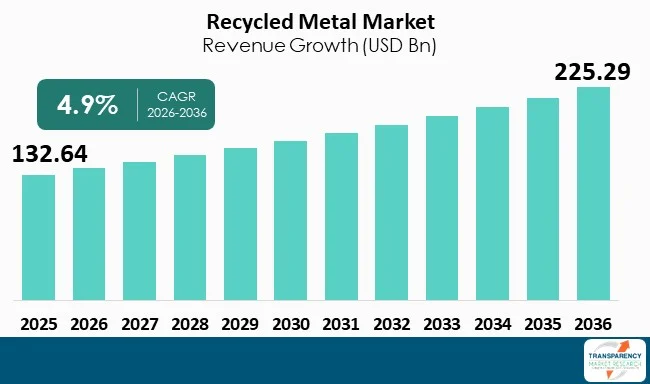
The global market for Recycled Metals is likely to witness stable growth throughout the forecast period due to growing concerns over sustainability, resource utilization, and reduction of carbon emissions in various industries. There are several environmental regulations implemented in different parts of the world, along with initiatives by governments to promote the use of recycled materials in manufacturing and construction processes. It should be noted that processing of recycled metals, especially steel and aluminum, consumes a lot less energy than that of the primary materials, which makes it a profitable choice for businesses willing to reduce their costs and become more sustainable.
It has been noticed that there is an emergence of new opportunities for recycled metals due to the shift towards low carbon production methods and green industry. The development of electric arc furnace (EAF) steelmaking techniques, enhanced metal recovery equipment, along with better scrap collecting and sorting methods will increase recycling efficiency and quality. Besides, ESG goals will make companies more likely to use metals with greater recycled content. Also, there will be greater efforts in developing recycling capabilities in emerging countries in order to develop industrial sector sustainably. Due to such trends as circular economy adoption and governmental sustainability measures, the Recycled Metal Market is forecasted to witness steady growth.
Recycled Metal Market can be described as the collection and subsequent recycling of metals such as iron and non-iron metal that are recovered from items at their end-of-life stage, industrial scrap, construction waste, and manufacturing waste. Metal recycling in steel, aluminum, copper, lead, and other metals is widely practiced across different industries like buildings, automobiles, packaging, electronics, and so forth, owing to its effectiveness and eco-friendly nature. Compared to making new metal, metal recycling involves lower consumption of energy and production of greenhouse gases, as well as lesser use of raw materials. Increasing efforts by businesses to embrace circular business practices and increasing demand for sustainable materials are projected to drive the market.
| Attribute | Detail |
|---|---|
| Recycled Metal Market Drivers |
|
Increasing emphasis on the development of a circular economy and availability of raw materials is one of the significant factors contributing to the Recycled Metal Market. The rising importance of recycling is attributed to the need to minimize dependency on foreign materials and preserve resources while retaining metals in use for prolonged periods. Recycled metals like steel, aluminum, copper, nickel, and various others non-ferrous metals have become strategically valuable as firms look for secure supplies of secondary materials.
For instance, the Circular Economy Action Plan of the European Commission proposes an objective that, by 2030, at least 25% of the annual consumption of strategic raw materials in the EU is to be recycled domestically. The purpose of this directive is to foster circularity, increase supply safety, and reduce the dependency on imports of materials used in green and digital technologies.
The special report of the European Court of Auditors for 2026 identified that there is an underdevelopment of recycling and the domestic production of critical raw materials in the EU, along with high dependence on imports when it comes to energy transition materials. Therefore, there is a significant drive towards improving the recovery rate of metals from end-of-life goods, industrial waste, batteries, electronic goods, and renewable energy technology.
Low-carbon construction and de-carbonization in industries constitute another important factor driving the Recycled Metal Market. Metals like steel and aluminum consume considerable amounts of energy when manufactured from their primary sources. As such, the utilization of recycled metal is favorable to enterprises that are trying to minimize their environmental footprints in line with their sustainability commitments. This would mean a reduced requirement for mining and landfilling, thus enabling circular flows of metal material through various sectors.
According to the U.S. Department of Energy, the primary sources of embodied carbon emissions in buildings are the manufacture of the building materials used including concrete, steel, wood, and glass. DOE highlights the use of materials that have low embodied carbon content and recycled or recovered waste materials as methods of minimizing carbon emissions in buildings under new construction. As such, the move to embody carbon reduction is likely to increase the use of recycled metals.
Recycling infrastructure efforts of the government are also contributing to the growth of the market. As per the recycling infrastructure assessment of the Environmental Protection Agency in the United States, ferrous metal cans, nonferrous metal containers, and aluminum foil are included in the list of commonly recycled materials and the agency says that such materials comprise 82% of the municipal solid waste stream. An enhanced system of collection and recycling will facilitate increased metal scrap feedstock supply for recycled metal manufacturing.
| Attribute | Detail |
|---|---|
| Recycled Metal Market Opportunity |
|
The recovery of batteries and critical minerals is likely to be a key area in the growth of the Recycled Metal Market. Growing demands for metals like lithium, cobalt, nickel, copper, aluminum, and steel are being driven by electric vehicles, grid storage applications, consumer electronics, and renewable energy facilities. The increasing difficulty of primary mining due to permitting concerns, high costs, environmental issues, and security of supply means that recycled metals are likely to play an increasingly important role in providing a secondary source of metals.
In March 2026, the Department of Energy issued a Notice of Funding Opportunity to provide support for up to $500 million for expansion of critical mineral and material processing, derivatives of battery manufacturing, and recycling. The Department of Energy said the funding will help develop and diversify American battery supply chains for defense applications, grid resilience and energy, transportation, manufacturing, and other industrial sectors.
Some ways for companies to gain advantages include investing in modern sorting systems, hydrometallurgy processes, automated recycling of scrap, black mass recycling, and collaboration through a closed loop with battery producers, automakers, and electronics manufacturers. Metal recovered from spent batteries and scrap generated during production could enable the country to rely less on imports of raw materials, minimize waste, and meet its circular economy goals. In light of the government’s efforts to ensure security of supply of critical materials domestically, recycled metals producers capable of providing high-quality recovered metals should have more prospects.
| Attribute | Detail |
|---|---|
| Leading Segment |
|
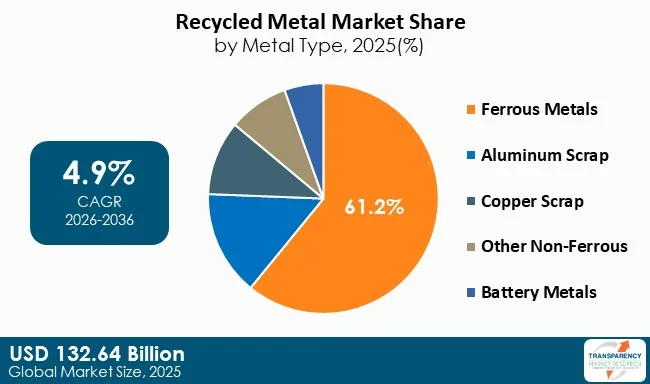
The Ferrous Metals (Steel Scrap) division represents an estimated 61.2% share of the worldwide Recycled Metal market in the initial year of forecast, making it the leading raw material type in the industry. The prominence of the division arises due to the high consumption levels of steel in construction, automobiles, machinery, infrastructure, and manufacturing industries. Steel scrap mainly comprises steel sourced from demolished buildings and infrastructure, production waste, consumer durables, and obsolete cars. The ready availability and organized recycling and recovery system have helped steel scrap emerge as the core material in the global recycled metals market.
One critical reason for this favorable growth prospect is that EAF steel manufacturing processes are gaining momentum due to the increased use of recycled steel as an essential source of raw materials. Given that corporations intend to reduce their carbon footprint as they make steel, then it makes perfect sense for recycled ferrous metals to become an important part of making steels with lower carbon emissions. While it requires more energy and emits more greenhouse gases, electric arc furnaces (EAFs) require much lower levels of energy input compared to blast furnaces. It is therefore evident that there is need for high-quality steel scrap.
Enhanced sustainability practices, regulations concerning environmental activities, and increased investments in circular economies are expected to positively influence the prospects of the Ferrous Metal (Steel Scrap) market. Recycling of metals is encouraged at the international level, especially in order to ensure that these metals do not end up in landfills. With the growing demand for sustainability in the manufacture of steel globally, the industry in question is expected to maintain its dominance in the Recycled Metal market going forward.
| Attribute | Detail |
|---|---|
| Leading Region |
|
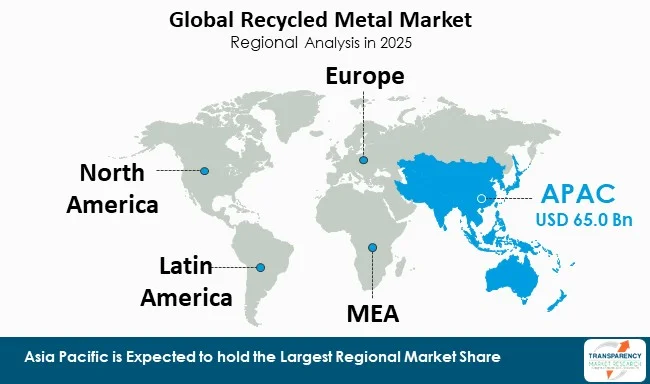
The Asia-Pacific region occupies 49.0% of the global Recycled Metal market by revenue share and represents the biggest region at the start of the forecast period. This region’s strong position is attributed to high levels of industrialization, extensive construction activities, rapid urbanization, and robust manufacturing sector. As a result, large quantities of recyclable metal are produced through construction works, industrial activities, vehicle production, consumer goods, and disposal of end-of-life items that create substantial amounts of metal available for recycling and reuse.
China emerges as the major driving force in the Asia-Pacific region owing to its steel production industry and its increasing efforts towards resource efficiency and emission reduction. The widespread use of EAF steel production process that requires recycled metal has led to a high demand for ferrous and non-ferrous metal scrap materials. The introduction of policies favoring circular economy and sustainability initiatives have further promoted recycling of metals.
Increasing investment in metal recycling technology, recycling infrastructure development, and higher requirements from various industries such as construction, automotive, electronics, and others, along with growing environmental concerns, are among the other factors contributing to the expansion of the market in the region. Considering that manufacturers tend to favor cost-effectiveness and eco-friendly materials in their operations, the Asia Pacific region will retain its dominance in the global Recycled Metal market during the forecast period.
By Metal Type
By Source
By End Use
By Geography
| Attribute | Detail |
|---|---|
| Market Size Value in 2025 (Base Year) | USD 132.64 Billion |
| Market Forecast Value in 2036 | USD 225.29 Billion |
| Growth Rate (CAGR 2026 to 2036) | 4.9% |
| Forecast Period | 2026-2036 |
| Historical Data Available for | 2021-2025 |
| Quantitative Units | USD Billion for Value |
| Dominant Region | Asia Pacific (49.0% share) |
| Leading Segment | Ferrous Metals/Steel Scrap (61.2% share) |
| Fastest-Growing Segment | Recycled Aluminum and Battery Metal Recovery |
| Regions Covered | North America, Europe, Asia Pacific, Latin America, Middle East & Africa |
| Key Companies | Nucor; ArcelorMittal; Novelis; Sims Metal; Schnitzer Steel; Aurubis; Umicore |
| Customization Available | Yes, on request |
The global Recycled Metal Market was valued at USD 132.64 Billion in 2025.
The market is projected to reach USD 225.29 Billion by 2036, driven by increasing circular economy initiatives, growing demand for low-carbon materials, rising corporate sustainability commitments, and expanding adoption of recycled metals across construction, automotive, packaging, and energy sectors.
The industry is expected to expand at a CAGR of 4.9% from 2026 to 2036.
The Ferrous Metals segment dominates the market with a 61.2% share, owing to the widespread use of steel in construction, infrastructure, automotive, and manufacturing industries, along with the growing adoption of electric arc furnace (EAF) steelmaking.
Asia Pacific leads the market with a 49.0% share, supported by rapid industrialization, large-scale infrastructure development, expanding recycling infrastructure, and strong manufacturing activity across China, India, Japan, and South Korea.
Key players operating in the Recycled Metal Market include Nucor Corporation, Steel Dynamics Inc., Commercial Metals Company, ArcelorMittal SA, Novelis Inc. (Hindalco Industries), Hydro ASA, Aurubis AG, Umicore SA, Sims Metal Management Ltd., OmniSource LLC (Steel Dynamics), Glencore Plc, Schnitzer Steel Industries Inc., Redwood Materials Inc., Li-Cycle Holdings Corp., and other key players.
Table 1 Global Recycled Metal Market Volume (Tons) Forecast, by Metal Type, 2026 to 2036
Table 2 Global Recycled Metal Market Value (USD Billion) Forecast, by Metal Type, 2026 to 2036
Table 3 Global Recycled Metal Market Volume (Tons) Forecast, by Source, 2026 to 2036
Table 4 Global Recycled Metal Market Value (USD Billion) Forecast, by Source, 2026 to 2036
Table 5 Global Recycled Metal Market Volume (Tons) Forecast, by End-use, 2026 to 2036
Table 6 Global Recycled Metal Market Value (USD Billion) Forecast, by End-use, 2026 to 2036
Table 7 Global Recycled Metal Market Volume (Tons) Forecast, by Region, 2026 to 2036
Table 8 Global Recycled Metal Market Value (USD Billion) Forecast, by Region, 2026 to 2036
Table 9 North America Recycled Metal Market Volume (Tons) Forecast, by Metal Type, 2026 to 2036
Table 10 North America Recycled Metal Market Value (USD Billion) Forecast, by Metal Type, 2026 to 2036
Table 11 North America Recycled Metal Market Volume (Tons) Forecast, by Source, 2026 to 2036
Table 12 North America Recycled Metal Market Value (USD Billion) Forecast, by Source, 2026 to 2036
Table 13 North America Recycled Metal Market Volume (Tons) Forecast, by End-use, 2026 to 2036
Table 14 North America Recycled Metal Market Value (USD Billion) Forecast, by End-use, 2026 to 2036
Table 15 North America Recycled Metal Market Volume (Tons) Forecast, by Country, 2026 to 2036
Table 16 North America Recycled Metal Market Value (USD Billion) Forecast, by Country, 2026 to 2036
Table 17 USA Recycled Metal Market Volume (Tons) Forecast, by Metal Type, 2026 to 2036
Table 18 USA Recycled Metal Market Value (USD Billion) Forecast, by Metal Type, 2026 to 2036
Table 19 USA Recycled Metal Market Volume (Tons) Forecast, by Source, 2026 to 2036
Table 20 USA Recycled Metal Market Value (USD Billion) Forecast, by Source, 2026 to 2036
Table 21 USA Recycled Metal Market Volume (Tons) Forecast, by End-use, 2026 to 2036
Table 22 USA Recycled Metal Market Value (USD Billion) Forecast, by End-use, 2026 to 2036
Table 23 Canada Recycled Metal Market Volume (Tons) Forecast, by Metal Type, 2026 to 2036
Table 24 Canada Recycled Metal Market Value (USD Billion) Forecast, by Metal Type, 2026 to 2036
Table 25 Canada Recycled Metal Market Volume (Tons) Forecast, by Source, 2026 to 2036
Table 26 Canada Recycled Metal Market Value (USD Billion) Forecast, by Source, 2026 to 2036
Table 27 Canada Recycled Metal Market Volume (Tons) Forecast, by End-use, 2026 to 2036
Table 28 Canada Recycled Metal Market Value (USD Billion) Forecast, by End-use, 2026 to 2036
Table 29 Europe Recycled Metal Market Volume (Tons) Forecast, by Metal Type, 2026 to 2036
Table 30 Europe Recycled Metal Market Value (USD Billion) Forecast, by Metal Type, 2026 to 2036
Table 31 Europe Recycled Metal Market Volume (Tons) Forecast, by Source, 2026 to 2036
Table 32 Europe Recycled Metal Market Value (USD Billion) Forecast, by Source, 2026 to 2036
Table 33 Europe Recycled Metal Market Volume (Tons) Forecast, by End-use, 2026 to 2036
Table 34 Europe Recycled Metal Market Value (USD Billion) Forecast, by End-use, 2026 to 2036
Table 35 Europe Recycled Metal Market Volume (Tons) Forecast, by Country and Sub-region, 2026 to 2036
Table 36 Europe Recycled Metal Market Value (USD Billion) Forecast, by Country and Sub-region, 2026 to 2036
Table 37 Germany Recycled Metal Market Volume (Tons) Forecast, by Metal Type, 2026 to 2036
Table 38 Germany Recycled Metal Market Value (USD Billion) Forecast, by Metal Type, 2026 to 2036
Table 39 Germany Recycled Metal Market Volume (Tons) Forecast, by Source, 2026 to 2036
Table 40 Germany Recycled Metal Market Value (USD Billion) Forecast, by Source, 2026 to 2036
Table 41 Germany Recycled Metal Market Volume (Tons) Forecast, by End-use, 2026 to 2036
Table 42 Germany Recycled Metal Market Value (USD Billion) Forecast, by End-use, 2026 to 2036
Table 43 France Recycled Metal Market Volume (Tons) Forecast, by Metal Type, 2026 to 2036
Table 44 France Recycled Metal Market Value (USD Billion) Forecast, by Metal Type, 2026 to 2036
Table 45 France Recycled Metal Market Volume (Tons) Forecast, by Source, 2026 to 2036
Table 46 France Recycled Metal Market Value (USD Billion) Forecast, by Source, 2026 to 2036
Table 47 France Recycled Metal Market Volume (Tons) Forecast, by End-use, 2026 to 2036
Table 48 France Recycled Metal Market Value (USD Billion) Forecast, by End-use, 2026 to 2036
Table 49 UK Recycled Metal Market Volume (Tons) Forecast, by Metal Type, 2026 to 2036
Table 50 UK Recycled Metal Market Value (USD Billion) Forecast, by Metal Type, 2026 to 2036
Table 51 UK Recycled Metal Market Volume (Tons) Forecast, by Source, 2026 to 2036
Table 52 UK Recycled Metal Market Value (USD Billion) Forecast, by Source, 2026 to 2036
Table 53 UK Recycled Metal Market Volume (Tons) Forecast, by End-use, 2026 to 2036
Table 54 UK Recycled Metal Market Value (USD Billion) Forecast, by End-use, 2026 to 2036
Table 55 Italy Recycled Metal Market Volume (Tons) Forecast, by Metal Type, 2026 to 2036
Table 56 Italy Recycled Metal Market Value (USD Billion) Forecast, by Metal Type, 2026 to 2036
Table 57 Italy Recycled Metal Market Volume (Tons) Forecast, by Source, 2026 to 2036
Table 58 Italy Recycled Metal Market Value (USD Billion) Forecast, by Source, 2026 to 2036
Table 59 Italy Recycled Metal Market Volume (Tons) Forecast, by End-use, 2026 to 2036
Table 60 Italy Recycled Metal Market Value (USD Billion) Forecast, by End-use, 2026 to 2036
Table 61 Spain Recycled Metal Market Volume (Tons) Forecast, by Metal Type, 2026 to 2036
Table 62 Spain Recycled Metal Market Value (USD Billion) Forecast, by Metal Type, 2026 to 2036
Table 63 Spain Recycled Metal Market Volume (Tons) Forecast, by Source, 2026 to 2036
Table 64 Spain Recycled Metal Market Value (USD Billion) Forecast, by Source, 2026 to 2036
Table 65 Spain Recycled Metal Market Volume (Tons) Forecast, by End-use, 2026 to 2036
Table 66 Spain Recycled Metal Market Value (USD Billion) Forecast, by End-use, 2026 to 2036
Table 67 Russia & CIS Recycled Metal Market Volume (Tons) Forecast, by Metal Type, 2026 to 2036
Table 68 Russia & CIS Recycled Metal Market Value (USD Billion) Forecast, by Metal Type, 2026 to 2036
Table 69 Russia & CIS Recycled Metal Market Volume (Tons) Forecast, by Source, 2026 to 2036
Table 70 Russia & CIS Recycled Metal Market Value (USD Billion) Forecast, by Source, 2026 to 2036
Table 71 Russia & CIS Recycled Metal Market Volume (Tons) Forecast, by End-use, 2026 to 2036
Table 72 Russia & CIS Recycled Metal Market Value (USD Billion) Forecast, by End-use, 2026 to 2036
Table 73 Rest of Europe Recycled Metal Market Volume (Tons) Forecast, by Metal Type, 2026 to 2036
Table 74 Rest of Europe Recycled Metal Market Value (USD Billion) Forecast, by Metal Type, 2026 to 2036
Table 75 Rest of Europe Recycled Metal Market Volume (Tons) Forecast, by Source, 2026 to 2036
Table 76 Rest of Europe Recycled Metal Market Value (USD Billion) Forecast, by Source, 2026 to 2036
Table 77 Rest of Europe Recycled Metal Market Volume (Tons) Forecast, by End-use, 2026 to 2036
Table 78 Rest of Europe Recycled Metal Market Value (USD Billion) Forecast, by End-use, 2026 to 2036
Table 79 Asia Pacific Recycled Metal Market Volume (Tons) Forecast, by Metal Type, 2026 to 2036
Table 80 Asia Pacific Recycled Metal Market Value (USD Billion) Forecast, by Metal Type, 2026 to 2036
Table 81 Asia Pacific Recycled Metal Market Volume (Tons) Forecast, by Source, 2026 to 2036
Table 82 Asia Pacific Recycled Metal Market Value (USD Billion) Forecast, by Source, 2026 to 2036
Table 83 Asia Pacific Recycled Metal Market Volume (Tons) Forecast, by End-use, 2026 to 2036
Table 84 Asia Pacific Recycled Metal Market Value (USD Billion) Forecast, by End-use, 2026 to 2036
Table 85 Asia Pacific Recycled Metal Market Volume (Tons) Forecast, by Country and Sub-region, 2026 to 2036
Table 86 Asia Pacific Recycled Metal Market Value (USD Billion) Forecast, by Country and Sub-region, 2026 to 2036
Table 87 China Recycled Metal Market Volume (Tons) Forecast, by Metal Type, 2026 to 2036
Table 88 China Recycled Metal Market Value (USD Billion) Forecast, by Metal Type 2026 to 2036
Table 89 China Recycled Metal Market Volume (Tons) Forecast, by Source, 2026 to 2036
Table 90 China Recycled Metal Market Value (USD Billion) Forecast, by Source, 2026 to 2036
Table 91 China Recycled Metal Market Volume (Tons) Forecast, by End-use, 2026 to 2036
Table 92 China Recycled Metal Market Value (USD Billion) Forecast, by End-use, 2026 to 2036
Table 93 Japan Recycled Metal Market Volume (Tons) Forecast, by Metal Type, 2026 to 2036
Table 94 Japan Recycled Metal Market Value (USD Billion) Forecast, by Metal Type, 2026 to 2036
Table 95 Japan Recycled Metal Market Volume (Tons) Forecast, by Source, 2026 to 2036
Table 96 Japan Recycled Metal Market Value (USD Billion) Forecast, by Source, 2026 to 2036
Table 97 Japan Recycled Metal Market Volume (Tons) Forecast, by End-use, 2026 to 2036
Table 98 Japan Recycled Metal Market Value (USD Billion) Forecast, by End-use, 2026 to 2036
Table 99 India Recycled Metal Market Volume (Tons) Forecast, by Metal Type, 2026 to 2036
Table 100 India Recycled Metal Market Value (USD Billion) Forecast, by Metal Type, 2026 to 2036
Table 101 India Recycled Metal Market Volume (Tons) Forecast, by Source, 2026 to 2036
Table 102 India Recycled Metal Market Value (USD Billion) Forecast, by Source, 2026 to 2036
Table 103 India Recycled Metal Market Volume (Tons) Forecast, by End-use, 2026 to 2036
Table 104 India Recycled Metal Market Value (USD Billion) Forecast, by End-use, 2026 to 2036
Table 105 India Recycled Metal Market Volume (Tons) Forecast, by End-use, 2026 to 2036
Table 106 India Recycled Metal Market Value (USD Billion) Forecast, by End-use 2026 to 2036
Table 107 ASEAN Recycled Metal Market Volume (Tons) Forecast, by Metal Type, 2026 to 2036
Table 108 ASEAN Recycled Metal Market Value (USD Billion) Forecast, by Metal Type, 2026 to 2036
Table 109 ASEAN Recycled Metal Market Volume (Tons) Forecast, by Source, 2026 to 2036
Table 110 ASEAN Recycled Metal Market Value (USD Billion) Forecast, by Source, 2026 to 2036
Table 111 ASEAN Recycled Metal Market Volume (Tons) Forecast, by End-use, 2026 to 2036
Table 112 ASEAN Recycled Metal Market Value (USD Billion) Forecast, by End-use, 2026 to 2036
Table 113 Rest of Asia Pacific Recycled Metal Market Volume (Tons) Forecast, by Metal Type, 2026 to 2036
Table 114 Rest of Asia Pacific Recycled Metal Market Value (USD Billion) Forecast, by Metal Type, 2026 to 2036
Table 115 Rest of Asia Pacific Recycled Metal Market Volume (Tons) Forecast, by Source, 2026 to 2036
Table 116 Rest of Asia Pacific Recycled Metal Market Value (USD Billion) Forecast, by Source, 2026 to 2036
Table 117 Rest of Asia Pacific Recycled Metal Market Volume (Tons) Forecast, by End-use, 2026 to 2036
Table 118 Rest of Asia Pacific Recycled Metal Market Value (USD Billion) Forecast, by End-use, 2026 to 2036
Table 119 Latin America Recycled Metal Market Volume (Tons) Forecast, by Metal Type, 2026 to 2036
Table 120 Latin America Recycled Metal Market Value (USD Billion) Forecast, by Metal Type, 2026 to 2036
Table 121 Latin America Recycled Metal Market Volume (Tons) Forecast, by Source, 2026 to 2036
Table 122 Latin America Recycled Metal Market Value (USD Billion) Forecast, by Source, 2026 to 2036
Table 123 Latin America Recycled Metal Market Volume (Tons) Forecast, by End-use, 2026 to 2036
Table 124 Latin America Recycled Metal Market Value (USD Billion) Forecast, by End-use, 2026 to 2036
Table 125 Latin America Recycled Metal Market Volume (Tons) Forecast, by Country and Sub-region, 2026 to 2036
Table 126 Latin America Recycled Metal Market Value (USD Billion) Forecast, by Country and Sub-region, 2026 to 2036
Table 127 Brazil Recycled Metal Market Volume (Tons) Forecast, by Metal Type, 2026 to 2036
Table 128 Brazil Recycled Metal Market Value (USD Billion) Forecast, by Metal Type, 2026 to 2036
Table 129 Brazil Recycled Metal Market Volume (Tons) Forecast, by Source, 2026 to 2036
Table 130 Brazil Recycled Metal Market Value (USD Billion) Forecast, by Source, 2026 to 2036
Table 131 Brazil Recycled Metal Market Volume (Tons) Forecast, by End-use, 2026 to 2036
Table 132 Brazil Recycled Metal Market Value (USD Billion) Forecast, by End-use, 2026 to 2036
Table 133 Mexico Recycled Metal Market Volume (Tons) Forecast, by Metal Type, 2026 to 2036
Table 134 Mexico Recycled Metal Market Value (USD Billion) Forecast, by Metal Type, 2026 to 2036
Table 135 Mexico Recycled Metal Market Volume (Tons) Forecast, by Source, 2026 to 2036
Table 136 Mexico Recycled Metal Market Value (USD Billion) Forecast, by Source, 2026 to 2036
Table 137 Mexico Recycled Metal Market Volume (Tons) Forecast, by End-use, 2026 to 2036
Table 138 Mexico Recycled Metal Market Value (USD Billion) Forecast, by End-use, 2026 to 2036
Table 139 Rest of Latin America Recycled Metal Market Volume (Tons) Forecast, by Metal Type, 2026 to 2036
Table 140 Rest of Latin America Recycled Metal Market Value (USD Billion) Forecast, by Metal Type, 2026 to 2036
Table 141 Rest of Latin America Recycled Metal Market Volume (Tons) Forecast, by Source, 2026 to 2036
Table 142 Rest of Latin America Recycled Metal Market Value (USD Billion) Forecast, by Source, 2026 to 2036
Table 143 Rest of Latin America Recycled Metal Market Volume (Tons) Forecast, by End-use, 2026 to 2036
Table 144 Rest of Latin America Recycled Metal Market Value (USD Billion) Forecast, by End-use, 2026 to 2036
Table 145 Middle East & Africa Recycled Metal Market Volume (Tons) Forecast, by Metal Type, 2026 to 2036
Table 146 Middle East & Africa Recycled Metal Market Value (USD Billion) Forecast, by Metal Type, 2026 to 2036
Table 147 Middle East & Africa Recycled Metal Market Volume (Tons) Forecast, by Source, 2026 to 2036
Table 148 Middle East & Africa Recycled Metal Market Value (USD Billion) Forecast, by Source, 2026 to 2036
Table 149 Middle East & Africa Recycled Metal Market Volume (Tons) Forecast, by End-use, 2026 to 2036
Table 150 Middle East & Africa Recycled Metal Market Value (USD Billion) Forecast, by End-use, 2026 to 2036
Table 151 Middle East & Africa Recycled Metal Market Volume (Tons) Forecast, by Country and Sub-region, 2026 to 2036
Table 152 Middle East & Africa Recycled Metal Market Value (USD Billion) Forecast, by Country and Sub-region, 2026 to 2036
Table 153 GCC Recycled Metal Market Volume (Tons) Forecast, by Metal Type, 2026 to 2036
Table 154 GCC Recycled Metal Market Value (USD Billion) Forecast, by Metal Type, 2026 to 2036
Table 155 GCC Recycled Metal Market Volume (Tons) Forecast, by Source, 2026 to 2036
Table 156 GCC Recycled Metal Market Value (USD Billion) Forecast, by Source, 2026 to 2036
Table 157 GCC Recycled Metal Market Volume (Tons) Forecast, by End-use, 2026 to 2036
Table 158 GCC Recycled Metal Market Value (USD Billion) Forecast, by End-use, 2026 to 2036
Table 159 South Africa Recycled Metal Market Volume (Tons) Forecast, by Metal Type, 2026 to 2036
Table 160 South Africa Recycled Metal Market Value (USD Billion) Forecast, by Metal Type, 2026 to 2036
Table 161 South Africa Recycled Metal Market Volume (Tons) Forecast, by Source, 2026 to 2036
Table 162 South Africa Recycled Metal Market Value (USD Billion) Forecast, by Source, 2026 to 2036
Table 163 South Africa Recycled Metal Market Volume (Tons) Forecast, by End-use, 2026 to 2036
Table 164 South Africa Recycled Metal Market Value (USD Billion) Forecast, by End-use, 2026 to 2036
Table 165 Rest of Middle East & Africa Recycled Metal Market Volume (Tons) Forecast, by Metal Type, 2026 to 2036
Table 166 Rest of Middle East & Africa Recycled Metal Market Value (USD Billion) Forecast, by Metal Type, 2026 to 2036
Table 167 Rest of Middle East & Africa Recycled Metal Market Volume (Tons) Forecast, by Source, 2026 to 2036
Table 168 Rest of Middle East & Africa Recycled Metal Market Value (USD Billion) Forecast, by Source, 2026 to 2036
Table 169 Rest of Middle East & Africa Recycled Metal Market Volume (Tons) Forecast, by End-use, 2026 to 2036
Table 170 Rest of Middle East & Africa Recycled Metal Market Value (USD Billion) Forecast, by End-use, 2026 to 2036
Figure 1 Global Recycled Metal Market Volume Share Analysis, by Metal Type, 2025, 2029, and 2036
Figure 2 Global Recycled Metal Market Attractiveness, by Metal Type
Figure 3 Global Recycled Metal Market Volume Share Analysis, by Source, 2025, 2029, and 2036
Figure 4 Global Recycled Metal Market Attractiveness, by Source
Figure 5 Global Recycled Metal Market Volume Share Analysis, by End-use, 2025, 2029, and 2036
Figure 6 Global Recycled Metal Market Attractiveness, by End-use
Figure 7 Global Recycled Metal Market Volume Share Analysis, by Region, 2025, 2029, and 2036
Figure 8 Global Recycled Metal Market Attractiveness, by Region
Figure 9 North America Recycled Metal Market Volume Share Analysis, by Metal Type, 2025, 2029, and 2036
Figure 10 North America Recycled Metal Market Attractiveness, by Metal Type
Figure 11 North America Recycled Metal Market Attractiveness, by Metal Type
Figure 12 North America Recycled Metal Market Volume Share Analysis, by Source, 2025, 2029, and 2036
Figure 13 North America Recycled Metal Market Attractiveness, by Source
Figure 14 North America Recycled Metal Market Volume Share Analysis, by End-use, 2025, 2029, and 2036
Figure 15 North America Recycled Metal Market Attractiveness, by End-use
Figure 16 North America Recycled Metal Market Attractiveness, by Country and Sub-region
Figure 17 Europe Recycled Metal Market Volume Share Analysis, by Metal Type, 2025, 2029, and 2036
Figure 18 Europe Recycled Metal Market Attractiveness, by Metal Type
Figure 19 Europe Recycled Metal Market Volume Share Analysis, by Source, 2025, 2029, and 2036
Figure 20 Europe Recycled Metal Market Attractiveness, by Source
Figure 21 Europe Recycled Metal Market Volume Share Analysis, by End-use, 2025, 2029, and 2036
Figure 22 Europe Recycled Metal Market Attractiveness, by End-use
Figure 23 Europe Recycled Metal Market Volume Share Analysis, by Country and Sub-region, 2025, 2029, and 2036
Figure 24 Europe Recycled Metal Market Attractiveness, by Country and Sub-region
Figure 25 Asia Pacific Recycled Metal Market Volume Share Analysis, by Metal Type, 2025, 2029, and 2036
Figure 26 Asia Pacific Recycled Metal Market Attractiveness, by Metal Type
Figure 27 Asia Pacific Recycled Metal Market Volume Share Analysis, by Source, 2025, 2029, and 2036
Figure 28 Asia Pacific Recycled Metal Market Attractiveness, by Source
Figure 29 Asia Pacific Recycled Metal Market Volume Share Analysis, by End-use, 2025, 2029, and 2036
Figure 30 Asia Pacific Recycled Metal Market Attractiveness, by End-use
Figure 31 Asia Pacific Recycled Metal Market Volume Share Analysis, by Country and Sub-region, 2025, 2029, and 2036
Figure 32 Asia Pacific Recycled Metal Market Attractiveness, by Country and Sub-region
Figure 33 Latin America Recycled Metal Market Volume Share Analysis, by Metal Type, 2025, 2029, and 2036
Figure 34 Latin America Recycled Metal Market Attractiveness, by Metal Type
Figure 35 Latin America Recycled Metal Market Volume Share Analysis, by Source, 2025, 2029, and 2036
Figure 36 Latin America Recycled Metal Market Attractiveness, by Source
Figure 37 Latin America Recycled Metal Market Volume Share Analysis, by End-use, 2025, 2029, and 2036
Figure 38 Latin America Recycled Metal Market Attractiveness, by End-use
Figure 39 Latin America Recycled Metal Market Volume Share Analysis, by Country and Sub-region, 2025, 2029, and 2036
Figure 40 Latin America Recycled Metal Market Attractiveness, by Country and Sub-region
Figure 41 Middle East & Africa Recycled Metal Market Volume Share Analysis, by Metal Type, 2025, 2029, and 2036
Figure 42 Middle East & Africa Recycled Metal Market Attractiveness, by Metal Type
Figure 43 Middle East & Africa Recycled Metal Market Volume Share Analysis, by Source, 2025, 2029, and 2036
Figure 44 Middle East & Africa Recycled Metal Market Attractiveness, by Source
Figure 45 Middle East & Africa Recycled Metal Market Volume Share Analysis, by End-use, 2025, 2029, and 2036
Figure 46 Middle East & Africa Recycled Metal Market Attractiveness, by End-use
Figure 47 Middle East & Africa Recycled Metal Market Volume Share Analysis, by Country and Sub-region, 2025, 2029, and 2036
Figure 48 Middle East & Africa Recycled Metal Market Attractiveness, by Country and Sub-region
Copyright © Transparency Market Research, Inc. All Rights reserved
Trust Online


Recycled Metal Market
