

Reports
Reports
The encapsulated chocolate flavor market is prognosticated to observe a profitable growth-share across the assessment period of 2018-2028. The rising utilization as an additive in the food industry will bring exponential growth for the encapsulated chocolate flavor market. Furthermore, encapsulation technology is gaining tremendous traction. Based on these factors, the encapsulated chocolate flavor market is expected to bring good growth prospects.
Flavors are considered sensitive and expensive products. They are reactive, easily oxidized, volatile, and has sensitivity to light. Usually, flavors find extensive use as an additive in the food industry. In a bid to maintain their stability and integrity for a longer time period, the aromatic molecules need to be prevented from being lost. Encapsulation of flavors involves the process of enveloping them and then dissolving under specific conditions such a certain temperature or a solvent. The encapsulated flavor releases its aroma in the destined medium. The global encapsulated chocolate flavor market is likely to be driven by the stellar growth of the food and beverage industry.
Increased research and development has led to many innovations the encapsulation technology, which further supports the growth of the global encapsulated chocolate flavor market. Over the last few decades, the twin-screw extrusion has emerged as a decisive and an important technology in the development and innovation of flavors such as chocolate. This technology can be treated with an extensive range of materials for the development of aromatic compounds.
Chocolate encapsulated flavors finds use as ingredients in the for various quick preparations such as
The global encapsulated chocolate flavor market is forecasted to be influenced by the low shelf life of products made with the usual chocolate flavors. In addition, conventional chocolate flavors also come with various reaction and stability issues, which pave way for the expansion of the global encapsulated chocolate flavor market. Increased stable shelf life of encapsulated chocolate flavor averts any kind of interaction with other elements within the product that can alter its texture, properties, and color.
Increased adoption across various end use sectors such as functional food, dairy product, and baking is likely to offer lucrative growth opportunities for the global encapsulated chocolate flavor market in the years to come.
Flavors are considered sensitive and expensive products. They are reactive, easily oxidized, volatile, and has sensitivity to light. Usually, flavors find extensive use as an additive in the food industry. In a bid to maintain their stability and integrity for a longer time period, the aromatic molecules need to be prevented from being lost. Encapsulation of flavors involves the process of enveloping them and then dissolving under specific conditions such a certain temperature or a solvent. The encapsulated flavor releases its aroma in the destined medium. The global encapsulated chocolate flavor market is likely to be driven by the stellar growth of the food and beverage industry.
Increased research and development has led to many innovations the encapsulation technology, which further supports the growth of the global encapsulated chocolate flavor market. Over the last few decades, the twin-screw extrusion has emerged as a decisive and an important technology in the development and innovation of flavors such as chocolate. This technology can be treated with an extensive range of materials for the development of aromatic compounds.
The global encapsulated chocolate flavor market is forecasted to be influenced by the low shelf life of products made with the usual chocolate flavors. In addition, conventional chocolate flavors also come with various reaction and stability issues, which pave way for the expansion of the global encapsulated chocolate flavor market. Increased stable shelf life of encapsulated chocolate flavor averts any kind of interaction with other elements within the product that can alter its texture, properties, and color.
Increased adoption across various end use sectors such as functional food, dairy product, and baking is likely to offer lucrative growth opportunities for the global encapsulated chocolate flavor market in the years to come.
Globalization is a powerful tool, which has changed the taste patterns of consumers across the globe. The way in which consumers perceive and interact with food products is a constantly evolving process. Controlled delivery of flavor is the key focus areas for the development of flavors. This has led to the rise of encapsulated chocolate flavor, and gradual replacement of conventional chocolate flavor with their flexible alternatives. The transition towards encapsulation process has led to the development of several types of encapsulated flavor, including encapsulated chocolate flavor variant. So why encapsulation of flavor necessary? Encapsulation is a technique used for sustained release of ingredients. It finds extensive application in food, pharmaceuticals, chemical, textile personal care and other industries. Encapsulation is expected to become a mainstream technology owing to benefits such as reduction in quantities of raw materials used, enhanced fragrance, improved shelf-life and enhanced taste. The demand for encapsulated chocolate flavor is expected to rise as conventional flavor takes over rigid. It is expected to be adopted by various industry verticals to ensure sustainability and adequate release of active compounds during product formulation processes.
Problems associated with conventional chocolate flavor which is not an encapsulated chocolate flavor is the lower shelf-life along with stability and reaction issues affiliated with these flavor. Although, that is not the case with encapsulated chocolate flavor. Increased shelf-life stability of encapsulated chocolate flavor prevents flavor from interacting with other elements in the products, which can change food color, properties, texture, whereas improved heat and oxidative resistance protects the flavor from processing heat, reducing volatility of molecules and protects flavor from degradation caused by air, and this applies to all encapsulation methods.
Encapsulated chocolate flavor is witnessing increasing adoption across various end-use industry sectors such as baking, dairy products and functional foods. This is attributed to increasing consumer awareness due to rising inclination towards products that offer health benefits. Moreover, traction of fortification of encapsulated chocolate flavor products among food manufacturers is increasing due to growing demand for nutritional products
Global Encapsulated Chocolate Flavor: Market Segmentation
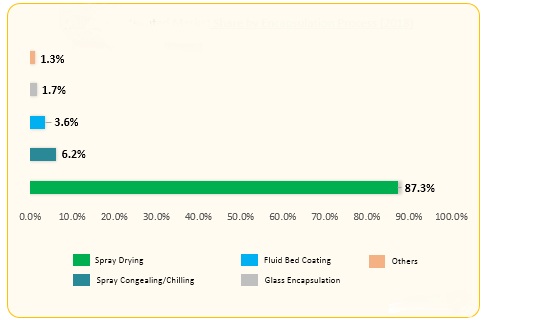
On the basis of encapsulation process, the global encapsulated chocolate flavor market has been segmented as –
On the basis of application, the global encapsulated chocolate flavor market has been segmented as –
On the basis of flavor, the global encapsulated chocolate flavor market has been segmented as –
Exhibit 1: Estimated Market Share by Encapsulation Process, 2018
Global Encapsulated Chocolate Flavor Market: Key Players
Some of the key players operating in the global encapsulated chocolate flavor market are: Givaudan SA, Symrise AG, Firmenish S.A, Archer Daniels Midland Company, International Flavours & Fragrances, Inc, Sensient Technologies Corporation, Ingredion Incorporated, FONA International, Inc, Kerry Group, Takasago International Corporation, Frutarom Industries Ltd, Tate & Lyle PLC, and Cargill, Incorporated among others.
The global encapsulated chocolate flavor market has evolved on the backdrop of new product innovations, and is expected to continue to grow in the same way, during the forecast period.
Key Developments across the Globe:
Opportunities for Market Participants
Manufacturers could focused on developing innovative products, while complying with regulations for food grade material usage. As the market is dominated by big companies, local players from countries such as China and India can start offering encapsulated chocolate flavor at comparatively lower price. Moreover, growing demand for functional food products in these countries is expected to increase options for various new entrants in the encapsulated chocolate flavor market in the near future. Furthermore, companies need to efficiently blend ingredients, while ensuring taste, flavor and shelf-life stability of finished products is of vital importance. Also, companies need to focus on enhancing encapsulation technology for enhanced product life of encapsulated chocolate flavor in applications such as dairy products, beverages and animal nutrition products.
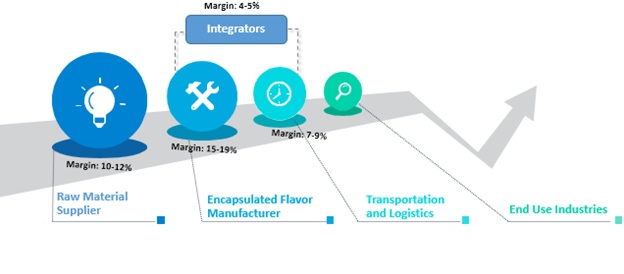
Global Encapsulated Chocolate Flavor Market: Value Chain
N/A
Copyright © Transparency Market Research, Inc. All Rights reserved
Trust Online


Encapsulated Chocolate Flavor Market

